


The 5 thebe coin Does it still hold value

02 Jul 2026
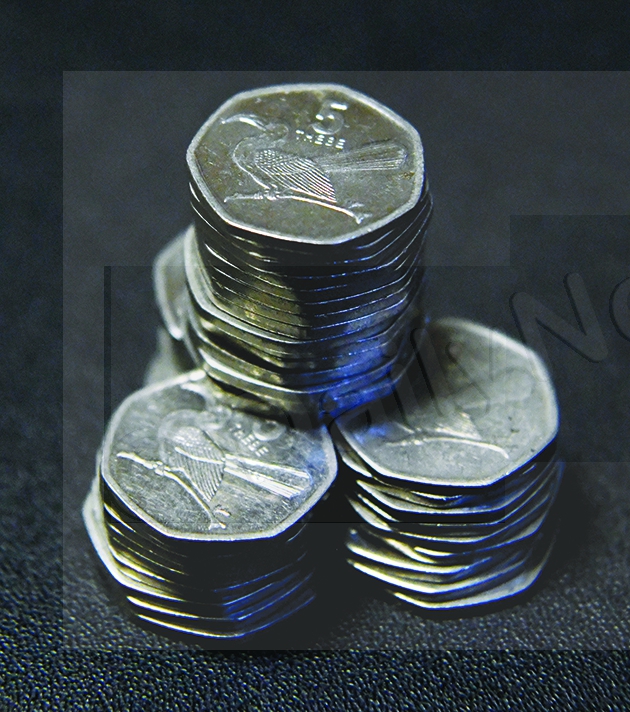
Would picking up a 5 Thebe (5t) coin do your pocket any good?
Once an essential part of daily transactions for decades that it could even make up the exact amount of an item at times, today the coin holds a different meaning.
In an era of rising prices, digital payments and changing consumer habits, it begs the question whether Botswana’ smallest circulating coin still serves a meaningful purpose and worth the fight after a purchase if not returned.
Some argue that it should be discontinued as it serves no practical economic relevance.
“There was a time when a few thebe could contribute meaningfully towards the purchase of basic goods,” explained Mr Louis Sibanda, an Economist by profession, .
“Today, however, it is difficult to find any item that can be purchased using a 5 thebe coin alone.”
The decline of the purchasing power of the 5t mirrors the fate of the 1t and 2t, which were eventually withdrawn from circulation after becoming increasingly impractical for everyday use. By the early 1990s, businesses found little use for the 1t coin, leading to its removal from circulation. The 2t coin followed a similar path and was demonetised in 1998.
Despite its limited purchasing power, Mr Sibanda explains that 5t continues to play a role in pricing and change making.
“Businesses often use prices ending in 5 thebe increments, and the coin helps ensure exact settlement of transactions, particularly in cash-based environments,” he said.
He notes that economists who favour retaining the coin argue that it supports precise pricing, reduces rounding errors, and preserves confidence in the completeness of the currency system.
Mr Sibanda also says the 5t coin can benefit consumers by preventing businesses from consistently rounding prices upward.
“In theory, this promotes fairness because neither the buyer nor the seller gain or lose due to rounding,” he said.
On businesses at times not giving customers their 5t change, Mr Sibanda explains that unreturned change can undermine trust in the fairness of transactions, and it may weaken the effectiveness of listed prices if consumers cannot reliably receive the exact change they are owed.
However, with the growing adoption of digital payments and the initiative of loyalty and savings cards by some retailers, the future of 5t and even the 10t still hangs in the balance.
Mr Sibanda notes that while low denomination coins allow businesses to price goods more precisely among other benefits, the decision policymakers ought to consider should depend on whether the economic benefits outweigh the costs associated with producing and distributing them.
However, he acknowledges that Botswana remains a mixed economy in which cash is still important for many citizens and small businesses.
“For that reason, the 5 thebe coin is unlikely to disappear immediately. However, if inflation persists and digital transactions become more dominant, the eventual withdrawal of the 5 thebe coin will not be surprising,” he said.
In many retail outlets, customers are not always given their 5t change often due to coin shortages.
BOPA then set out to talk to regular customers who candidly shared their thoughts on the matter.
One fourth year finance student from the University of Botswana, who wished to remain anonymous, shares that he has curated a witty tactic which has been in motion for some time.
Divulging its layout, he says that whenever a cashier fails to return his 5t, he makes an agreement with the personnel to either return it to him the next time he comes around or to let him make a purchase in the case he is short 5 thebe.
“I get the cashier’s name and I hold them to their word. So far it has worked for me. I believe 5 thebe is still valuable and that the fairness of transactions needs to be upheld.”
Some argue on the contrary.
One of them, a beautician by profession, who also wished for anonymity, said that she normally did not make a fuss over an unreturned 5t.
“It is not a big deal for me usually. I am of the opinion that retailers need to do the needful and return our five thebes. However, I mostly just let it go easily.”
While the loss may appear insignificant on an individual transaction, the cumulative effect can become substantial over thousands of purchases.
It is clear that when consumers do not receive the exact change they are owed, it effectively transfers small amounts of value from consumers to businesses.
A former retail store cashier who has worked in two stores, affirms this.
Opting for anonymity also, she shared that whenever they accumulated excess cash from retained 5 thebes, the excess money is transferred to the business.
She described the practice as unfair, as they never get a share of the small change. Perhaps so, as on the other hand, one former cashier explains that in the event they fell short of the right amount of money, the retail store demands it back mercilessly. ENDS
Source : BOPA
Author : Benita Magopane
Location : Gaborone
Event : Feature
Date : 02 Jul 2026
Related News



14 Sep 2026
Direlang Living for radio

28 Aug 2026