


Waste water poses no harm to environment
18 Oct 2018
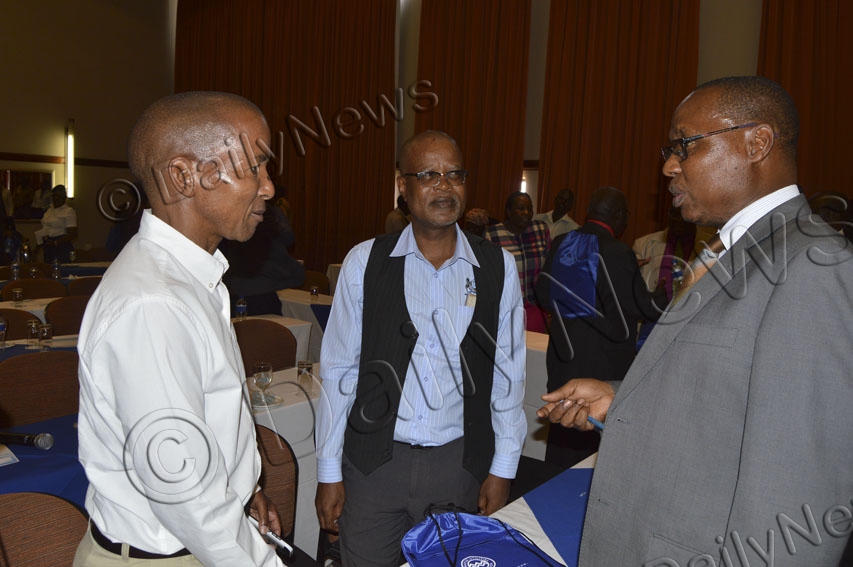
Waste water from Water Utilities Corporation (WUC) sewerage ponds will not pollute the environment or even spread measles in livestock, says (WUC) general manager in Mahalapye, Mr Moitseemang Monthe.
Mr Monthe was responding to concerns from councillors at a stakeholders’ seminar in Mahalapye on October 16. Councillor Tumelo Koolekanye of Flowertown/Boseja had raised fears that the waste water was likely to pollute the environment.
In relation to organising the stakeholders gathering, Mr Monthe said the corporation saw it appropriate to engage the sub district leadership to keep them abreast with their operations.
Mr Monthe said WUC was undergoing reforms and that encountering challenges along the process was likely to impede on quality and timely service delivery.
He said the critical challenges faced by the corporation were low cost recovery, insufficient income, poor service and low investment. He was, however, hopeful that with the support of all stakeholders, the challenges would be addressed.
Mr Monthe said the company would achieve financial growth and sustainability by reducing water wastage and improving debt collection.
He also emphasised on the need to improve infrastructure and to make use of the latest technological advancements in order to improve service delivery.
“Our human resource must be result orientated and innovative.The ongoing restructuring exercise is focused on improving human resource to satisfy customers through improved service delivery,” he said.
Furthermore, he appealed to stakeholders in the sub district to assist WUC in engaging the community and making them understand and appreciate efforts made to improve water quality and distribution.
“We are perceived negatively as a result of the challenges that impede on our efforts to provide the community with water as we desire,” he said.
Mr Monthe was also concerned by vandalism of their infrastructure.
“We appeal to the community to reduce vandalism of water supply networks and other facilities such as prepaid public standpipes in some villages outside Mahalapye which are continually vandalised,” he said.
On communities which were not satisfied with their response to reports, Mr Monthe acknowledged the challenge and called on the sub district to assist the corporation in addressing the community and making them understand that all shortcomings in water supply were not intentional but emanating from the challenges faced by the corporation.
Mr Monthe said WUC was overwhelmed by reports of breakdowns and leakages.
“In Mahalapye alone, we are able to receive about 80 reports in a day. We prioritise and attend to heavy leakages first,” he said.
Despite challenges of shortage of resources, financial constraints and human resources, Mr Monthe did not dispute that poor workmanship by some employees was likely to worsen their woes.
He also admitted that due to financial constraints, the corporation was not able to expand water distribution networks to newly allocated residential plots.
“We do all we can with the limited resources to improve on our service delivery and expand our water distribution networks to newly developed areas,” he said.
Presenting on the water supply situation, waterworks engineer, Mr Morris Mpotsang said the sub district was supplied with water from the North-South Carrier, Pallaroad well field, Ramokgonami borehole and Sefhare well field.
Mr Mpotsang said some of the villages in the sub district were supplied by designated individual village boreholes.
Mr Mpotsang noted that Mahalapye Sub-district was in demand of 16 360 cubic litres of water per day.
He said available boreholes were able to supply 10 128 cubic litres per day, adding that when augmented with water from the North-South carrier all water sources available in the sub district were able to yield 14 995 cubic litres of water.
With supply from boreholes only, he said the sub district would experience a shortage of 6 222 cubic litres of water a day, adding that with the relief of water from the North-South carrier the water shortage would be reduced to 132 cubic litres per day.
He said about 47 per cent of potable water supplied to Mahalapye Sub-district communities was from boreholes while the remaining 53 per cent was supplied by the North-South water carrier.
Although the villages of Mosolotshane, Moralane, Kodibeleng and Tobela were receiving enough water, Mr Mpotsang said the quality of the water was a challenge as it had high salinity.
He said at some stage water shortage was worsened by breakdowns and maintenance works.
He, however, said it was unfortunate that some breakdowns leading to shortage of water were a result of vandalism in the water distribution network by some members of the community.
He said some possible causes of inadequate water supply were power disruptions, frequent failure of equipment and supply infrastructure and vandalism of equipment.
“Low yields of boreholes due to over pumping and lowering of the water table also contributed to water shortage,” he said. ENDS
Source : BOPA
Author : Moshe Galeragwe
Location : MAHALAPYE
Event : Seminar
Date : 18 Oct 2018
Related News

18 Aug 2026
Men lead conversation on GBV root cause

18 Aug 2026
Botswana and US conclude Southern Accord 2026
18 Aug 2026