


Audit report recommendations to shape reform agenda
04 May 2026
The national forensic audit report’s recommendations will shape a comprehensive public sector reform agenda to strengthen institutional resilience.
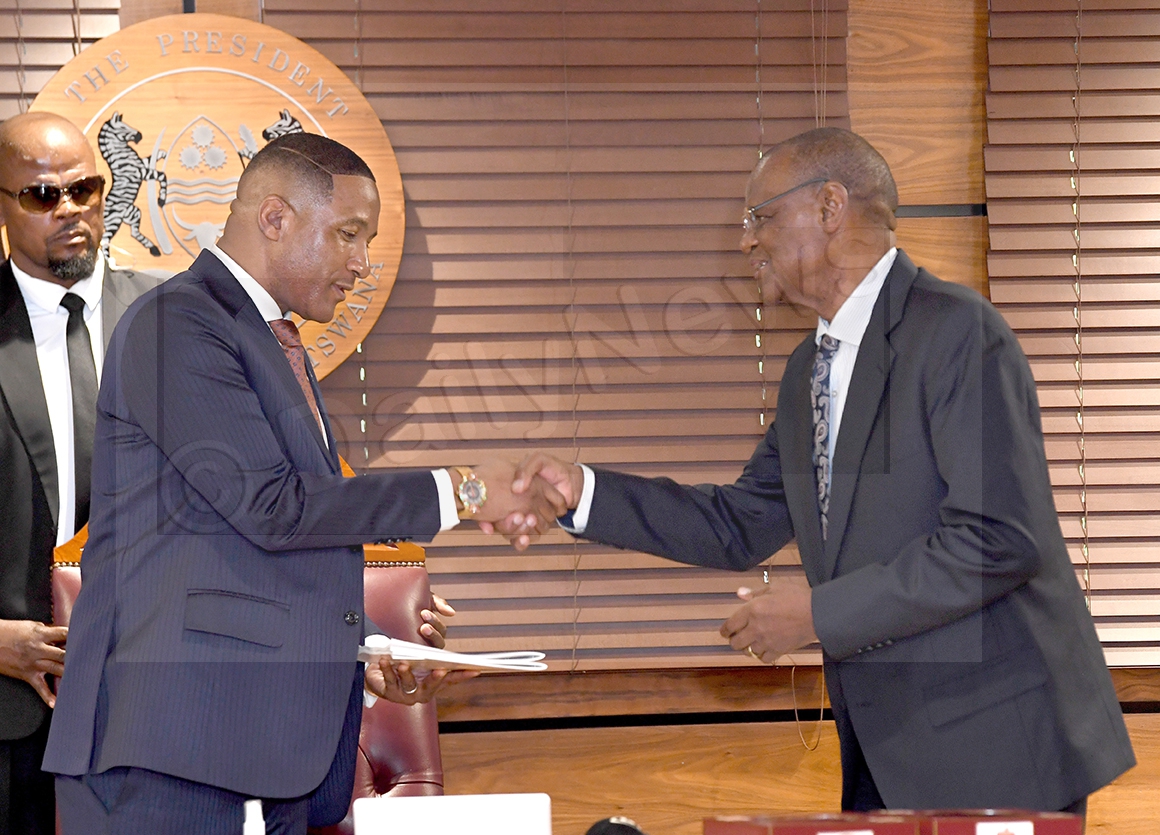
This was said President Advocate Duma Boko when receiving the report from the chairperson of the project steering committee, Mr Moses Pelaelo on Friday.
“The forensic audit has made its findings and recommended possible actions by appropriate authorities and it has also detailed recommendations that would inform a comprehensive public sector reform to enhance good governance, institutional resilience and accountability,” President Boko said.
President Boko thus noted that the audit marked a reference point in government quest to attain professionalism in both administrative and systems of governance and the conduct of public affairs.
He noted that the report would be carefully studied and actioned as it might entail some measures of criminal or civil action owing to further investigations and probing.
“That probing must not be compromised by unstructured or uncoordinated release of very sensitive information that may enable any person implicated to anticipate the investigation and cover their tracks,” he said.
He reaffirmed government’s commitment to fight corruption wherever it manifested itself and would do so without any favour.
He stated that government had to do a series of public sector reforms to address some of the critical shortcomings even as the audit process was underway, thorough reshaping and realigning process to ensure maintaining strides in rooting out corrupt practices enablers.
President Boko, in his maiden State-of-the-Nation Address in 2024, stated government’s commitment to restoring public trust and good governance.
In that regard, government appointed the Dubai registered auditing firm; Alvarez & Marsal Middle East Limited to conduct the forensic audit at the tune of just over P54 million which was a 14-month investigation into financial irregularities across country’s public sector and various government entities and was divided into two phases covering over 92 government entities.
For his part, chairperson of the project steering committee, Mr Pelaelo explained that the forensic audit exercise, which resumed in March 2025, was divided in to two phases with the first one entailing a comprehensive risk profiling of over 92 public sector entities.
“The target population was nearly 92 entities and the project team would have wished to have an official list of those entities but had to heavily rely on open sources in order to populate such a number,” he said.
He said the first phase took a period of four weeks and was completed on time at the end of May 2025.
Mr Pelaelo said as an output of such process and using their methodology, the forensic auditors produced a risk-based audit plan and schedule of 30 prioritised audits and came out with a priority list using a very robust methodology of risk profiling entities that should be prioritised for the audit.
The second phase of the audit, he said entitled a detailed audit of each of these 30 entities and this phase was initially scheduled to take 10 months ending January 31 2026, but nonetheless had to be extended to April 30,2026 due to unforeseen logistical challenges.
“In addition to the report presentation, there are 30 entities specific reports containing very detailed findings on corruption, fraud and abuse of public office, waste and misuse of public resources and other acts of misconduct.”
To preserve the entirety of the investigations and possible prosecutions as well as prospects recovery of the looted products, Mr Pelaelo said 30 audits would not be made public but would rather be referred to relevant authorities within government for necessary action and more importantly to underpin institutional and other government reforms. ENDS
Source : BOPA
Author : Thato Mosinyi
Location : Gaborone
Event : national forensic audit report
Date : 04 May 2026
Related News


09 Oct 2026
Duma Boko School prepares for January intake
09 Oct 2026
Botswana and Zimbabwe seal waste management deal

08 Oct 2026