


Govt transforms energy sector
16 Apr 2026
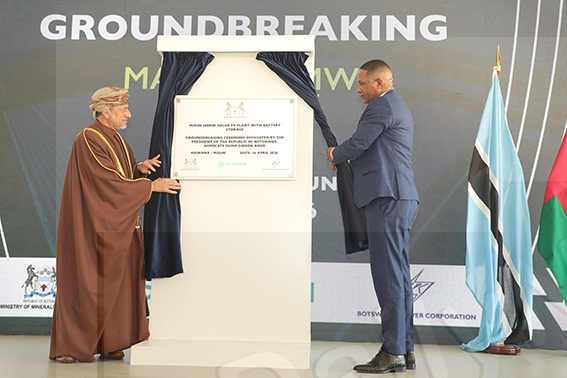
The implementation of the 500 MW solar photovoltaic plant and a 500 MWh Battery Energy Storage System in Maun positions Botswana as a net exporter and a leader in the regional energy transition.
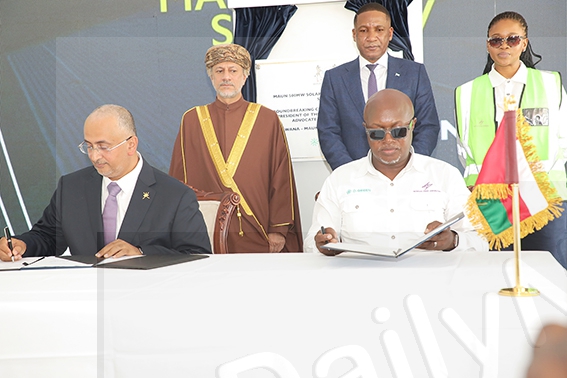
Implemented through government-to-government partnerships with the Sultanate of Oman, the solar plant will be the largest grid-scale solar project in Botswana, and the second-largest energy storage project in Africa to date. Once operational, it will inject 500MW of clean and reliable power into the national grid. The mega project is expected to be commissioned in 2029.
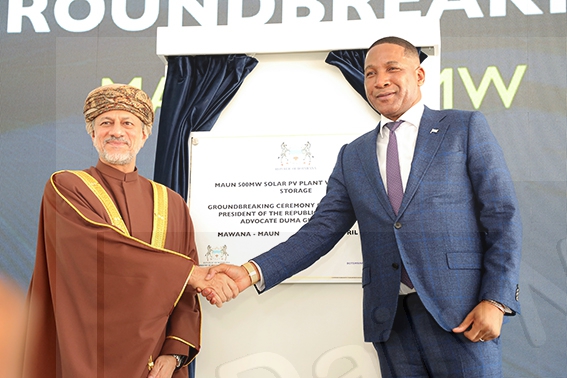
Officiating at the ground-breaking of the project, President Advocate Duma Boko said government was doing everything to elevate Botswana’s stature on the global energy landscape, acknowledging that the project placed Botswana firmly among the leading nations in energy storage development on the African continent.
Government, he said was decisive in transforming the energy sector from fossil-based to a diversified energy mix, comprising both renewable and non-renewable sources. Vision 2036 targets to increase the share of power generation from solar and other renewable sources to 50 per cent by 2030, from a current baseline of approximately eight per cent and to achieve that President Boko stated that government had adopted a revised and accelerated Integrated Resource Plan, aimed at fast-tracking renewable energy deployment and positioning Botswana as a net exporter of electricity by 2030.
“This is not just a project. It is a clear statement that Botswana is poised to be a regional energy hub. We are advancing steadily to provide affordable and clean energy across all economic sectors, in full alignment with Sustainable Development Goal 7, which aims to ensure access to affordable, reliable, sustainable, and modern energy for all by 2030, focusing on increasing renewable energy and improving energy efficiency”.
President Boko further extended sincere gratitude to the Sultanate of Oman and their partners from Oman, saying government valued their collaboration and looked forward to its continued growth as the country moved towards building an economy that was powered by clean energy; an economy that was competitive and one that created opportunities for Batswana.
Furthermore, he noted that government was focusing on accelerating the implementation of an Integrated Resource Plan in order to deliver 1.5 gigawatts of renewable energy by 2030, saying that would indeed bring to light the broader ambition of being a regional hub for solar energy generation.
The gathering learnt that Botswana was uniquely positioned to lead in the energy space with over 3 200 hours of sunshine annually and some of the highest solar irradiation levels in the world, which positioned the country as a natural hub for solar energy development. While government was vigorously and expeditiously integrating renewables to enhance the energy mix through projects such as the one in Maun, President Boko reiterated that Botswana remained committed to fighting climate change and global warming.
“As a party to the United Nations Framework Convention on Climate Change and a signatory to the Paris Agreement which seeks to limit global warming to well below 2 degrees, ideally by 1.5 degrees by 2030, we have pledged and resolved to reduce greenhouse gas emissions by 15 per cent by 2030 relative to 2010 levels”.
The reality of climate change, he said was no longer abstract but was rather immediate, visible and at times disruptive. While Botswana contributed a small fraction, approximately 0.02 per cent to global carbon emissions, he appreciated that the country was among the most vulnerable to its consequences.
Persistent droughts, extreme temperatures, and environmental stress, he cited, were no longer distant threats but present realities affecting livelihoods and economic stability.
Kgosi Tawana Moremi hailed government for advancing efforts to plug into solar energy, which he said was extensively adopted globally. He said solar energy was a renewable and abundant resource that once harnessed could provide significant benefits to daily life.
“This project is a welcome development in Ngamiland, the sunlight itself is free and once harvested, the project will provide benefits to our community and the nation at large. The project also has the potential to stimulate the local economy,” he added. ENDS
Source : BOPA
Author : Esther Mmolai
Location : MAWANA
Event : groundbreaking
Date : 16 Apr 2026
Related News


10 Oct 2026
Feature Reliving the Long March 90 years on

09 Oct 2026