Education Transformation Requires Collective Efforts
18 Mar 2026
There is a need for an urgent and coordinated action to transform higher education sector into a key driver of economic growth.
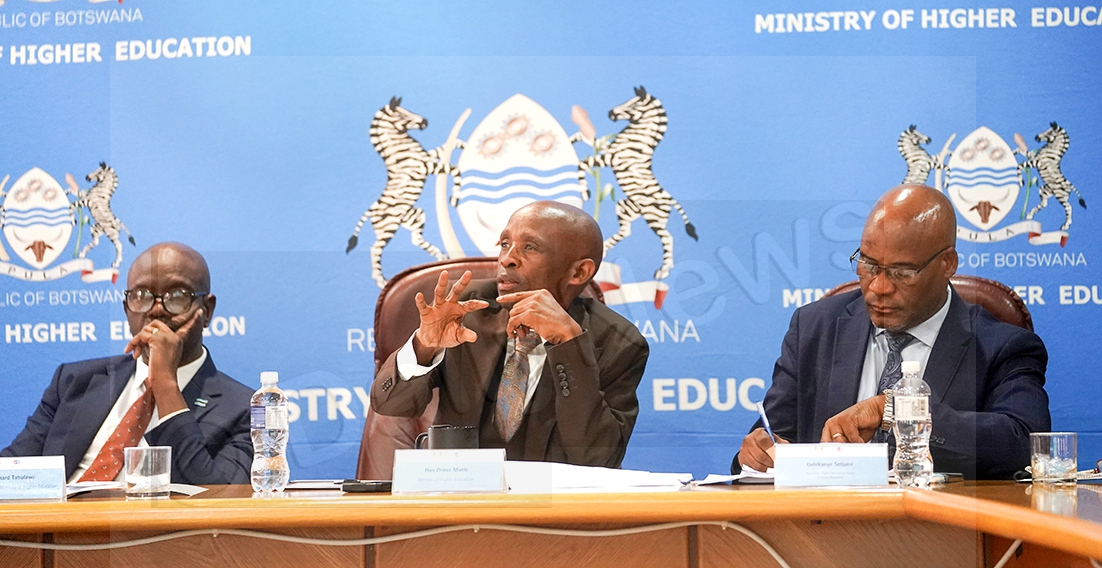
This was said by Minister of Higher Education, Mr Prince Maele at the inaugural meeting of the Higher Education Sub-High Level Consultative (Sub-HLCC) in Gaborone on Tuesday.
Thus, Mr Maele said the transformation required collective leadership rather than fragmented efforts.
Placing human capital development at the centre of national transformation, Mr Maele said higher education must be repositioned from a social service to a strategic economic sector capable of driving innovation, productivity and diversification.
He further noted that Botswana’s long-standing reliance on a consumption-driven economy must transition toward a production-oriented model, an evolution that depended heavily on a responsive and agile education system, particularly higher education and Technical and Vocational Education and Training.
He further commended participants from government, academia and the private sector for their presence at the Sub-HLCC, saying the ministry was the first to establish such a platform, positioning it as a model for cross sector collaboration.
He said the Sub-HLCC would serve as a structured platform to strengthen collaboration between government and industry in shaping policies, programmes and investments aligned with Botswana’s economic transformation agenda.
He emphasised the need to maintain momentum ahead of the main High-Level Consultative Council (HLCC) meeting scheduled for September, proposing July 7 as the next engagement to allow stakeholders to consolidate positions and present a unified strategy.
He added that the forum should play a critical role in tracking reform progress and ensuring accountability among stakeholders.
Also, he said the Sub-HLCC must evolve beyond a discussion forum into a results-driven platform capable of translating policy into implementation and commitments into measurable outcomes.
The minister also highlighted systemic inefficiencies that continued to constrain the sector, including delays in programme accreditation, misaligned student sponsorship frameworks, infrastructure limitations and regulatory bottlenecks.
Calling for a renewed culture of collaboration, the minister outlined complementary roles for key stakeholders.
Government, he said, must provide clear policy direction and enabling frameworks, adding that higher education institutions must deliver quality education and foster innovation while the private sector must take a more active role in shaping the skills ecosystem. end
Source : BOPA
Author : Lorato Gaofise
Location : Gaborone
Event : inaugural meeting of the Higher Education Sub-High Level Consultative
Date : 18 Mar 2026
Related News

12 Oct 2026



10 Oct 2026