


Government pivots to digital-first economy
09 Mar 2026
With Botswana approaching six decades of independence, the digital economy represents not merely technological progress, but a pathway to diversified growth, job creation and global competitiveness.
At 60, the government is betting that connectivity, innovation and strategic partnerships will form the backbone of a more prosperous and digitally empowered nation.
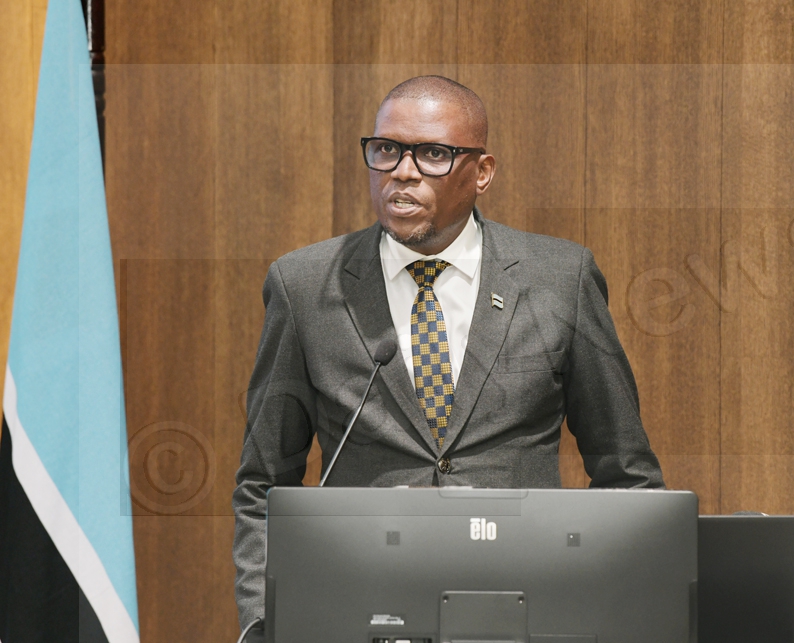
Addressing members of the Diplomatic Corps during a high-level Policy Dialogue recently in Gaborone, the Minister of Communications and Innovation, Mr David Tshere, set out an ambitious vision to digitally transform the country’s economy, declaring that the responsibility may be heavy, but the opportunity to reshape Botswana’s future is even greater.
The dialogue, held under the theme: Botswana at 60: Building Resilience, Driving Prosperity, brought together members of the diplomatic community and government leaders to reflect on the country’s development path and economic future direction.
Recalling President Advocate Duma Boko’s call to fully digitalise the economy, Mr Tshere acknowledged the magnitude of the task facing the ministry, particularly coming into office shortly after the 2024 general elections.
While Botswana has previously invested substantial resources in e-governance and digital services, the minister conceded that the efforts had not yet delivered the seamless, citizen-centred system envisioned, one where people can safely access public services from their homes or offices, where efficiency is improved, and revenue collection is strengthened through smart systems.
Shortly after assuming office, Mr Tshere said he convened leaders from the public and private sectors in Mahalapye, where an Information and Communications Technology (ICT) roadmap had been crafted a decade earlier, to measure progress and chart a new course.
Out of that meeting, he emerged the ICT Roadmap 2030, which Minister Tshere explained as an ambitious blueprint designed to reposition Botswana as a competitive digital economy. The roadmap, aims to create 100,000 ICT-related jobs within five years and increase the sector’s contribution to gross domestic product into double digits.
“It prioritises nationwide broadband expansion, fibre connectivity, modernised e-government platforms, secure digital identity systems, government cloud infrastructure, stronger data governance, enhanced cybersecurity, protection of critical national infrastructure, promotion of digital start-ups,s,” added the minister.
Currently, there is already approximately 16,000 kilometres of fibre optic cable laid across the country, linking it not only internally, but also to neighbouring South Africa, Namibia, Zimbabwe and Zambia.
As the foundation exists, Minister Tshere said what remained was scaling access, improving reliability and ensuring that infrastructure translated into meaningful economic participation. Central to this effort, Mr Tshere said had been the overhaul of the legislative framework governing digital transformation.
Parliament in 2024 passed the Digital Services Act which sets out how digitalisation will be implemented, governed and secured. The law came into effect November 21, 2025 and provides a strict two-year implementation window.
A second critical piece of legislation, the minister said was the Cyber Security Act, which is expected to come into force in April, to strengthening protections for critical infrastructure and citizens’ data while enhancing international cooperation.
Furthermore, Minister Tshere expressed gratitude to international partners, including; Finland, France and Estonia, under European Union support, for assisting Botswana in aligning its legal framework with international standards.
Beyond legislation, he said the ministry was confronting the challenge of ageing ICT infrastructure, expressing delight that a significant milestone was reached with the commissioning of a Tier III National Data Centre, the Delta Digital Data Centre named after the Okavango Delta to symbolise abundance and national pride.
“The government is now migrating its core ICT systems into this secure environment, with plans to complete the initial phase by mid-year before transferring applications from various ministries onto the unified platform,” he said.
To pursue peaceful and productive applications of nuclear science, he revealed that Cabinet had approved the establishment of a Centre for Nuclear Science and Technology.
This includes the local production of medical radioisotopes, reducing reliance on imports that often expire before reaching patients, and the irradiation of agricultural exports such as beef and citrus to meet international standards and extend shelf life.
Minister Tshere noted that Botswana had also taken its first steps into space. In March 15, 2025, with support from the United States Embassy and SpaceX, he said the country successfully launched its first space satellite (BOTSAT-1), marking March 15 as Botswana Space Day.
The next phase, he said involved commercialising satellite data and building local expertise to harness space technology for economic gain an area where he invited further international collaboration.
Meanwhile, Botswana’s participation in the Square Kilometre Array project, in partnership with Germany, is positioning the country as a player in global astronomy research. BOPA
Source : BOPA
Author : Lorato Gaofise
Location : GABORONE
Event : High-level Policy Dialogue
Date : 09 Mar 2026
Related News



10 Oct 2026
Feature Reliving the Long March 90 years on



09 Oct 2026