Neighbourhood Watch Cluster Tackles Delinquency
26 Feb 2026
Rising unemployment, rapid technological change, and a growing population have contributed to new and complex forms of crime in Molepolole.
From housebreaking to cyber-enabled offenses, communities are increasingly under pressure. Alongside this, drug abuse, particularly among the youth, has become a troubling trend, threatening social stability.
In response, the Central Neighbourhood Watch Cluster based in Magokotswane ward, has intensified its efforts to combat these challenges. So determined to build a peaceful, drug-free, and crime-free Molepolole is the cluster that it has now joined efforts with the police, soldiers, medical practitioners and private security firms to restore calm in the Bakwena capital.
Cluster publicist, Mr Motsholathebe Moduke, explained that the initiative has expanded beyond traditional crime prevention methods.
“We are living in a society where many young lives are being destroyed by drugs and alcohol. These youths often lose their senses and become problem children who harass community members, rob them, and sell stolen property to fund their addictions,” he said.
Mr Moduke lamented the rise of informal beer hubs within residential compounds, where both young and old spend long hours drinking and using drugs. He noted that substances such as methcathinone and marijuana were common, often leading to mental disturbances, violent behavior, and personality loss.
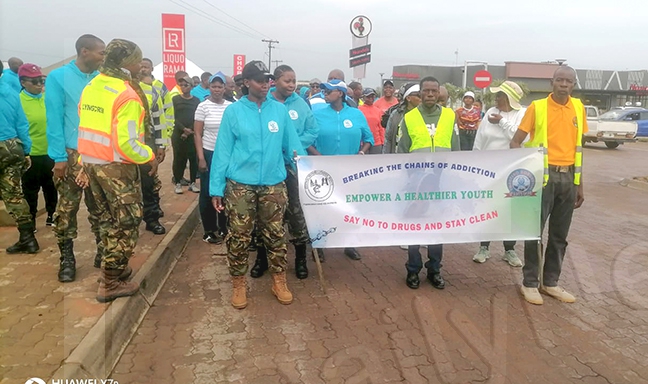
To counter this, the cluster launched an anti-drugs and alcohol campaign under the theme: No to Alcohol and Drug Abuse. The community march which took place this past Saturday and was anchored in mottos such as : #BreakTheChainOfAddiction #EmpowerAHealthierYouth #SayNoToDrugsStayClean formed part of the spirited campaign.
The march concluded with an educational session where participants were taught about the dangers of substance abuse and guided toward healthier coping strategies. Mr Moduke also highlighted the role of technology in fueling crime, noting that some youths advertise drugs on social media in pursuit of fast money and flashy lifestyles.
Mr Mohammed Shibly Sadeque, Principal Clinical Psychologist at Scottish Livingstone Hospital, described substance abuse as the root cause of many societal problems. He defined it as the intentional misuse of drugs and stressed that prevention was better than cure.
“Smoking tobacco is more dangerous than drinking alcohol. I am not saying you should drink alcohol, but smoking cigarettes is extremely harmful,'' he said.
He explained that tobacco caused cancer, damaged the lungs, and harmed non-smokers through secondhand smoke. To curb drug use, he recommended reducing availability and urged medical practitioners, pastors, and teachers to set an example by avoiding alcohol and tobacco themselves.
He also criticised the presence of bars near schools, citing Molepolole as a case in point. Mr Sadeque concluded by encouraging those struggling with addiction to seek help at Scottish Livingstone Hospital.
Lieutenant Colonel Kabelo Mokganele, Squadron Commander at Thebephatswa Airbase, warned that alcohol and drug abuse were tearing families apart and weakening communities. He listed commonly abused substances, including cannabis, prescription medication, cocaine, heroin, nyaope, and methcathinone.
Lt Col Mokganele stressed that substance abuse also contributed to fatal accidents, gender-based violence, family breakdowns, and declining moral values.
“The solution is simply to say no to drugs, say no to alcohol abuse, and protect our children,” Lt Col Mokganele said.
He urged parents to report children under the influence to police or rehabilitation centers before the situation worsened.
Assistant Superintendent Future Modisadife from Molepolole Police reported that drug abuse cases continued to overwhelm law enforcement.
“Cannabis remains the most common drug, with 62 cases recorded in 2024 and 54 in 2025.”
He explained that the police often apprehend users through stop-and-search operations, but recent trends showed cannabis being distributed via public transport, homes, and even schools.
ASP Modisadife outlined penalties under the Illicit Trafficking in Narcotic Drugs and Psychotropic Substances Act of 2018, which stipulates that if found in possession of less than 60 grams of cannabis, the perpetrator is fined up to P20,000 or imprisonment for up to 3 years, or both, whereas if found in possession of cannabis of more than 60 grams, a fine of up to P500,000 or imprisonment for up to 10 years, or both, will be meted out.
Like other speakers before him, he warned that drug and alcohol abuse fueled domestic violence, theft, rape, and family conflicts. Also, he stated that addicts often resorted to stealing from households, sometimes even from their own families, to fund their habits.
ASP Modisadife also raised alarm over “drug houses” run by local lords, which were linked to defilement, abuse, and trafficking. Residents were urged to report suspected cases anonymously or through toll-free numbers. BOPA
Source : BOPA
Author : Keetile Bontsibokae
Location : Molepolole
Event : Awareness Campaign
Date : 26 Feb 2026
Related News

08 Oct 2026