


Mohwasa emphasises importance of ConCourt
02 Feb 2026
The process of amending the constitution takes time and it is more urgent to develop a Constitutional Court where the citizens and interest groups within society could find recourse on their constitutional rights.
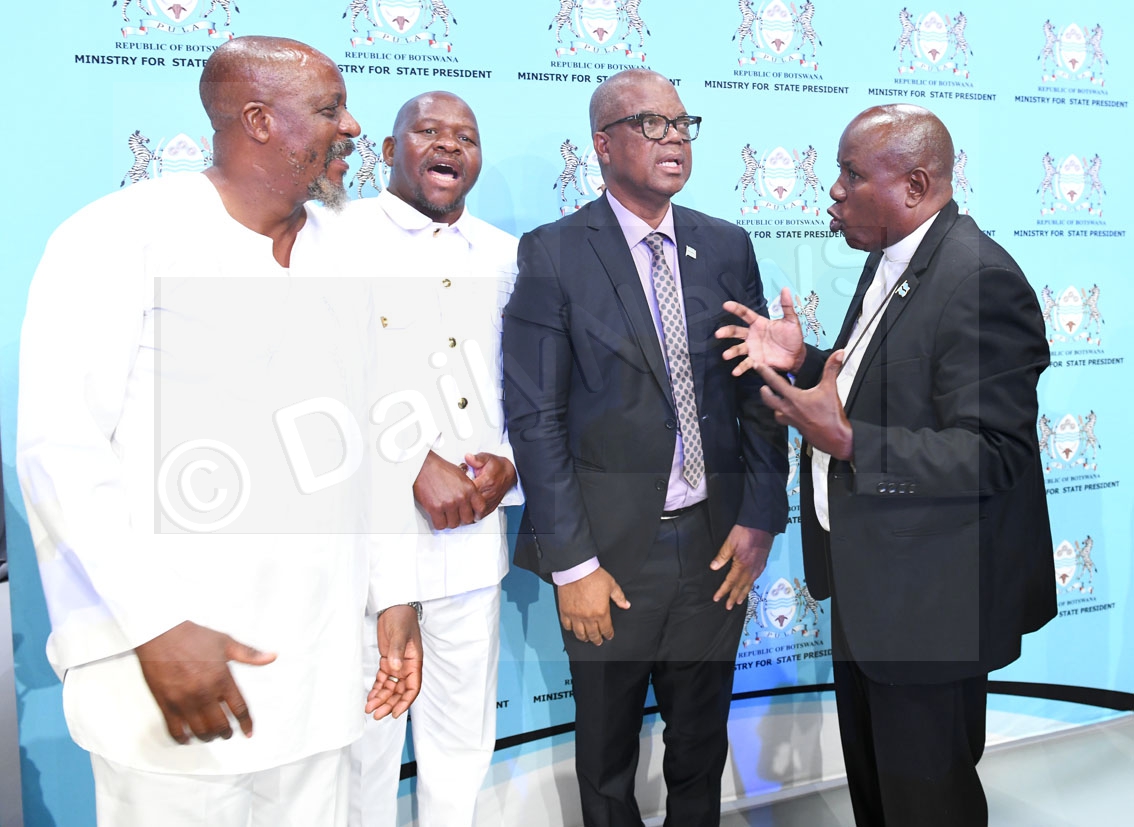
This was said by the Minister for State President, Defence and Security, Mr Moeti Mohwasa, while addressing religious leaders in Gaborone recently, as part of the ongoing public and stakeholder consultations on the enactment of a Constitutional Court.
He said the Constitutional Court could address issues such as those aggrieved by land tenure systems, electoral petitions and the right to be protected from infringement on religious freedom. He cited the example of the case of Mr Pitseng Gaborekwe whose wish was to be buried in his ancestral land, the Central Kalahari Game Reserve (CKGR) but whose family was denied that right by the judicial system including the existing tribunal of last instance, the Court of Appeal.
Giving background, Mr Mohwasa said after consultation with political parties at the All Parties Conference, the Bill on the Constitutional Court was noticed on July 4, 2025.
The Constitutional Amendment Bill of 2025, which seeks to establish the Constitutional Court of Botswana, was presented by Minister Mohwasa in Parliament last December, and passed through a third reading, and will now require a two thirds majority vote in the National Assembly within the first three months of this year to become law.
Mr Mohwasa said the government acknowledged that before the Constitutional Amendment Bill of 2025 was gazetted and tabled before Parliament, there should have been prior consultation.
He said the President recently admitted to that omission and asked for pardon from the Ntlo Ya Dikgosi, and the minister also expressed the same to religious leaders, citing that scriptural texts such as the Bible and the Quran preach forgiveness.
Mr Mohwasa said if the bill passed through a two thirds majority vote in Parliament, it would then be put to the public for an approval vote through a referendum.
He added that the UDC government was focused on uplifting the marginalised, and this had already manifested through increased old age pension scheme, the increase in the technical vocational education student allowance, relief on some outstanding water bills and tariff reductions.
He said organised religion tended to share this quest for economic and social justice, by seeking to have the marginalised uplifted in the economic, social and cultural rights and the Constitutional Court would be a vehicle to ensure fairness in society.
Mr Mohwasa said it should be acknowledged that in the past, people owned livestock as well as the serfs who herded those cattle in their farms, but he urged religious leaders to support the government in pursuing human rights and equality for all.
He said the church had played a significant role in the struggle for the liberation of neighbouring South Africa and Zimbabwe, and called for the church to assist in the ‘parting of the Red Sea’ and ‘bring down the walls of Jericho’ to lead Batswana to the promised land.
Mr Modiri Tshutledi of the Botswana Muslim Association said the constitution being a document agreed between the people and the state regarding the laws they wish to be governed under, but said there had never been a referendum before the constitution was initially passed.
He said there was a need to first address this loophole and develop an amended constitution after wide consultation and a referendum, before the Constitutional Court was adopted.
Bishop Mothusi Letlhage, representing the Botswana Christian Council (BCC) also called for government to first work on exhausting the process of amending the constitution before the Constitutional Court was developed.
Pastor Clyde Ketshabile of the Seventh Day Adventist Church said since the constitution was the supreme document that safeguarded the interest of the nation, it was important for it to include clauses guarding the rights to health, education and the liberty of conscious, and institutions where people could find recourse if denied such rights.
Mr Japhta Radibe of the Apostolic Faith Mission said government should not be in a hurry to introduce the Constitutional Court, saying he feared it could be used to pass reforms such as the abolition of the death penalty and corporal punishment as well as the introduction of same sex marriage.
He called for the bill to be withdrawn and wait for the constitutional review process.
Pastor Nchunga Nchunga said he supported the Constitutional Court since Batswana as a nation differed on many different constitutional matters and there was a need for an institution that would act as a fair arbiter on constitutional matters.
He said he did not subscribe to conspiracy theories of hidden agendas on the matter, saying that people had a tendency to allow their fears to generate unproven thoughts. Pastor Nchunga said he was also impressed by the humility of the President in apologising for the consultative process to having started late.
Rev. Thabo Mampane of the Evangelical Lutheran Church in Botswana said he supported gay and lesbian rights as well as the abolition of the death penalty and 100 per cent supported the Constitutional Court as an institution that could guarantee the rights of all within society.
He said he had previously been concerned about the pace with which the process was taking place but had been assuaged by the minister’s presentation. ENDS
Source : BOPA
Author : Pako Lebanna
Location : Gaborone
Event : Religious leaders address
Date : 02 Feb 2026
Related News


10 Oct 2026
Feature Reliving the Long March 90 years on

09 Oct 2026