


New Mobile X-ray units end long journey for scans
30 Jan 2026
For many residents in the remote areas, a persistent cough or a suspected fracture used to signify the start of an exhausting journey. For a patient in Pandamatenga or Shakawe, seeking a simple X-ray often meant hours, or even days, of travel over rough terrain to reach a major hospital, often at great personal and financial expense.
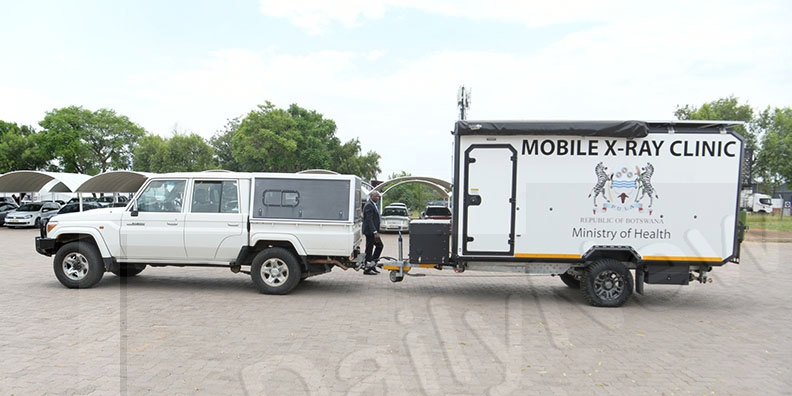
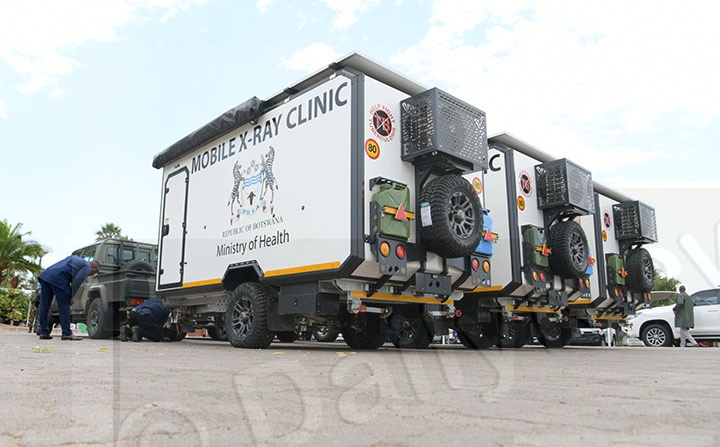
However, that burden is about to be lifted following the recent dispatch of three state-of-the-art mobile X-ray units to Pandamatenga Clinic, Bobonong Primary Hospital and Gumare Primary Hospital by the Ministry of Health, marking a turning point in rural healthcare.
No longer will the distance between a patient and a diagnostic machine determine the quality of their care.
Speaking at the dispatch ceremony in Gaborone recently, Minister of Health, Dr Stephen Modise said the units, procured in 2025, were designed to meet patients exactly where they were.
“We are looking at different variables that work together in the health space to ensure we deliver quality healthcare to our people. This is our first installment. We will be rolling out more equipment, including CTs, MRIs and even AI-powered tools, to ensure that every hospital, regardless of location, has a full complement of biomedical equipment,” Dr Modise said.
For the elderly, the injured or those weakened by illness, the relief of accessing the services locally cannot be overstated. By cutting down travel time, the Ministry is not just providing a service, but returning time and dignity to the community.
The new units represent a leap into the future of digital health.
For her part, Dr Topo Makhondo-Danquah, the Tuberculosis (TB) programmes officer who oversaw the procurement, highlighted that each unit was integrated with Artificial Intelligence (AI) to assist in screening for TB and other abnormalities.
“The computer AI helps interpret the X-ray. It does not replace the doctor. The physician still uses their expertise to reach a conclusion. The AI acts as a safety net, identifying abnormalities in the lungs to reduce human error. Diagnosis is not the easiest thing out there, and this helps us be more precise,” Dr Makhondo-Danquah explained.
Understanding the challenges of the local landscape, the units have been ruggedised for the journey.
On one hand, each unit is self-sustaining and powered by a combination of solar panels for renewable energy, a petrol generator for backup as well as an eight-hour battery life, specifically designed to keep the air conditioning running and ensure that both the equipment and patients remain cool in the heat.
To protect the delicate internal sensors from the bumps of rural roads, the panels are fortified with specialised shock absorbers.
Meanwhile, the rollout is part of a broader mission to revitalise the primary healthcare system in the country. By addressing infrastructure and equipment shortages head-on, government aims to catch diseases like TB and cancer in their earliest and most treatable stages.
For the resident in Shakawe and Gumare, the arrival of the units is a promise kept and a sign that in the modern Botswana health system, no one is too far away to be seen. ENDS
Source : BOPA
Author : Gontle Merafhe
Location : Gaborone
Event : Donation hand over
Date : 30 Jan 2026
Related News



10 Oct 2026
Feature Reliving the Long March 90 years on


09 Oct 2026