


Botswana strives for sustainable coexistence
20 Jan 2026
Botswana’s recognition as a global conservation success story faces a critical challenge on how to sustain its remarkable biodiversity and tourism industry while ensuring the safety and livelihoods of its people.
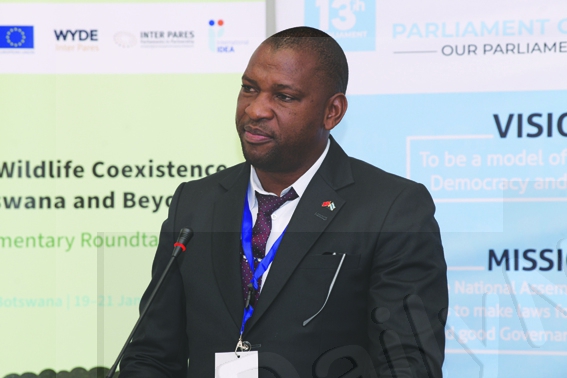
Speaking at a three-day International Parliamentary Roundtable on human-wildlife coexistence in Gaborone on January 19, Mr Gabatsholwe Disho, chairperson of the wildlife, tourism, natural resources and climate change committee, stressed that the nation stood at a pivotal moment requiring urgent, inclusive action.
Botswana’s achievements in protecting wildlife, he said, especially its elephant population of over 132 000 - the largest in the world - had garnered international acclaim.
However, this success has intensified human-wildlife conflicts, marked notably by crop destruction, livestock predation and safety risks.
Districts like Ngamiland, Chobe, and Ghanzi are experiencing escalating tensions as wildlife ventures beyond protected areas into communities, exacerbated by climate change-induced droughts and habitat shrinkage.
Mr Disho said that farmers lose thousands of hectares of crops annually to elephants and other species, pushing households into food insecurity.
from page 1
Livestock losses due to predators such as lions and hyenas further undermine rural economic and social stability. These conflicts, Mr Disho said had also led to tragic human injuries and fatalities, underscoring the urgent need for effective mitigation measures.
He called for stronger policies and community participation, including fair compensation schemes, wildlife corridors, and land-use planning that balances ecological needs with human safety.
Mr Disho reaffirmed parliament’s commitment to revitalising the Community-Based Natural Resource Management Bill, empowering local communities as active partners in conservation and tourism. He stressed that addressing climate change’s role in conflict requires an integrated approach across sectors.
Moving forward, he advised the country’s leadership to prioritise evidence-based policies, inclusive development, and innovative solutions to foster sustainable coexistence.
Ultimately, Mr Disho urged a shared national responsibility in protecting wildlife while safeguarding the dignity and livelihoods of the people.
In her opening remarks, acting Speaker of the National Assembly, Ms Helen Manyeneng underlined Botswana’s distinguished conservation record, notably hosting the world’s largest elephant population of approximately 140 000.
She stressed that wildlife was integral to Botswana’s identity, tourism, and global reputation.
However, she acknowledged the complex reality that many communities lived in close proximity to wildlife, which presents significant challenges.
Ms Manyeneng pointed out that predators like lions and hyenas threaten livestock and livelihoods, while herbivores such as elephants frequently damage crops and infrastructure, causing economic and safety concerns.
Over the past three years, the department recorded 25 672 human-wildlife conflict incidents, resulting in 28 deaths and 51 injuries, mostly from elephants.
She said that these figures represent real families and communities affected daily.
While Botswana has compensation mechanisms for losses, she said the rising costs and incident frequency strain available resources, adding that human-wildlife coexistence was a governance challenge that spans conservation, land use, climate resilience and community development.
Ms Manyeneng stressed on the importance of balanced, sustainable policies and highlighted the role of parliamentarians as vital links between citizens and the state, tasked with crafting informed, long-term solutions through dialogue, legislation and oversight.
Dr Jonathan Murphy, head of the Inter Pares programme at International IDEA said that the Inter Pares initiative is EU’s flagship parliamentary development project aimed at strengthening democratic institutions worldwide.
He explained that the programme promoted inclusive democracy through peer-to-peer exchanges, regional cooperation, and capacity building, driven by the priorities identified by partner parliaments such as Botswana, Sri Lanka and Zambia.
These priorities he said, often intersect with global challenges like gender equality, youth participation and environmental protection.
Dr Murphy highlighted that Inter Pares supports parliaments in becoming more effective, transparent, and accountable, enabling them to respond to complex issues through legislation, oversight, and stakeholder engagement.
He underlined that the programme’s demand-driven nature ensures that partner parliaments shape activities aligned with their unique needs, fostering sustainable institutional development.
He also pointed out that the programme’s work embodies the spirit of South-to-South and triangular cooperation, fostering shared learning across regions. ENDS
Source : BOPA
Author : Ndingililo Gaoswediwe
Location : GABORONE
Event : Parliamentary Roundtable on human-wildlife coexistence
Date : 20 Jan 2026
Related News



10 Oct 2026
Feature Reliving the Long March 90 years on


09 Oct 2026