

'Mandela was a great states man'
15 Dec 2013
Former South African President and international icon, Mr Nelson Mandela has been described as a great son of Africa, a legend and a man of immeasurable virtue and impeccable integrity.
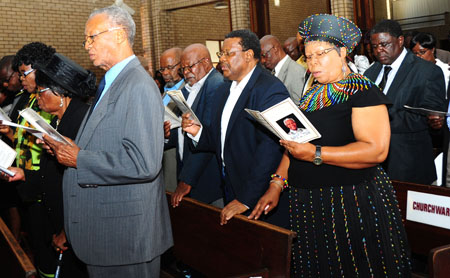
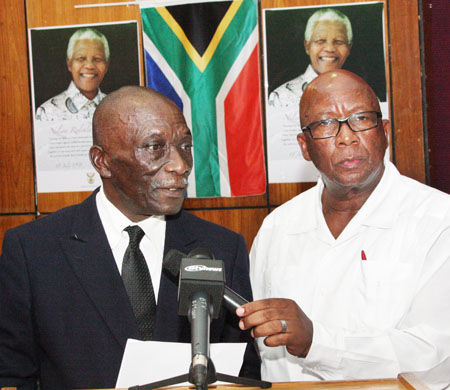
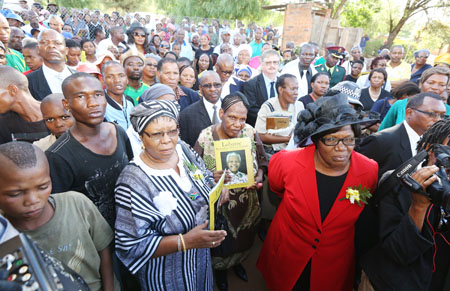
Mandela, aged 95 died on December 5 and was buried at Qunu, his ancestral home on Sunday, December 15. Speaking at a memorial service held in his remembrance, on Friday (December 13) in Gaborone, Minister for Presidential Affairs and Public Administration, Mr Mokgweetsi Masisi said Mr Mandela contributed immensely to the advancement of justice and equality for all, beyond the shores of the region.
The accolades he had received from all quarters since his demise, Mr Masisi said demonstrated beyond doubt that he was indeed one of the greatest political icons of the time.
“There is no doubt he changed the course of history not only for South Africa but the region, continent and the world over,” he said.
Mr Masisi said Madiba, as he was affectionately known, would be forever remembered for his legacy of hope and promise he bequeathed.
President Mandela, he said had fought the good fight in his struggle to set the people of South Africa free from the shackles of bondage and racial discrimination. He said Mr Mandela bore no grudges against his oppressors adding that it was not by accident that his ability to steer South Africa through the crisis of its rebirth, earned him the international reputation of a benevolent negotiator and quintessential peacemaker.
“Madiba was indeed a great statesman whose visionary leadership helped create the necessary platform for South Africa to transition into a peaceful, tolerant and secure nation and indeed, a good neighbour,” he said.
From this platform, Mr Masisi said South Africa had achieved tremendous economic growth and become a key player in global affairs. “President Mandela’s influence and integrity transcended borders and was felt worldwide.” As a virtuous leader, he said President Mandela influenced other nations on the African continent to embrace diplomacy and reconciliation as a vehicle towards African renaissance.
Mr Mandela’s principles and values, he noted led him to take a strong position on international issues, sometimes against world powers.
As Botswana is part of Southern Africa, he said it was fitting to remember with immense gratitude and pride his contribution to its liberation. He said the kinship between the people of Botswana and South Africa remained deeply anchored in the common and shared values dating back to time immemorial.
He told how Mr Mandela regarded Botswana as his home evidenced by the letter he wrote to former President Sir Ketumile Masire while in prison in July 1980 following the demise of Sir Seretse Khama. For his part, South African High Commissioner, Mr Mdu Lembede described former President Mandela as a great man who managed to capture the imagination of the whole world. Therefore, Mr Lembede said his death came as a loss of a great patriot and international icon who was a key player in the South African victorious struggle against the political system of apartheid which was declared by the whole world through the United Nations as a crime against humanity.
“Madiba was a great man and there are no questions about that,” he said. He described Mr Mandela as a fearless commander and freedom fighter in all respects and also a compassionate leader whose resilience and charisma made an impact on millions thought out his life. Mr Mandela, he said possessed very rare leadership qualities and was an internationalist and toast of the world who was feted by kings and queens but also felt at home in small villages around South Africa talking to simple people.
“He saved us in the nick of time when we were about to turn against each other and destroy ourselves as a nation. He actually single-handedly gave us back or dignity. He returned justice and democracy to our land. He liberated all of us; black and white in the same way he was able to free his own jailers from their own emotional prisons,” he said.
Mr Mandela’s very first visit out of South Africa was in Botswana in 1962, at the formative stages of the armed struggle. The apartheid regime would follow his trail with kidnappings, bombings, armed raids and assassinations that violated the sovereignty and peace of Botswana with the intention to intimidate the leadership of the country. However, intimidation would not come easily for a country that was rooted in democratic principles and the respect for human rights.
Botswana was the first country in a tour of 45 nations, in the world to receive gratitude for the support proffered to the African National Congress during the years of struggle. During his visit to Botswana as the president of the new South Africa, he shared his vision of a liberated South Africa as the beginning of a new era, dedicated to reverse the legacy of apartheid and destabilization of yester years, to contribute to the socio economic advancement of the African people. The new South Africa would also become an active member of the Southern African Development Community, ready to play her part towards peace and prosperity in our region. ENDS
Source : BOPA
Author : Segametsi Kebonang
Location : GABORONE
Event : Memorial service
Date : 15 Dec 2013
Related News
11 Jun 2026
Xi arrives in Pyongyang for state visit to DPRK
10 Jun 2026
Government secures more medical supplies

10 Jun 2026
Govt secures more medical supplies
10 Jun 2026