


Seretse Khama Man of peace
30 Jun 2022
Botswana’s sovereignty is assured. Among other notable bonuses is a voice that is respected regionally and internationally.
All this, is in no small measure thanks Sir Seretse Khama vision.
Here is a man who could have chosen to live a quiet life in Serowe as Bangwato Kgosi. Instead, he chose politics, at the time considered by many, to be a lowly position compared to being a royal.
Seretse’s commitment to the peace and stability of Botswana would always be remembered.
It was his determination that ensured Botswana became the success story that it is today.
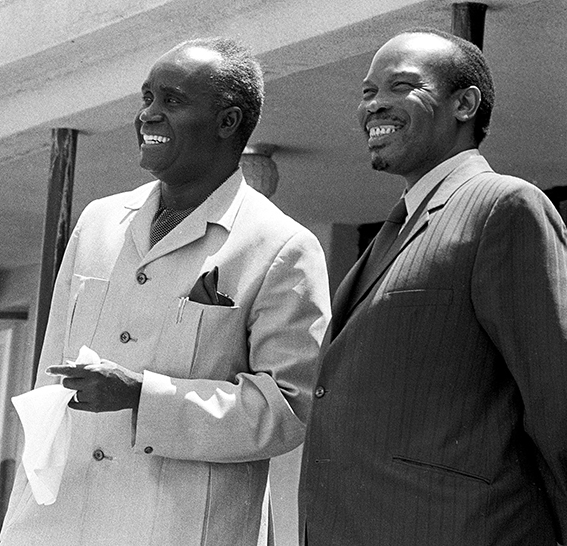
A man of great candor, and an uncompromising belief in peace, Sir Seretse was. Zambia’s founding president and a close acquaintance of his, Dr Kenneth Kaunda, became the first head of state to visit Botswana soon after independence.
He summed Sir Seretse’s character thus: “From the time I met you I realised Africa had a man of deep sincerity, an honest leader; an able and determined leader of his people.”
Concurs local historian Dr Jeff Ramsay: “He was able to inculcate the indigenous norms of free speech, free association to nation building and unity.
The nation did not crack along ethnic lines like what happened elsewhere such as in the Congo who experienced ethnic violence.” Sir Seretse, says Dr Ramsay, was a visionary and a true democrat because he did not only believe in democracy, but translate and matched its principles, to Setswana ideals, hence we now have Puso ya batho ka batho, which is the Setswana meaning of democracy.
Sir Seretse’s wise diplomacy policy saw Botswana enjoying diplomatic relations, even with countries whose political philosophies were polars apart.
These included the then Soviet Union, United States and the People’s Republic of China, said Dr Ramsay.
The support Botswana received from the international community made it difficult for South Africa’s apartheid regime to attack the country, as the minority white government of the time, would very much have loved to.
When white aggression grew in the 1980s with a new wave of refugees, including prominent people seeking refuge in Botswana, Sir Seretse worked hard to ensure everyone understood Botswana’s non-aggression position.
He established nonracial policies at home and urged his neighbors to do the same.
All the while he maintained an open-door policy for genuine political refugees, says Dr Ramsay. Political commentator Mr Solly Rakgomo says Sir Seretse thoroughly believed in restraint, hence his motto “Ntwa kgolo ke ya molomo,” an equivalent of “to jaw-jaw is always better than to war-war”.
With his country sandwiched between minority apartheid South Africa and Rhodesia’s (later Zimbabwe) white minority rule of Ian Smith to the north and South, with Namibia to the west struggling for independence from white South Africa, Sir Seretse would not resort to violence.
On the one hand he had to deal with the haughty white and aggressive racist rulers whose countries completely blocked all access to the sea, leaving only Zambia, through which one had to cross the mighty Chobe River. Yet Sir Seretse stood firm on his principle, displaying great restraint, which he might also wisely have done because he was also aware that his military capabilities were inferior to those of the aggressors. Such was Sir Seretse’ s belief in peace that it was not until 1977 that Botswana Defence Force (BDF) was established.
It was only after much aggression by the Ian Smith regime in Rhodesia that Sir Seretse announced Botswana would increase its military strength. Its main security service would graduate from a paramilitary police unit to a defense force, to protect Botswana’s borders.
And he made it clear he wanted conflict with no one. “His strategy of restraint and engagement and also his cautious diplomacy helped maintain peace in the country and even across the borders.
For example, it is said at the time Cuba was involved in the wars in Angola and Namibia, Fidel Castro asked Khama if he use Botswana as a launch pad for liberation attacks against apartheid regimes in the regions, Seretse gently declined,” says Rakgomo.
He knew what the likely consequences would be. And they would have included much suffering for his people, and so declined.
Indeed, the man had his critics who felt that he was cowardly, but he remained resolute in his non-aggression policy. He kept true to his quest for peace that he had made clear to the world early on in 1969, when he addressed the United Nations General Assembly in September for the first time: “Because Botswana is part of a region that faces the threat of violent conflict, I want to lay particular emphasis on the need to find peaceful solutions to our problems.
Southern Africa lives with the dangers of violent racial conflict. I want this afternoon to discuss the threat of racism as it affects southern Africa,” he had said as he laid the foundation to a speech in which he clearly explained the dire consequences of perpetuation of the status quo.
And world leaders agreed with him, hence the support they happily gave to Botswana afterwards. Sir Seretse had already consolidated relations with independent African republics to the north, building on old personal relationships and starting with Malawi and Zambia as shown by his state visits to the two countries in 1967.
He also forged relations with Kingdoms of Lesotho and Swaziland in education, and made attempts to start negotiations with South Africa over a customs union.
The last burst of political activity for Sir Seretse was the first ever summit for the Southern African Development Coordination Conference (SADCC) on April 13, 1980 in Lusaka where he sat as chair, having galvanised his friends from across Southern Africa to build the Organisation, to deal with the common challenges they faced, from economic deprivation, to dealing with the monster of apartheid. He would have been gratified.
For, only a month earlier, Zimbabwe had become independent, and here he was with his ‘brothers’, chairing a meeting after which he hoped the region would chart a new path for the development of its people.
And he would have been right.
Renamed SADC years later, after Sir Seretse had passed on, the bloc has grown tremendously over the years and has ensured integration of the members across all sectors. Sir Seretse died on July 13 1980, 12 days from his birthday and aged only 59. ENDs
Source : BOPA
Author : Baleseng Batlotleng
Location : GABORONE
Event : Interview
Date : 30 Jun 2022
Related News


06 Aug 2026
Maele backs BQA

06 Aug 2026
At least 22 Batswana missing abroad
06 Aug 2026
Gaolathe inspires learners to dream big
06 Aug 2026