

Global warming impacts on food production
20 Oct 2013
Global warming compels farmers to adopt new ways and means that will secure food production.
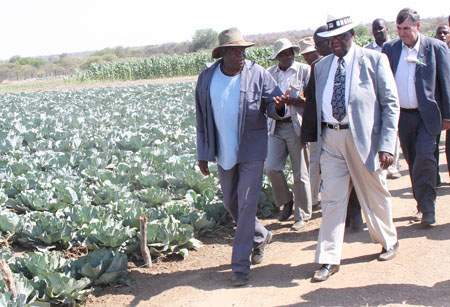
Officiating the World Food Day commemorations held in Tonota Molapo Farms on October 17, the Vice President, Dr Ponatshego Kedikilwe said that due to global warming, there is increased outbreaks of pests and diseases which impact negatively on agricultural production.
“The nutrition of the soil is also affected by the disappearance of nitrogen due to the high temperatures and reduction of vegetative yield, both in cultivated and range lands, further compounding the challenge of production,” said Dr Kedikilwe. He said it was therefore, imperative that farmers be selective and careful with their plants and how they fertilise them because some can produce nitrogen for themselves while others cannot.
The Vice President, who is also Mmadinare MP said, one of the five main focus areas of the Rural Development Council is Agriculture Development and Food Security in Botswana. He explained that the aim of the focus area is to boost domestic production and reduce hunger and malnutrition, especially in school going children and also help rural communities to make money through agricultural projects that are sustainable.
He said it was then imperative that rural communities be in the forefront in the quest to meet the country’s food demand.
Dr Kedikilwe noted that agriculture support programmes such as Livestock Management and Infrastructure Development (LIMID), Integrated Support Programme for Arable Agriculture Development (ISPAAD) and the Poverty Eradication programme have been designed not only to increase food production but, also to create opportunity for gainful production.
“These programmes are a clear indication of government’s commitment to agricultural development and have resulted in better agricultural outputs,” he said. He said since the inception of ISPAAD in 2008, cereal production has increased to 62 000 metric tons in 2010 while horticulture production has increased to 41 000 tons in 2012/2013.
He noted that government invests about P250 million every year in the ISPAAD programme and the level of investment should yield an increasing return which translates into higher quantities and qualities of production. He emphasized the need to improve farming technologies such as proper soil tillage, row planting, appropriate fertilizers, drought tolerant seed varieties and weeding of fields as they can result in substantial increase in yields.
“While currently, our national average yield of sorghum is about 10 bags per hectare, with improved technologies coupled with good rains a hectare can yield 70 bags,” he said. He said the cattle industry continues to be the backbone of agriculture in the county as it is a source of employment, income, raw material, draught power and protein.
With regards to poultry industry, the Vice President said although most of the eggs and broiler meat come from the country a lot can still be done for the industry to have a meaningful impact on poverty eradication and contribute to the household food security situation. He said he was hopeful that with some investors setting up dairy farming projects, the milk production will increase significantly in the near future.
Dr Kedikilwe said the food challenge before everybody is to produce healthy food and to ensure particular attention is paid to food safety issues and to ensure that policies and interventions aimed at increasing food production are designed with nutrition in mind. The Food and Agricultural Organisation (FAO) Country Representative, Mr David Tlale said food availability does not automatically translate into good health.
He said statistics have indicated that 165 million children under the age of five in the world are malnourished and will never reach their full physical and cognitive potential. Mr Tlale said about two billion people in the world lack vitamins and minerals and malnutrition also results in various deficiencies that reduce immunity and increase the risk of diseases such as diabetes. The theme of the commemoration was “Sustainable food system for food security and nutrition." ENDS
Source : BOPA
Author : Keamogetse Letsholo
Location : Francistown
Event : World Food Day
Date : 20 Oct 2013
Related News




09 Jun 2026
Harvard Health Partnership role significant

09 Jun 2026