

MoH grapples with cataract backlog
14 Oct 2013
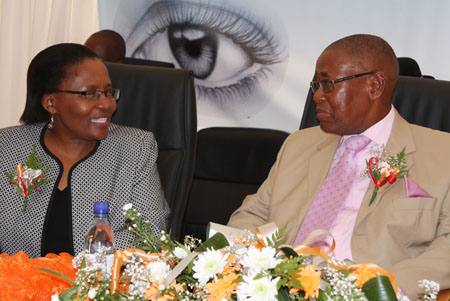
The Ministry of Health has a cataract backlog of about 6 000 patients, says the Assistant Minister of Health, Dr Gloria Somolekae.
Dr Somolekae said 50 per cent of blindness and poor sight was due to cataract, whose surgery took less than 20 minutes to perform. “If people with cataract were to receive cataract surgery on time, blindness and severe visual impairment from such condition could be reduced.
Speaking at the commemoration of the world sight day in Serowe on October 10, Dr Somolekae said blindness had profound human and socio economic consequences in developing countries such as Botswana. To address the backlog, Dr Somolekae said operations were ongoing in three hospitals, Sekgoma, Scottish Livingstone and Deborah Retief.
She said major cataract operation campaigns were conducted during world sight day commemoration and external assistant was also provided by international partners for cataract surgeries through campaigns.
She noted that diabetic retinopathy was the second leading cause of blindness accounting to 20 per cent. The assistant minister encouraged all patients with diabetes to go for eye testing twice a year or annually.
For his part, the former vice president Lt Gen. Mompati Merafhe said studies had shown that cataract, refractive errors, glaucoma and diabetic retinopathy were the main causes of a high prevalence of blindness in adults and children in Botswana.
Lt Gen. Merafhe said 80 per cent of visual loss was due to preventable or treatable causes hence the need to eliminate such blindness. He said it was imperative for all member nations to institute cost effective interventions to reduce the burden and mitigate the socio economic impact of visual impairment and blindness.
Lt Gen Merafhe said this year’s theme “universal eye” and “call to action” is “get your eyes tested” calls for action by the government to mobilise political will and resources to create a successful and sustainable eye care system to eliminate preventable and treatable blindness by the year 2020.
The attainment of this, he said, calls for cross- sector collaboration of the public, private sector, government, eye professionals and philanthropic interest to equitably help people to have good sight all over the world.
“Our target should be to reduce by 25 percent the baseline prevalence of blindness by 2019 and to significantly reduce the need for referrals abroad for eye care,” he said. Lt Gen Merafhe said Botswana has to rise to the challenge of contributing to the attainment of this goal because blindness and visual impairment have far reaching social, economic and developmental implications for individuals, family and the wider community.
Loss of productivity or lack of the opportunity to attend school due to the visual impairment has implications for national development, he added. He noted Botswana embraced the vision 2020 “the right to sight” that aims to eliminate blindness due to preventable and treatable cause by the year 2020 by drawing national strategic plan to combat unnecessary blindness.
The strategy, he said, focuses on development and provision of human resources for eye care ,development of appropriate infrastructure and equipment for eye health services.
It also targets control of the major causes of blindness, which are cataract, glaucoma, refractive errors and diabetic retinopathy. The establishment of eye care services at primary, secondary and tertiary levels of health care systems is covered by the strategy.
Government, he said, has trained personnel while the recruitment of ophthalmologists is in the pipe line and necessary equipment to address blindness had been purchased.
He said moving towards providing universal eye health, government needed to adopt recommendations of the 66th world health assembly for prevention of avoidable blindness through the global plan for 1014-2019.
The global plan for 1014-2019, he said, is based on the principles of universal access and equity, human right, evidence-based practice a life course approach and empowerment of people with visual impairment.
The former vice president said WHO estimated in 2010 that there were 285 million people with visual impairment globally, of whom 39 million were blind and 82 percent of the blind were aged 50 years and above.
Lt Gen Merafhe said the number of visual impaired people was likely to increase to 76 million by 2020 due to ageing of the world population and increased life expectancy, hence the need to provide effective interventions.
Furthermore, he said, uncorrected refractive errors at 42 per cent and cataract at 33 per cent are the main causes of visual impairment in the world. Ends
Source : BOPA
Author : Aobakwe Molefhi
Location : SEROWE
Event : World Sight Day commemoration
Date : 14 Oct 2013
Related News

09 Jun 2026
09 Jun 2026
Government to review civil litigation practices

09 Jun 2026
Hirschfeld laid to rest
09 Jun 2026
Harvard Health Partnership role significant
09 Jun 2026
SARS cautions foreign motorists against scammers
09 Jun 2026