Elephants compromise food economic security
04 Mar 2019
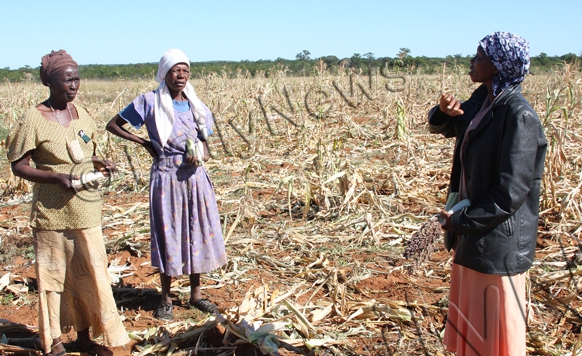
As government is still considering recommendations from the report of a cabinet sub committee on the hunting ban social dialogue, residents of Khumaga are reeling in disbelief as elephants continue to destroy their fields and other properties.
Residents live in uncertainty as food and economic security in the village is compromised due to elephants which raid their fields. People in the area are dependent on farming and fishing.
Located alongside Boteti River and Makgakgadi National Park, 230 kilometres from Letlhakane, the sub district’s headquarters, the village has not that much of economic activities.
Villagers are reluctant to engage in activities to generate income, be it fishing, harvesting of tswii, ploughing, cattle rearing and camp sites. Government in consultation with the affected communities decided to install an electrified game proof fence, but that met resistance from some of the residents. Kgosi Keeditse Orapeleng of Khumaga reiterated that the community was dependent on farming, but that it was near impossible to make a meaningful leaving from it due to elephants.
Kgosi Orapeleng said elephants also destroyed their borehole and water pipes, saying their wish was to live harmoniously with elephants, but that it has proved impossible as they attacked them.
Fencing the river on the side of the village, he said, was a good idea as it could reduce human/wildlife conflict. One of the residents, Mr Bapaletswe Motlamma said elephants had put economic activities in the village in jeopardy thus threatening the lives of the people of Khumaga. Farmers were no longer kraaling as they were compelled to rush to their homes before sunset in fear of elephants. Mr Motlamma indicated that elephants had destroyed their fields and farm fences, adding that it took longer to claim compensation for the damages.
Commenting on the installation of the electric game proof fence alongside the river on the side of the village, he said peoples’ lives were dependent on the river, saying people plough and graze their livestock along the river. He noted that the location of the village was influenced by the river.
Another resident, Mr Budzani Baetsi, who is the chairperson of Ngande Trust owned by residents, said elephants had caused deforestation in the area, and had done a lot of damage in the river as well as on the fields.
Mr Baetsi noted that elephants consumed a lot of water as they drank around 300 litres per day, and also destroyed the river by mud-bathing. He said Gwaraga Game Park, which is owned by the Ngande Trust, had also been destroyed by elephants, damaging natural resources as well as causing deforestation.
The elephants, he said, had also destroyed boreholes and water storage tanks. With regard to the game proof fence installation along the river on the side of the village, Mr Baetsi said it had advantages and disadvantages.
Mr Baetsi said the community was not against fence erection, but were not at ease with the boundary, noting however, that the proposed boundary could be instrumental in promoting tourism.
The fence, he said, would reduce movement of people hence enhancing game drives.
He also said the river could be used for recreational purposes, supporting livestock, harvesting of tswii and fish and sustainable sand mining for building.
Another resident whose wife was recently attacked by an elephant, Mr Oeditsemang Motsamai said he was shocked at the speed the elephant was running when it attacked her wife. She suffered a broken arm, fractured leg from the knee downward and injured her head. The incident occurred in February this year. Ms Motsamai, who is currently recuperating at Mahalapye hospital, was initially taken to Rakops hospital and later referred to Nyangabwe hospital.
According to Mr Motsamai, the only strategy that could be used to address the current situation with elephants was to cull them, saying scarring them with chillies proved ineffective as only electricity could prevent them from entering their fields.
Installing electricity on the fence, he said, was expensive and could not be afforded by everyone. Even with electricity he said it was still ineffective because an elephant could put a tree on the fence to cut the flow of current. He had a chillies garden in his backyard which he established with assistance of Elephant Africa Association.
In a desperate plea, one old man in Makalamabedi requested to be taught how he could communicate with elephants so that he could reach an agreement with them on how to live amicably together.
In previous gatherings in Boteti villages it emerged that government had a backlog of compensations for damages done by wildlife with others dating from 2005, 2006, whilst others had cases from 2015 and 2016.
The regional wildlife officer, Mr Dikamatso Ntshebe said government had compensation backlog dating from 2017, and that those who had outstanding compensation for years beyond 2017 would be assisted accordingly.
When receiving the report President Dr Mokgweetsi Masisi stated that it would be taken to cabinet for consideration and thereafter be shared with the public. “If need be we will give Parliament an opportunity to also interrogate before we make a final decision,” he said then.
The moratorium on hunting ban was introduced in 2014 and it was not meant to be a permanent decision, and it was against this background that government decided to consult stakeholders on the hunting ban in view of the human/wildlife conflict. ends
Source : BOPA
Author : Thandy Tebogo
Location : LETLHAKANE
Event : Interview
Date : 04 Mar 2019
Related News

15 Aug 2026
15 Aug 2026