Govt invest on educating citizens
28 Feb 2019
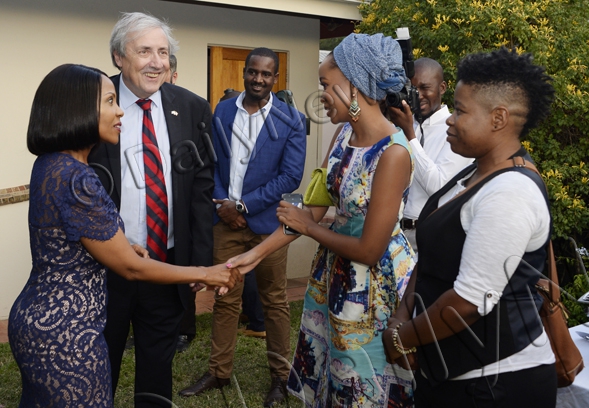
Education remains the cornerstone upon which all human development rests, First Lady Neo Masisi has said.
Speaking at International Women’s Day commemoration in Gaborone on February 26, she said it was in this regard that government had since independence invested heavily in educating its citizens, the efforts which resulted in the country attaining gender parity in basic education in 2010, five years before deadline of the Millennium Development Goals of 2015.
She said Botswana had also identified the gap regarding participation of girls in the Science, Technology, Engineering and Mathematics (STEM).
“I have been informed that the Botswana International University for Technology (BIUST) has initiated the promotion of STEM throughout the country. Efforts include capacity building and mentorship of girls to enrol in STEM,” she said.
Ms Masisi said it was envisaged that the interventions should result in increased participation of girls in STEM, hence the importance of BIUST in supporting their efforts.
Furthermore, she said the other critical area where Botswana had made progress was women’s health adding that as a country which was highly affected by HIV/AIDS, government committed substantial resources to address the scourge.
“Government embraced the 90:90:90 target against which Botswana is at 83.3 per cent; 87.4 per cent and 96.5 per cent.
Also to step up efforts in managing HIV, government adopted the Treat All Strategy which was launched in June 2016,” she said
The strategy, she said, promoted Universal Health Coverage and ensured that all who tested positive got treatment irrespective of their viral load or CD4 count.
The initiative was anticipated to save more than 118 000 people from being infected by HIV, and prevent more than 54 000 HIV deaths by 2030.
The statistics, she said, indicated the strides Botswana had made in HIV testing and HIV treatment and monitoring which could be attributed to High HIV testing coverage; free HIV testing; point of care diagnostic HIV testing; Community based HIV testing; as well as provision of Free Anti- Retroviral Therapy (ART).
In other issues, she said, despite the achievements that Botswana made in improving access to services towards attaining gender equity, there were challenges that continue to haunt the nation such as Gender Based Violence (GBV).
“I am however comforted that government has prioritized its prevention and elimination.
The government in 2014 developed the 6 year National Strategy on Ending GBV by 2020, which adopts an integrated approach to addressing GBV,” she said.
Key stakeholders such as the police, education sector, dikgosi, Faith Based Organisations and other Community Leaders, the Magistrates and Social Workers have been identified as part of the strategy.
Ms Masisi said the government continued to make commitments to ending GBV even at the highest political level including, President, Dr Mokgweetsi Masisi.
For his part Ambassador of France to Botswana Mr Pierre Voillery said 70 years ago, the United Declaration of Human Rights was written and signed.
He said it defined Human rights as the inalienable rights of all human rights beings irrespective of nationality, place of residence, gender, ethnic or national origin, colour origin, language or any other status and cover a multitude of themes. He said the rights formed part of the founding values of the French Republic as proclaimed in the preamble to the French Constitution.
Respect for human rights, he said was central to the exercise of democracy in his country and to their commitment as a member of the European Union and an international organization.
“France is strongly committed to certain causes in particular, and amongst them is the respect on women’s right,” he said. ends
Source : BOPA
Author : Anastacia Sibanda
Location : GABORONE
Event : commemoration
Date : 28 Feb 2019
Related News

15 Aug 2026
15 Aug 2026