


Stakeholders unite to fight malaria
10 Oct 2018
Humana People to People Botswana (HPP) has engaged communities in 12 villages in six districts to eliminate malaria. This will be done through the implementation of projects which empower people with tools, knowledge and skills to foster own developments in their households and the nation.
Humana People to People Botswana senior programmes manager, Ms Segametsi Mashumba said their national malaria programme was aimed at achieving zero local malaria transmissions by 2018.
She said despite the goal, malaria remained a major public health problem in certain regions, adding that in the northern part of Botswana it was endemic, regular and had high transmission rates while in the central parts it was an intermediate transmission. She said within the northern and central regions there was a significant difference in the levels of transmission in different localities. She highlighted that in years of heavy rainfall, there was a risk that the transmission areas would continue to move southwards to traditionally non-malaria areas.
“Malaria is still an important cause of death and illness amongst adults and children in Botswana, therefore, HPP would run a project across key malaria regions within the country to educate and empower communities to fight malaria and reduce its impact on our society,” she said.
Ms Mashumba noted that HPP was selected to partner with UNAIDS and NACA in south east to assist communities to become the agents of change in an approach called Communities Acting Together to Control HIV (CATCH).
However, leveraging their proven bottom-up approach that was successfully deployed for HPP’s CATCH Project, the Communities Acting Together To Eliminate Malaria (CATTEM) Project will follow a similar methodology to ensure the right outcomes.
“We see ourselves as a movement of people with a common aim of bringing about development for vulnerable and marginalised communities, also called the Humana People to People Movement,” she stated. She said the objective of the project was to drive community competence in assessing their own situation and drive locally owned solutions.
“The CATCH strategy has empowered communities to identify their concerns and determine their own destiny, the process helps communities to accept, appreciated and own the challenges they have and commit to ways of addressing them,” she said. She noted that the proactive engagement by communities with their health facilities helped in creating demand for health services and contributed to improving collaboration and understanding between groups.
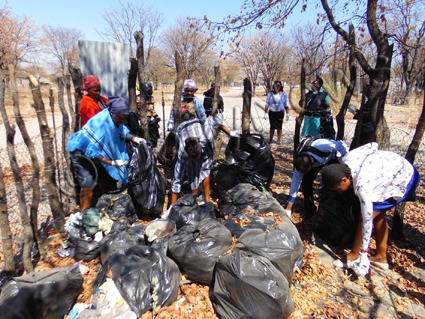
Nata Village Development committee chairperson, Mr Kago Seisa said due to floods around Nata-Gweta many places had become the host for mosquitoes, but that people were doing their best to clear them as they had knowledge on how to prevent and control malaria.
He said the most common practice that attracted mosquito was water which was often poured in pit latrines and behind houses. He applauded B&K Hardware for supporting them with diamond mash wire and standard steels to construct litter cages.
Giving welcome remarks earlier, Kgosi Rebagamang Rancholo of Nata applauded residents for availing themselves to be equipped with malaria education even though they visited hospitals regularly. He said people could eliminate malaria when looking after the environment they were living in.
He further said through workshops which were aimed at educating the community about malaria people now had knowledge of how to prevent and control malaria. He applauded HHP for their project as he explained that living in a clean environment helped to improve one’s health. ENDS
Source : BOPA
Author : Joseph Tlholego
Location : Nata
Event : Interview
Date : 10 Oct 2018
Related News

18 Aug 2026
Men lead conversation on GBV root cause

18 Aug 2026
Botswana and US conclude Southern Accord 2026
18 Aug 2026