


Kaudwane co-op keeping afloat where many sank
27 Sep 2018
Sitting just 3km from the mouth of the lion infested Khutse Game Reserve, there is not much of a life in Kaudwane, a sparsely populated village.
Apart from government initiatives such as Ipelegeng, employment opportunities are hard to come by and residents loiter aimlessly around with curious eyes following any and every vehicle that passes by.
The small population and the fact that the majority of the population is unemployed renders business opportunities few, but like a mole out of a beautiful woman’s smooth face, the Kaudwane Cooperative Society has found a niche by operating a shop where business opportunities seemed close to impossible.
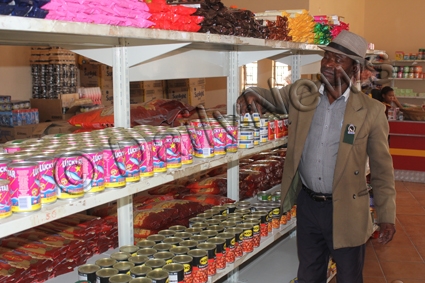
Established through government assistance after residents were relocated from the Central Kalahari Game Reserve (CKGR), the co - op, as the shop is known in short, has flourished in contrast to many a cooperative around the country that have collapsed due to many factors such as mismanagement. It is so well stocked that it can give supermarkets in big villages a run for their money. The shop also has a symbiotic relationship with residents; it survives on them and they survive on it.
Under the stewardship of its youthful chairperson, the co-op has bigger plans for the future. “At the moment we only have the shop under our name, but in future we plan to diversify and include components such as poultry, cattle marketing and sales agency and others. It’s dangerous to put one’s eggs in one basket, isn’t it?” It is rather a statement than a question from 29-year-old Gabaakelwe Kelatlhemang, the cooperative’s newly elected chairperson.
“Our objective is that in a few years residents of this village, especially the cooperative membership, live such decent lives that those outsiders will want to join,” she said.
Ms Kelatlhemang is confident of the direction their enterprise is taking that she does not even envisage it collapsing as many establishments like it have. She said that their sole advantage was the fact that the village was small and they were the only shop of its size in the village.
“The only competition we have in the village are small kiosks, and obviously they do not have the quality and variety that we stock. Our employees are also residents of the village, so it is easier to reprimand them if they go offline,” she said. She said from its establishment the cooperative was helped to get well rooted by the Kweneng District Council which gave them funds for their initial stock as well as assisting with tenders, especially for supplying food hampers to the destitute and the needy under various government initiatives.
Apart from that, she said the council also provided them with a free vehicle to procure stock whenever they needed to. She said, however, that at the moment the council has pulled back as it believed that the cooperative was now established and mature enough to run on its own affairs.
Ms Kelatlhemang said that the 80 member cooperative made enough profit to sustain its membership. Quizzed on how much profit they make in a month, she flatly refused with the figures citing security reasons.
“The last time we did an interview here with the Batho Pele crew and disclosed our profits, the next day we were attacked. So for safety reasons, I cannot disclose that, just know that we make enough profit,” she said with a stern face. Attacked four times last year, the coop lost big with the robbers getting away with more than P12 000 cash and much more in stock in one of the incidents.
Away from robberies and the likes, Ms Kelatlhemang said that the joining fee, which is only open to residents of Kaudwane, is P170 once off, and that members enjoyed benefits such as assistance during funerals as well as annual returns at the end of each year.
In a small village like Kaudwane, where almost everybody knows each other, there is always a sense of empathy when a resident falls on hard times, hence the cooperative often lends a helping hand even to non-members.
“Sometimes we are forced to extend our assistance to even non-members because there are families that are so poor that when tragedies like funerals strike, they have nothing to bury their beloved ones with so out of compassion we sometimes help,” she said.
Doing business in a far flung area often raised the final price, and the cooperative could also not escape that basic business move of passing the final cost to customers, which makes the shop seem a bit expensive.
Ms Kelatlhemang said that they buy their stock from as far as Gaborone as the Molepolole Sefalana is not well stocked with the variety they need. She said the other challenge that the cooperative faces was that there was no educational requirement when electing a new committee, which made the grasp of modern day business dynamics a bit of a challenge.
“Our cooperative is also audited after a very long time, although it is supposed to be on an annual basis. The last audit was done way back in 2013 and the newly elected committee was handed without any audit. The reason is that the Department of Cooperatives has indicated that they have too much workload, and at the same time we cannot afford to engage a private auditor,” she said.
She said that for their daily survival, they often sought advice from authorities such as the Local Enterprises Authority and the Department of Cooperatives as well as the Letlhakeng Sub-district Council. One of the pioneers of the cooperative, Mr Gabolemelwe Ramaeba, who is also a former area councillor, recalled the initial days of the establishment.
“It all started when government came up with initiatives to uplift our lives after our relocation from the CKGR. Initially we registered a trust called Kuanghoo, which was to establish a campsite, but one day on our visit to New Xade, a settlement of a similar status to us, we noted that they have been assisted to establish a cooperative and we liked the idea. So we proposed to government to establish the same for us to which she obliged,” he said.
He said in 2002, the pioneering committee which he was part of, was elected and taken on benchmarking trips to both Ghanzi and New Xade, but that things moved slowly with the initial funds of P60 000 being disbursed only in 2010 for the coop’s first stock.
“By then, the construction of the building from which the shop operated had already been completed two years earlier, and the cooperative never looked back up to today,” he said.
Mr Ramaeba said from its initial babysitting, the council later pulled back after it believed the cooperative was now established to run its own affairs, though it still offered advice.
As the month end approaches and the village prepares for independence festivities, a team from the local committee that organises the annual Kaudwane Independence Day horse race, files in to collect a stack of items they have bought, which includes loads of food items.
“This promises to be a ‘female’ month for us,” smiles the youthful Ms Kelatlhemang as the committee boosts their sales. “We are often busy at this time of the year, and at month end when pensioners get their monthly allowance we are also assured of big business,” she flashes a smile of a content business person.
Meanwhile, regular customers file in one by one to buy their daily needs, thus keeping the cooperative from the small village afloat in the sea that swallowed many a cooperative across the country. ENDS
Source : BOPA
Author : Olekantse Sennamose
Location : Kaudwane
Event : Interview
Date : 27 Sep 2018
Related News

18 Aug 2026
Men lead conversation on GBV root cause

18 Aug 2026
Botswana and US conclude Southern Accord 2026
18 Aug 2026