


PAC members question El-Halabi on savingram
13 Jun 2017
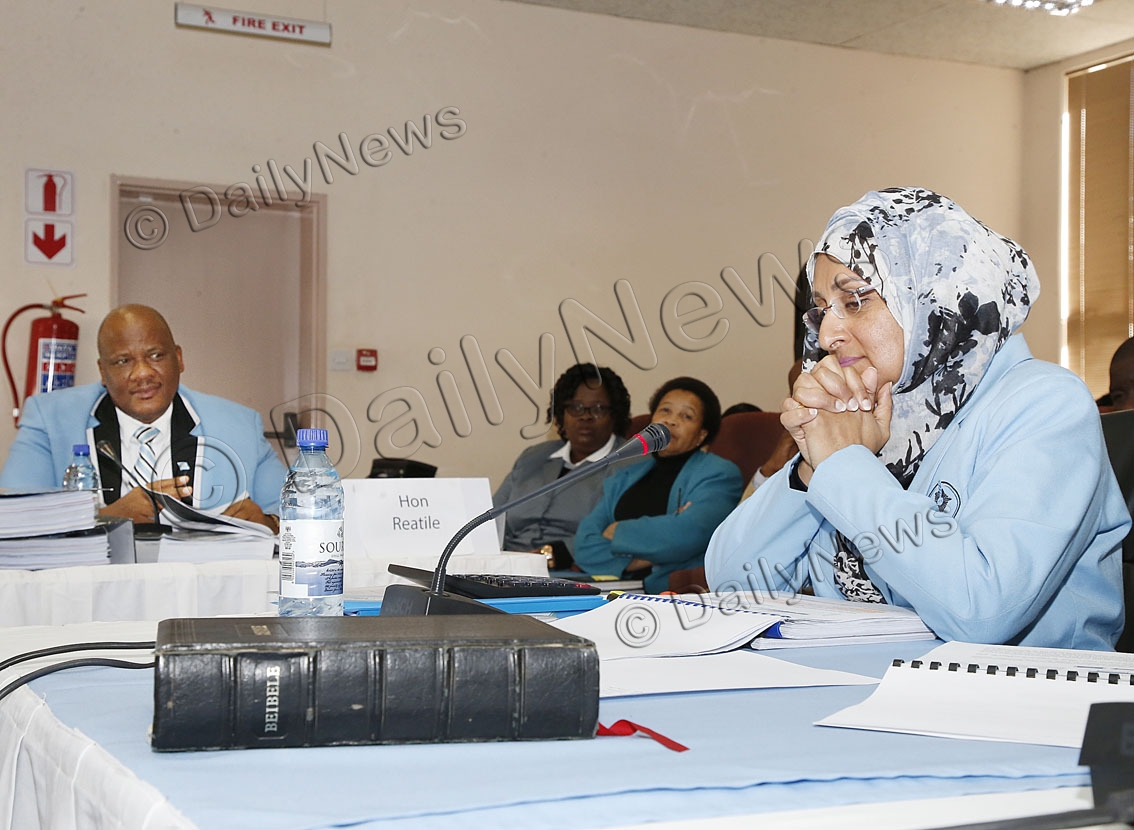
Ministry of Health and Wellness has withdrawn a savingram that stated that patients who presented self-inflicted health conditions because of alcohol and substance abuse should not be treated.
Permanent secretary in the ministry, Ms Shanaaz El-Halabi disclosed this when she appeared before the Public Accounts Committee (PAC).
Specially elected Member of Parliament, Ms Bogolo Kenewendo had asked what the motivating factors behind the savingram were and what assessments were done to ascertain percentages of patients who visited health facilities with self-inflicted illnesses.
Ms El-Halabi said the move was made on account of health costs prioritisation.
“We prioritise health conditions to manage costs. This was a cost containment measure, but the savingram has been withdrawn following feedback that was received,” she said.
Another PAC member, Mr Dithapelo Keorapetse wanted to know if any legal advise was sought given the implications that patients would have had to pay for their treatment which was contrary to the terms of the constitution, the World Health Organisation and the Public Health Act.
He added that the move was unacceptable because the accounting officer did not have the legal right.
“You do not have the powers to do so according to the Public Health Act. It’s a violation of patient’s rights,” emphasised Mr Keorapetse.
“But we are talking about a savingram that has been withdrawn,” Ms El-Halabi said, adding that the Ministry of Health and Wellness was mandated to provide health services to every Motswana free of charge, and that the savingram was cancelled after negative feedback.
“Was this your initiative as the Ministry of Health and what was the position of Cabinet on the savingram?” specially elected MP and PAC member, Mr Mephato Reatile further asked.
Ms El-Halabi said it was a Cabinet directive, but that they had since withdrawn it.
On other issues, MP Keorapetse wanted to know the Botswana Health Professionals Council (BHPC) board members and who represented government at the board.
He further asked if it was true that the majority of board members were private doctors and that they controlled the board.
Furthermore, Mr Keorapetse wanted the accounting officer to clarify whether it was true that Batswana were sent to China to train as medical doctors and specialise in certain fields, but that when they returned BHPC refused to register them.
Ms El-Halabi said government was represented by the attorney general and that she was not in a position to answer for the BHPC.
She, however, said she was aware that the ministry sent students to study medicine in China, and that they were given medicine courses for developing countries.
“We have been trying as a ministry to understand why students were given courses for developing countries. I met the ambassador to China regarding the course accreditation,” she said, adding that the education system of China was different, and that they would do follow-ups to see what could be done to ensure quality education for medical students who were sent to China.
Furthermore, Mr Keorapetse wanted to know why doctors who were not qualified as specialists were paid at a scale of specialists, adding that some Batswana medical students from China with the same qualifications as a Chinese national were denied registration and consequently to practice.
In response, Ms El-Halabi said she was not aware of that happening and that she would follow it up.
MP Keorapetse also wanted to know why employees in the Ministry of Health and Wellnes at D1 and below who were on fully sponsored assignments were denied the 25 per cent per diem as per the Public Service General Orders Section 109.9, but that those at scales above were given the per diem.
The health ministry permanent secretary said she took the decision as a cost containment measure because they were faced with financial constraints.
However, Mr Keorapetse said the general orders must be followed to protect the integrity of the country.
On other issues, Mr Reatile wanted to know why to date condoms were not distributed in prisons yet there were health risks associated with prisons.
Ms El-Halabi said the Ministry of Health and Wellness has a report on HIV/AIDS and sexually transmitted infection cases in prisons, but that the distribution of condoms in prisons was beyond her jurisdiction.
“As a ministry we can only advice. We must come up with a robust combination prevention strategy. We need to identify all the drivers of the epidemic and identify mitigating factors,” she said.
On other issues, MP Kenewendo wanted to know if there were any systems in place at the Central Medical Stores to avoid multimillion Pula loses of drugs which expired in storage.
Ms El-Halabi said they have come up with initiatives to ensure that they managed drug expiries.
“We have a six months drug threshold, and we ensure that we have drugs that have a shelf life of over 80 per cent,” she revealed.
Interrogated on government expenditure on external health care, Ms El-Halabi said there were referrals to other countries because there was a shortage of expertise in areas such as oncology, orthopedics, cardiology and Intensive Care Unit.
However, she said the ministry was working to build in-country capacity. ENDS
Source : BOPA
Author : Calviniah Kgautlhe
Location : GABORONE
Event : PAC
Date : 13 Jun 2017
Related News

21 Aug 2026
20 Aug 2026
Botswana Donates FMD Vaccines To Lesotho
20 Aug 2026