

Outlook for price stability remains positive
01 Mar 2017
The meeting of the Monetary Policy Committee (MPC) held on February 28 has concluded that the outlook for price stability remains positive, with forecast inflation within the three to six per cent objective range in the medium-term.
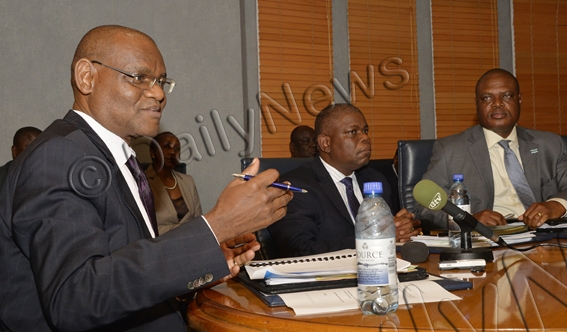
This was revealed during a press conference that was organised by Bank of Botswana (BoB) to unpack MPC’s decision regarding the 2017 Monetary Policy Statement (MPS) that was launched on February 27.
The MPS reviews the conduct of monetary policy in 2016 and assesses prospects for inflation and the monetary policy stance in 2017 in light of domestic and global economic developments.
In his remarks, BoB governor, Mr Moses Pelaelo said global output was projected to grow by 3.4 per cent in 2017, from an estimated 3.1 per cent in 2016, and 3.6 per cent in 2018.
This improvement in performance in 2017, he said was driven by an expected pick-up in growth in both advanced and emerging market economies.
“However, uncertainty surrounding the trade policy direction of the new United States of America administration, the process towards withdrawal of the United Kingdom from the European Union, moderation of growth in China and risks to stability of the Euro area could alter medium-term growth prospects,” he said.
Meanwhile, BoB governor said economic performance across the world remained uneven, with challenges relating to economic restructuring in both developed and emerging market economies.
In Botswana, in the 12 months to September 2016, Mr Pelaelo said real Gross Domestic Product (GDP) grew marginally by 0.9 per cent, compared to the contraction of 0.1 per cent in the corresponding period ending September 2015, which reflected growth in non-mining activity.
However, he said following a similar contraction of 11.8 per cent in 12 months to September 2015, mining output contracted by 11.9 per cent.
“In contrast, non-mining output grew by 3 per cent in the year to September 2016 compared to 2.1 per cent in the corresponding period ending in September 2015,” he added.
The governor said in the medium-term, projections indicated that domestic non-mining output would be below trend ‘influenced mainly by the restrained growth in personal incomes, lower rate of increase in government expenditure, sluggish recovery of the mining sector, as well as modest economic growth in major trading partners.’
In December 2016, Mr Pelaelo said inflation increased marginally from 3 to 3.1 per cent in January, and was forecasted to be within the 3 to 6 per cent objective range in the short to medium term.
“Subdued domestic demand pressures and modest increase in foreign prices contribute to the positive inflation outlook in the medium term,” he said.
However, he said the outlook was subject to downside risks emanating from sluggish global economic activity and the resultant low commodity prices.
“It could, however, be adversely affected by any unanticipated large increase in administered prices and government levies, as well as international oil and food prices beyond current forecasts,” added Mr Pelaelo.
Further, the current state of the economy and both the domestic and external economic outlook, including the inflation forecast, BoB governor suggested that the prevailing accommodative monetary policy stance remained consistent with maintaining inflation within the bank’s medium-term objective range of 3 to 6 per cent.
Due to this, he said the MPC decided to maintain the bank rate at 5.5 per cent, adding that monetary policy was also aligned with the need to safeguard financial stability. In this regard, he said credit growth was considered to be at a sustainable level- thus not posing a threat to financial stability.
Giving a summary of the MPS, BoB deputy director for Monetary Policy, Mr Moemedi Phetwe, said the main purpose of the statement was to promote an understanding of the conduct of monetary policy and its objectives.
“And to be accountable, we report on the policy formulation and implementation and assess the impact on key economic variables, that include; economic growth, inflation and some aspects of financial stability,” he said.
That, Mr Phetwe said was done for both 2016 and in the medium term, adding that the MPS also reviewed trends in inflation and also evaluated the determinants of changes in the level of prices and their impact on inflation in Botswana.
“In so doing, it also looks at the performance of inflation relative to the objective range. Therefore, it also assesses the current inflation compared to the forecasts,” he added.
The intension, when looking ahead, Mr Phetwe said was to understand the prospective influences on the medium-term inflation outcome and as a result articulate the expected policy response.
In Botswana, he said the primary objective of monetary policy was price stability, which is defined as a sustainable low level of inflation that is within the medium-term objective of 3 to 6 per cent.
The Monetary Policy Framework (MPF), he said was formulated with a view to safeguarding the stability of the financial system.
“A low and predictable level of inflation and a conducive financial environment fosters savings mobilisation, productive investment and the international competitiveness of domestic producers, which in turn contributes to the broader national objectives of sustainable economic development and employment creation,” he added.
The MPF, he said was forecast based on a medium-term perspective to policy formulation and implementation. ENDS
Source : BOPA
Author : Lorato Gaofise
Location : GABORONE
Event : Press Conference
Date : 01 Mar 2017
Related News


30 Jul 2026
BMC eyes new export deals

29 Jul 2026
Modisaotsile on rise to the top

29 Jul 2026
Poultry industry attains self-sufficiency
28 Jul 2026
Ross Breeders pioneers Botswana poultry exports

28 Jul 2026