Care and human rights - Two coins of the Boko coin
09 Jul 2026
Let us talk about the First Lady.
Not the one in the headlines. Not the one in the gowns and the motorcades. Let us talk about the office itself - this strange, unwritten thing that sits somewhere between the Constitution and the conscience of a nation.
Because here is the truth: Botswana has never really known what to do with the First Lady. We have never written her job description. We have never put her on the payroll. And yet, every republic finds it has one. And finds she matters.
Mma Ruth Khama gave the First Ladyship its first real meaning. She attached herself to the Red Cross, to child welfare, to ordinary suffering, and made the office human. Mma Olebile Masire built on it. Ga Mma Masire is not just a youth centre in Mmankgodi. It says the First Lady can leave behind social infrastructure that outlasts the administration. Then Mma Neo Masisi dragged gender-based violence, teenage pregnancy and HIV into the public square. Some people squirmed. Good.
Now we have Mma Kaone Boko. And already, the pattern is shifting- and widening.
She calls her programme Mpepu. And before the bureaucrats turn it into a PowerPoint, let us sit with that word.
Mpepu.
In Setswana, it is not just cloth. It is a way of being. The child on the back is not luggage. The child is carried into life. The mother walks, works, leads — and the child is there, held, present, protected. The child is inside life, even before they can walk.
Tell me that is not a national metaphor. It says the vulnerable are not an afterthought. It says a nation cannot speak of progress while its youngest citizens are outside the circle of care.
And Mma Boko is treating it that way. She has structured Mpepu around two pillars: Early Childhood Development -maternal and infant care, nutrition, learning disabilities, and Child Protection: positive parenting, masculinity and femininity, and child-friendly environments.
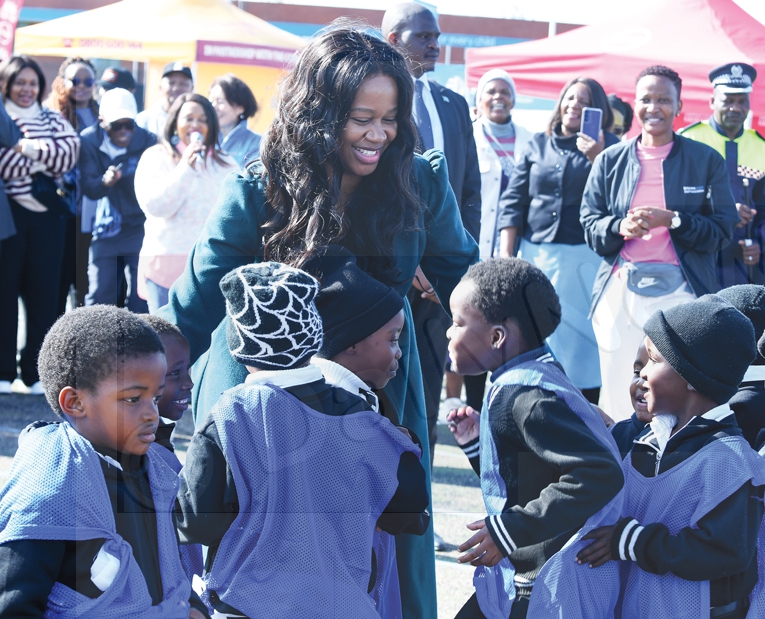
This is not feel-good work. This is architecture. But here is what separates her from the NGO crowd: she knows you cannot do this from Gaborone alone. In June, she took Mpepu to the Ntlo Ya Dikgosi. She stood before traditional leaders and said: this is your programme too. She asked for their wisdom, for their guidance, for what would work in their villages.
And the dikgosi told her something important. Talk to our wives, they said. Talk to the Bahumagadi. They know the children. They see the neglect, the hunger, the abuse. One kgosi suggested village committees of Bahumagadi to anchor the programme. Another asked for mental health to be woven in, because what is the point of feeding a child if the child is broken inside?
This is what happens when the First Lady stops performing and starts listening.
Through Mpepu, she has partnered with the Merck Foundation, bringing psychometric tools for children with disabilities, scholarships for healthcare professionals, and support for twenty underprivileged girls in school. She has spoken about child malnutrition, underage pregnancy, and the need for age-appropriate sexual education and a toll-free abuse helpline. She has handed out sanitary pads, yes, but she has also spoken about what it means when a girl who cannot afford a pad cannot stay in school, and what that says about us.
But the most revealing thing she has done is the National Healing, Remembrance and Closure Programme.
Launched this month, it honours the 54 Batswana who died in the Matsha truck accident of 2015 and the Mmamatlakala bus tragedy of 2024. This is not a feeding programme. It is not a scholarship. It is the state, through the First Lady’s office, returning to families still carrying grief. Refurbishment of the Home Economics Laboratory at Matsha.
Housing improvements for vulnerable families. Upgrading the Dutlwe Memorial Monument into a permanent site of memory and road safety awareness. Psychosocial support. Household engagements with bereaved families. Road safety reforms to protect minors.
This is not charity. This is the republic saying: we remember. Your loss is our loss. Your pain is not forgotten. That is moral architecture — what happens when the First Lady understands her office is not about cutting ribbons, but carrying the nation’s grief when government has moved on.
And here is something worth noticing.
Her husband, President Duma Boko, built his political life around human rights. A constitutional lawyer who ran a public interest firm, who fought for the indigenous groups, who helped draft the Children’s Act of 2009. His philosophy is cerebral: rights, statutes, the machinery of justice.
Mma Boko’s work is the communal extension of that same philosophy. Where he works through courts and constitutions, she works through communities, families, the social fabric that holds people together when the law is not enough. The child on the back. The village gathering. The bereaved family. The Bahumagadi committee. The memorial monument.
These are not contradictions. They are complements. The rights of the citizen and the care of the community, two sides of the same Boko coin.
Sceptics will say: the First Lady has no constitutional power. She cannot pass laws, command ministries, or appropriate funds.
True. And that is precisely the point.
The power of the First Lady is soft power, influence not by command, but by attraction, persuasion, example and moral legitimacy. It is the power to convene where institutions work in silos. To bring dikgosi, Bahumagadi, teachers, churches, civil society, the private sector, development partners and ordinary communities around a table and say: this matters.
Eleanor Roosevelt used it for human rights. Michelle Obama for health and education. Queen Rania for dialogue. They did not command. They attracted. They persuaded. They led by example.
Botswana needs this now more than ever.
We are a small country whose influence has never come from military might or economic scale. It has come from governance, peace, constitutionalism, and the moral story we tell about ourselves. That is our soft power. And it is wearing thin.
The First Lady can help renew it. At home, she can keep children, families, bereaved communities and the vulnerable at the centre of national development. Abroad, she can project Botswana as a caring, humane republic. She can shine light on what policy documents bury: malnutrition, child neglect, gender-based violence, the boy-child nobody watches, the bereaved family, the grief that outlasts the headlines.
But this influence must be protected. The moment the First Lady’s office becomes a parallel ministry, it loses its power. The moment it becomes a procurement office, it loses its trust. Its strength lies in advocacy, convening and moral persuasion. It works best when it supports institutions rather than competing with them. When it helps the country feel, not merely administer.
From Mma Ruth Khama’s humanitarianism, through Mma Masire’s institutions, through Mma Masisi’s advocacy, Mma Kaone Boko now has the opportunity to place the child, the family, remembrance, healing and community protection at the centre of Botswana’s next social conversation. And she is doing it with her husband’s human rights philosophy in one hand, and Setswana wisdom about carrying the vulnerable in the other.
This is not small work.
A country is not built only through roads, budgets, laws and industries. It is built through care. Through the way it treats the child in the village, the girl in danger, the boy without guidance, the mother without support, the bereaved family, the community under strain. The First Lady cannot solve all of this. Nobody expects her to.
But she can help the nation see it.
And sometimes, in public life, making a nation see clearly is where transformation begins. ENDS
Source : BOPA
Author : Tshireletso Motlogelwa
Location : GABORONE
Event : Analysis
Date : 09 Jul 2026
Related News