


Nama community seeks recognition
09 Jul 2026
Across the Kalahari, indigenous communities share one demand: recognition as the gateway to development. And Lokgwabe is not immune. Recently residents of Lokgwabe in Kgalagadi North told the Inter-Ministerial delegation assigned by the Office of the President to consult Basarwa communities that their political voice, language and land were key to survival
For the Nama people of Lokgwabe, that demand carries the weight of more than a century of displacement, war and marginalisation.
As the largest Khoekhoe group in Southern Africa, the Nama, also known as Namaqua or Khoe speak a click language and maintain an oral tradition rooted in pastoralism. In Botswana they are classified as Remote Area Dwellers. Nationally they number about 4 000, with roughly 1500 living mainly in Kgalagadi and Ngwaketse districts.
Though not many, the Nama are a distinct community with a history, culture, and identity that continue to shape the region. According to the information derived from the archives found in the village museum, Lokgwabe was born as a result of war. After the Battle of Swartfontein in 1905 during the Nama-German War, the Kharakhoen/Fransman Nama clan fled Namibia under pressure from colonial forces.
High-level negotiations between London, Berlin, and the Nama leadership led to the founding of Lokgwabe in 1909 by resistance leader Captain Simon Kooper.
Today the village has about 1417 residents and remains a living symbol of both colonial-era suffering and resilience.
Central to the community’s grievances is lack of political representation.
Nama leaders told the delegation that no Nama currently hold elected or appointed positions at any level of government.
Some called for the appointment of their own Kgosi. Others proposed that the deputy chief seat be reserved for a Nama, given that Lokgwabe is shared with the Bakgalagadi.
“Inclusivity could go a long way in addressing most of our challenges. Our concerns would be articulated directly by one of our own,” said one
Former Councillor Paul Cooper argued the same principle should apply to specially elected councillors.
“While merit should apply, consideration should be made to cater for marginalised groups. Right now we are overpowered by the majority group, the Bakgalagadi, who win during elections and also get specially elected positions,” Mr Cooper said.
“Representation is not about numbers alone, but about ensuring that policies and programmes reflect the realities of a community that has often been overlooked.”
Secondly, the Nama community complain of language, culture and economic needs. Geogenah Baka called for the Nama language to be taught in schools. While a policy including Indigenous Knowledge exists, she said it is not being practised.
“For a community whose identity is tied to oral tradition and click-language, the loss of mother tongue would mean the loss of heritage,” Ms Baka said.
She described Namas as naturally reserved, which she said has contributed to slow progress in empowerment, with only a few achieving success.
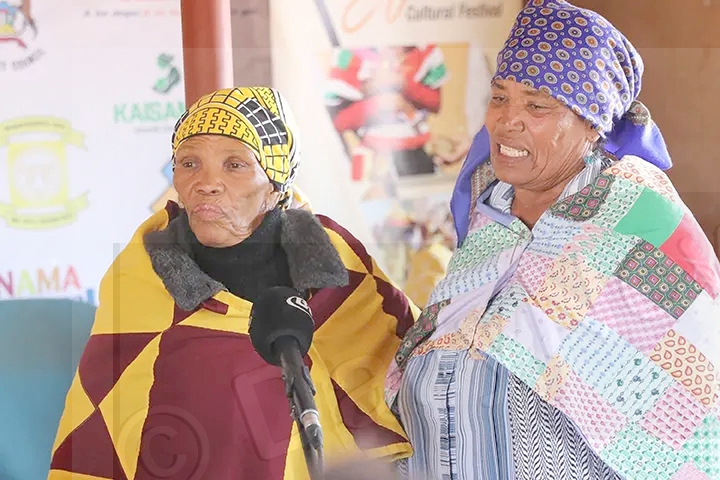
Ms Baka also requested that the community’s patchwork attire be patented and protected. The garments, she explained, originated during the German genocide when clothes were torn as people fled, leading to patchwork designs that became a symbol of survival.
The community further raised concerns over the judging of Namastap competitions. As originators of the dance, they said it was losing substance because adjudicators lacked the skill to identify authentic performances. They also appealed for government support to revive the Nama Cultural Festival, which was cancelled last year due to lack of funds.
On economic issues, residents said access to land for livestock was urgent.
“We are impoverished,” residents told the delegation. “Farms would provide income, food security, and a pathway out of poverty for families that have historically depended on pastoralism.”
A decades-old grievance was also raised. Hendrick Mogagomi said a clinic donation offered by Germany in 1973 as compensation for the genocide was built in Hukuntsi instead of Lokgwabe.
The council says there is no evidence to support the claim.
“For a community that traces its origins to war, flight and resettlement, the clinic would represent more than healthcare infrastructure, but an acknowledgment and justice,” Mogagomi said.
Kgalagadi North District Council Chairperson Taolo Lucas acknowledged the distinction.
“I have recognised that the Namas are spectacularly different from the Basarwa. Their reasons for wanting their own Kgosi are understandable, said Mr Lucas.
Council leadership is beginning to appreciate the unique identity and needs of the Nama community, separate from other Remote Area Dweller groups.”
From political representation to language, land and cultural festivals, the message from Lokgwabe was consistent.
With recognition, they believe, they will have schools that teach their mother tongue, farms that sustain livestock, a clinic in their ward, leadership that reflects their identity, and cultural programmes that preserve their heritage.
For the Nama of Lokgwabe, development cannot begin until they are first seen, heard, and counted as equal citizens of Botswana. ENDS
Source : BOPA
Author : Thuso Kgakatsi
Location : Hukuntsi
Event : interview
Date : 09 Jul 2026
Related News

07 Oct 2026