


Government and UN partner in tackling GBV
15 Jun 2026
|
|
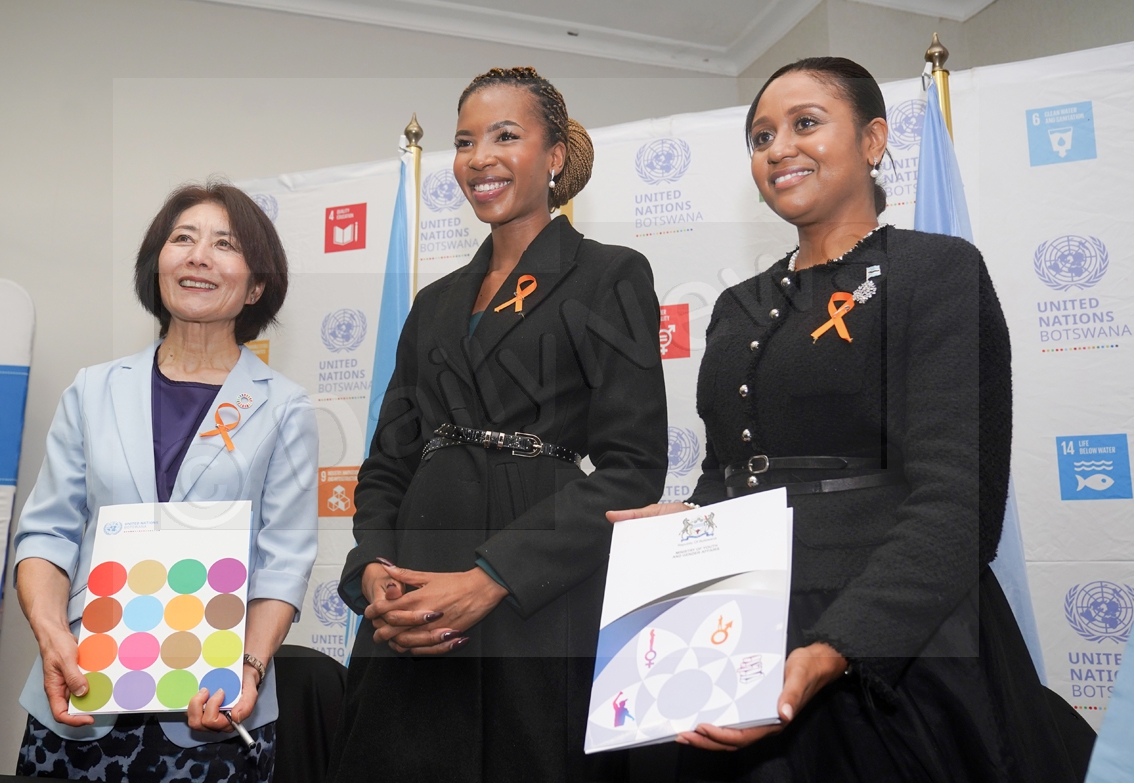
With the stroke of a pen, a commitment was made to tackle one of the world’s most prevalent forms of abuse as the Ministry of Youth and Gender
Affairs launched a Joint gender-based violence (GBV) Prevention and Response Programme with the United Nations, through its reproductive health agency, UNFPA.
The blueprint stems from a five-year spotlight sub-regional partnership initiative held in South Africa in 2023 with an aspiration to reduce gender disparity, empower women and girls to access human rights and benefit from inclusive development by combating GBV.
The proposed joint programme aims to leverage high-level, multi-sectoral technical expertise across diverse partners including the private sector, the diplomatic community, academia, the media, faith-based organizations and NGOs with a goal to ensure collective, harmonised action against GBV aligned with global and national development priorities.
Launching the programme in Gaborone recently, the Minister of Youth and Gender Affairs,
Ms Lesego Chombo, highlighted that while there was still a lot of ground to be covered, the government’s dedication was seen through several significant legislative, judicial and
community strides in changing the gender landscape for the equality and empowerment of women and girl children collectively.
“Legislative reforms such as the Domestic Violence Act, specialised GBV courts, men and boys initiatives, as well as one-stop service centres, are just a few of the practical reforms targeted at combating GBV,” she said.
Authorities revealed a gruelling picture for Botswana, as GBV prevalence had reached epidemic levels, with 67 per cent of local women aged 15 years and above having experienced physical or intimate abuse in their lifetime, compared to the global average of 33 per cent.
“Botswana’s numbers are double that of the global average, and what is concerning is that less than three per cent of these cases actually get reported,” said Ms Natasha Rampa,
Permanent Secretary in the Ministry of Youth and Gender Affairs. She said the ministry had developed a robust Theory of Change to bridge the missing middle between everyday activities and long-term goals by breaking down the pathway into clear, structured components for effective, joint GBV prevention and response.
Ms Rampa further highlighted that since government had no reserve fund or specific budget for addressing the GBV scourge in Botswana, the desired outcome required concerted commitment and multi-stakeholder collaboration, bearing in mind its geo-political and economic context.
The United Nation’s position on Botswana calls for urgent reforms in tackling GBV, describing it as a national emergency demanding specific outcomes targeted at holding perpetrators accountable and ensuring victims' access to justice, as well as comprehensive, survivor-centred support services.
“In a pandemic, partnerships are the cornerstone of transformative change between diverse stakeholders to achieve any development goals. Botswana must align its GBV efforts
towards national strategies, requiring whole-of-society involvement for real, meaningful
impact,” advised Ms Wenyan Yang, United Nations Botswana Resident Coordinator.
The European Union has pledged to accelerate Botswana’s GBV Programme through its
system-level access to provide the critical leverage needed to amplify an advocacy message, which will ultimately translate awareness into actionable systemic change.
“We will use our existing platforms to position Botswana’s efforts in fighting GBV as a model
for reform and collaboration. This programme served as a foundational step in a long-term
strategy where GBV has no place in the future,” said the Ambassador of the EU to Botswana
and SADC, Her Excellency Ambassador Petra Pereyra. ENDS
Source : BOPA
Author : Mpho Mosojane
Location : Gaborone
Event : Launch of a Joint GBV Prevention and Response Programme
Date : 15 Jun 2026
Related News
08 Oct 2026


07 Oct 2026