


Panic grips Ranaka pastoralists
15 Jun 2026
Under the heavy morning heat at Ranaka kgotla, men sit in low chairs and their faces etched with worry that goes far deeper than money.
To an outsider, a cow is livestock and beef, a commodity and a number on a spreadsheet at the Botswana Meat Commission (BMC).
But to a local farmer, a cow is a living bank account, family legacy and a sacred thread connecting the living to their ancestors.
Now, an invisible enemy is creeping toward the village and farmers are terrified.
With Foot and Mouth Disease (FMD) recently detected just a stone’s throw away in Molapowabojang and Digawana, the air in Ranaka is thick with desperation.
It is a panic so raw that it has driven local cattlemen to demand a cure that veterinary rules forbid, immediate vaccination.
They know it contradicts established standards, but fear has a way of silencing bureaucracy.
For Mr Rebaone Ralotshephe, the threat is not a theoretical headline, but a ghost he has already chased.
Standing before his peers, Mr Ralotshephe’s voice carried the weight of a man who has looked absolute ruin in the eye.
He used to work in Boteti, a region that was declared a ‘red zone’ during a previous outbreak. He watched helplessly as the vibrant economic pulse of that community flatlined.
He saw proud men reduced to tears when they were barred from selling to the premium European Union (EU) export markets and their cattle transformed overnight from assets into liabilities.
“Our livelihoods and our economy remain deeply tied to cattle production,” Mr Ralotshephe pleaded, his hands gesturing to the red earth.
“I am a married man who has paid his bride price (bogadi) through live cattle.” In that single sentence, Mr Ralotshephe captured the heartbeat of the crisis.
To lose these herds is not just to face poverty, but to witness the unravelling of social fabric, tradition and dignity.
Driven by this fear, he argued passionately for immediate vaccination, proposing that each farmer be allocated drugs for self-administration and called for immediate training.
Reiterating this desperate proposal, Mr Emmanuel Gagoangwe stood up to echo his neighbour’s call, demanding a blanket vaccination campaign for all animals in the area to shield them from the approaching red zone.
As the meeting unfolded, it became clear that the virus is not the only predator stalking Ranaka’s hills, the community feels under siege from multiple fronts.
Badisa Kgomo Association chairperson, Mr Reuben Ditsile, spoke grimly of a darker reality, stressing that the effective control of FMD depends entirely on the commitment and cooperation of the farmers themselves.
Out in the bush, his association has discovered a trail of bones and scattered animal skins, the calling cards of stock thieves feeding a ruthless black market.
Mr Ditsile warned that while the country faces meat shortages due to FMD restrictions, certain butcheries remain fully stocked, failing to adhere to required slaughtering procedures and standards.
He suspected that owners were being supplied by thieves and illegal sellers and urged government to implement rigorous meat inspections in butcheries and vendor storages to verify safety, handling and traceability.
He even called on authorities to consider deploying drones for surveillance and monitoring to track down the threat.
Even daily economic activities have become terrifying. Sand trucks, rumbling through the village from designated FMD management zones, are now viewed not as signs of development, but as Trojan horses carrying the microscopic virus on their tires, posing high risk of spreading the disease.
Then there is the heart-breaking logistics of survival. One farmer, Mr Thapediso Ntwaetsile raised his hand to voice a dilemma that keeps him awake at night.
Mr Ntwaetsile requested rezoning of Zone 11, citing its unmanageable vastness and pressed for an update on the proposed containment zone fence stretching from the Ramotswa border through Mogobane to the Kanye junction.
He also raised a critical logistical riddle that cuts to the core of daily life, “How will our cattle get access to water after the establishment of the containment zone?
The grazing area will be on one side of the containment zone, whilst the drinking point is on the side of the village.”
To a farmer, the thought of their animals staring at a wire fence and dying of thirst while looking at their usual watering hole, is psychological torture.
Advocating for a heavy legal iron fist to protect their herds and halt the virus, former councillor, Mr Mothibedi Mothibedi requested government to introduce steep fines for those who fail to kraal their animals, stock thieves and illegal border entries.
In efforts to deter cattle from wandering into restricted zones, he also called for the installation of cattle grids and restriction of access points to a single controlled gate.
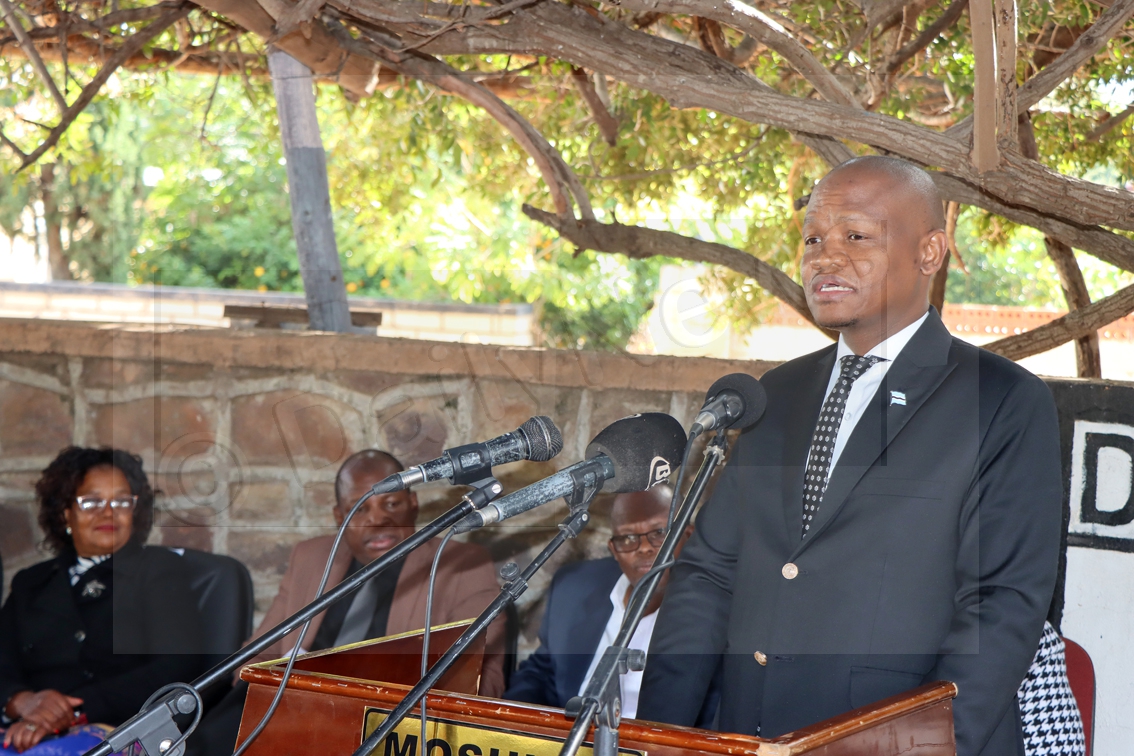
When the Minister of Lands and Agriculture, Dr Edwin Dikoloti, stood to respond, he faced a crowd of anxious eyes.
Dr Dikoloti had to deliver tough and counter-intuitive truth to men who just wanted to save their animals and advised them against demanding immediate FMD vaccination.
The minister explained the cruel paradox of global trade, indicating that vaccinated beef loses its premium quality on the global stage. Because Botswana relies heavily on the EU market, the idea is to avoid complicating the export standard of local beef.
He stated that 70 000 cattle have already been vaccinated since the launch of the targeted campaign, but for Ranaka, the strategy relies on containment.
The containment zone will start from the Ramotswa borderline, running through Mogobane up to the Kanye junction.
Highlighting the scale of the challenge, Minister Dikoloti indicated that Botswana shared a borderline of over 2 000km with South Africa and another 500km with Zimbabwe.
Construction of the containment fence, he said, could not be done by the state alone as it required a united front, spirit of volunteerism from farmers and active participation from community clans to build physical barriers.
All efforts, he emphasised, must be channelled toward the fence first and the rezoning of Zone 11 could only be looked into after the containment zone was complete.
To assist, the ministry has partnered with the Department of Prisons and the Botswana Defence Force (BDF) to assist with installation, but Dr Dikoloti reiterated that farmers must assume the responsibility to ensure that the fence was finished by the end of this month.
Strong farmer associations and volunteerism, he insisted, were the bedrock of successful disease management, urging local committees to maintain dilapidated veterinary cordon fences.
He reminded them that before the outbreak, cattle prices were rising and defeating FMD was critical to maintaining that upward path.
To ease the sting of the water crisis, veterinary services director, Dr Kobedi Segale, stepped forward with words of reassurance and promised that after completion of the containment zone fence, an alternative plan would be devised to supply water to the cattle on the grazing area side to ensure that animals could drink without violating the strict movement ban.
Adding weight to government’s stance, Southern Region FMD coordinator, Dr Odireleng Thololwane, emphasised that vaccination devalued the selling price of livestock.
He reiterated that it was far more crucial to focus on controlling the virus’s spread through discipline rather than needles.
To ensure security, Dr Thololwane stated that strict surveillance would be conducted in Ranaka and warned that all cattle must have ear tags and be fully registered on the Botswana Animal Identification and Traceability System (BAITS).
Meanwhile, at the end of the kgotla meeting, farmers left with a heavy mandate.
The panic had not evaporated, but it had been channelled into a quiet and vigilant resolve as the battle against FMD is not being fought in a laboratory, but in the dust and by proud men determined to protect the animals that carry their history, wealth and honour. ENDS
Source : BOPA
Author : Thandy Tebogo
Location : Kanye
Event : Interview
Date : 15 Jun 2026
Related News
08 Oct 2026

07 Oct 2026