



Mining wealth hinges on innovation
09 Mar 2026
Botswana remains attracting for investors in the mining sector, recently ranked first in Africa by the 2025 Global Mining Survey.
Presenting budget proposals for the Ministry of Mining and Energy for 2026/27 financial year amounting to P8.7 billion in Parliament recently, Minister of Minerals and Energy Ms Bogolo Kenewendo said the sector aimed to achieve the optimisation of mineral wealth through innovation in mineral extraction, beneficiation, value addition and global competitiveness.
Ms Kenewendo said the implementation of the Mineral Resources Development, Exploration, Exploitation and Value Chain strategy was the gateway to the ultimate goal of creating a diversified and innovative mining sector that emphasised extensive value addition and job creation.
She also said government recognised the important role of small scale mining in increasing mining output and revenue in the country, whilst creating opportunities for local participation.
“This drives mineral economy, diversification, growth, citizen empowerment as well as job creation,” she said.
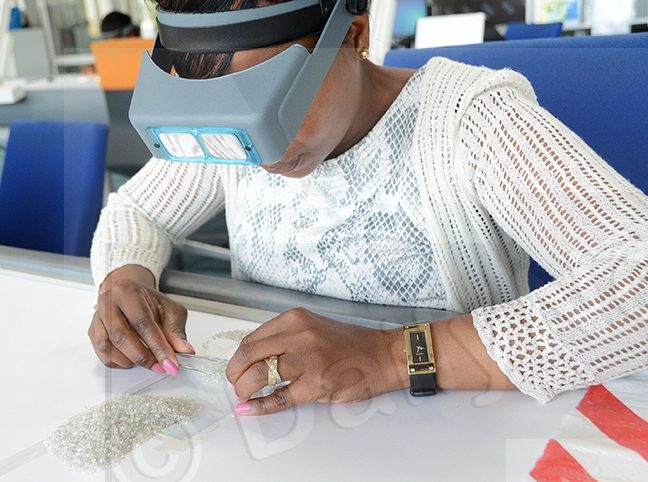
Meanwhile, the minister said the diamond industry, Botswana’s economic backbone, was currently undergoing a period of ‘significant transition’.
“Amidst declining consumer demand for natural diamonds, falling prices and reduced production, the business find itself at a crossroads,” she said.
Ms Kenewendo said 2025 was marked by significant shifts, primarily driven by the booming, price-falling lab-grown diamonds (LGD) sector, which was pressuring natural diamond prices and creating a wide gap there by forcing natural diamond players to focus on brand, value and transparency to counter LGD saturation and maintain emotional appeal.
Meanwhile, she said the local diamond manufacturing industry was supplied with diamonds worth US$571 million (over P7.75bn) in 2025 compared to US$580 million (over P7.87bn) in 2024.
She said the Okavango Diamond Company (ODC) sold US$457 million carats (P6.20bn) compared to US$425 million (over P5.76bn) in 2024. She further told Parliament that government had embarked on diversifying the mining sector, with focus on critical minerals which had been positioned as Botswana’s future.
“The development of critical energy minerals is aligned with national development priorities including economic resilience, industrialisation and environmental sustainability,” she said.
Talking about electricity, the minister said the country continued to rely on imports as demand continued to grow at an annual rate of five per cent, outgrowing supply. She said therefore, rotational loadshedding would continue to be implemented when necessary, to manage supply shortfalls and the high cost of imported electricity until all new generation projects came into service.
Ms Kenewendo said electricity generation was expected to improve towards the end of the current financial year following the completion of remediation works on one unit at Morupule B Power Station and the commercialisation of the 100MW Mmadinare Solar Plant as well as the operation of the 100MW Jwaneng Solar Plant.
She said the construction of 600MW plant at Mmamabula had started, with Phase one expected to deliver 300MW by first quarter of 2027 and full commissioning scheduled for May 2028. The minister said the national electricity across the country stood at 83 per cent. BOPA
Source : BOPA
Author : Tebagano Ntshole
Location : Gaborone
Event : Parliament
Date : 09 Mar 2026
Related News

25 Aug 2026
Forensic audit generates 90 priority actions
25 Aug 2026