


Mmolotsi calls for inter-party dialogue
17 Feb 2014
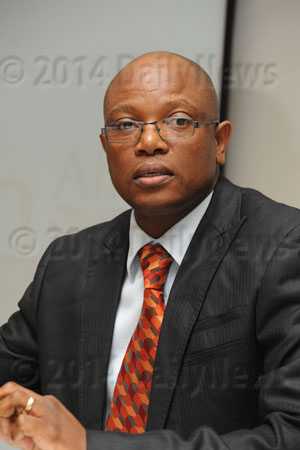
Francistown South MP, Mr Wynter Mmolotsi, on Friday, February 14 presented a motion in Parliament calling for government to facilitate an inter-party dialogue to discuss national issues.
Presenting his motion, MP Mmolotsi said inter-party dialogue offered a platform on which parties could talk freely with each other, overcome conflict, build a base for cooperation and work on political reform.
He said political party dialogue was often vital to sustainably address the underlying structural, economic and socio-political bottlenecks in order to achieve needed reforms.
MP Mmolotsi said it also contributed to democratic consolidation and sustainable socio-economic development by rallying political parties around a shared national development agenda
He said the political atmosphere in Botswana had changed to be more liberal and people had increasingly become more demanding on the state.
Given the scenario, MP Mmolotsi said some citizens had begun to put pressure on political institutions as well as on the state to create more effective representation and more equitable processes for power distribution.
“It is against this backdrop that it is critical to stimulate effective and greater political cooperation to address, among others, reforms that could address some of the challenges the nation is facing,” he said.
MP Mmolotsi said the idea had become an international practice; for instance, in Ghana it was started in order to bring political parties closer together and to jointly work on improving the country’s democratic and political system.
“Now it is gradually evolving from a forum that focuses on democratic reforms to a forum that will look at more socio-economic issues, with the aim to make Ghana’s democracy deliver,” he advised.
Kenya had inter-party dialogue following the aftermath of its election-related violence in 2007/08 and this resulted with a new constitution and transformation of key institutions such as the Electoral Commission.
MP Mmolotsi said political parties agreed on an electoral code of conduct and an amendment of the electoral law which led to improved transparency in the elections.
In Mauritania, inter-party dialogue averted a looming conflict at a time of widespread poverty, corruption, uneven development and social exclusion, he said.
There are however challenges, he observed.
“Inter party dialogue is an ongoing , continuous process during which the nature and intensity of inter-party relations keep on changing sometimes giving rise to suspicion among the parties,” he said.
MP Mmolotsi said another challenge could arise when one or more political parties’ agendas are not aligned in such a way that all parties agree on common goal for their dialogue.
Another party might want to take credit for reform proposals that come out of the dialogue thus relegating other parties to the periphery, he said. This is because of the competitiveness and the drive to win the next elections than pursuing goals cooperatively.
He said although parties engage in parliament, such dialogue cannot solely and adequately meet the need for vigorous interrogation of the concerned issues affecting the citizens.
“Botswana therefore needs a vibrant and effective inter party dialogue in an effort to address development challenges and other issues of national concern,” he said. ENDS
Source : BOPA
Author : BOPA
Location : GABORONE
Event : Parliament
Date : 17 Feb 2014
Related News

25 Aug 2026
Forensic audit generates 90 priority actions
25 Aug 2026