


Agric sector performance declines
05 Nov 2013
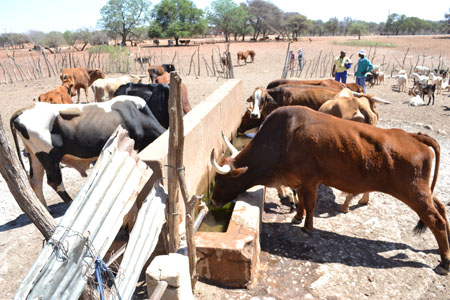
For the second year in a row, the performance of the agriculture sector has expereinced a setback due to inadequate rainfall, resulting in country wide crop failure and poor grazing, President Lt Gen. Seretse Khama Ian Khama has said.
Delivering a State-of-the-Nation Address in Gaborone on November 4, President Khama said this led to government declaring yet another drought year. As a way forward, he said, the Revised National Policy on Agriculture Development was being completed for implementation to accelerate diversification and commercialisation in the sector, while reaching out to disadvantaged groups.
President Khama said the livestock sector continued to be the economic mainstay of many Batswana, but unfortunately, the sector was beset with challenges of drought, animal disease outbreak and market access problems. ‘We are therefore encouraging farmers to sell off some of their livestock, while using failed crops as fodder for livestock,” he said.
The President said the Livestock Advisory Centre was selling some livestock feeds at a subsidised price. Regarding animal disease, President Khama said the Foot and Mouth Disease (FMD) situation in Bobirwa and the North East District has stabilised, allowing restocking to be effected in the areas.
He said occasional isolated incidences still occurred in Ngamiland adding that the overall situation had improved. In the North East District, the President said the FMD situation was compounded by the discovery of the virus in goats, sheep and wild game. He told the nation that the change over from the bolus to the ear – tag for the Livestock Identification and Traceback System (LITS) was progressing.
President Khama said in the South East and Kgatleng districts, a total of 102 334 cattle had been fitted with ear tags and those cattle found without bolus would be fitted with double ear tags. In addition to the traditional beef markets, he said government seeks to secure additional markets with promising prospects in the Middle East.
He noted that they had been exporting live cattle to Zimbabwe, with over 8 600 head having been exported from Ngamiland. Furthermore, President Khama said in the context of the drought, farmers have also been granted a temporary dispensation to export live cattle older than 30 months and this dispensation would be reviewed at the end of the year.
The President said he was happy to report that BMC exports from Lobatse to the lucrative market of the European Union have resumed. He told the nation that the Livestock Management and Infrastructure Development (LIMID) programme is contributing to self-employment including the youth.
“As of August 2013, 9 060 applicants have benefitted from the programme, of which 2 185 are youth who have been approved, while 3 648 are being processed,” he said. On arable farming, the President said, as a result of erratic rainfall and the early onset of cold weather, the country has been seeing lower yields per hectare.
However, he said the total estimated crop yield for this year is 55 000 metric tons as compared to 73 000 last year, thus increasing dependency on imports. President Khama said despite the lower outputs, 2 208 local farmers were able to sell about P4.9 million worth of produce to schools as of June 2013. He also informed the nation about the revised measures that were put in place for the coming ploughing season following the review of ISPAAD programme.
“Assistance will be extended to herbicides provision to help farmers control weeds, while draught power will only be extended to those who practice row planting,” he said. President Khama said farmers have been divided into subsistence, emerging and commercial categories for assistance, depending on their level of production. In addition, he said, the fencing of fields for farmers can be done for individual fields, as well as clusters of fields at subsidized rates.
The nation was also informed that horticulture farming has been significantly boosted by the inclusion of irrigated farming under ISPAAD, whereby farmers contribute 60 per cent while government contributes 40 per cent towards the cost of installing equipment.
The President said, “Government is also in the process of using treated waste water from sewage ponds for irrigation.” The Zambezi Agro- commercial Project, he added would also contribute significantly to irrigated agriculture. On issues of forestry, President Khama said Botswana’s landscape is prone to wild land fires, adding that recently fires frequency, intensity and multiplicity have recently increased significantly thereby posing potential harm to the ecosystem.
He said government continues to mobilise resources to areas of high economic importance and is working closely with the government of Australia in training officers and communities to equip them with wild land fire management strategies. To date, he highlighted that 2 220 fire fighters have been trained and a fire management strategy has been developed. In addition, he said four rural fire brigades have been established in Chobe, Ngamiland, Central and Ghanzi districts which are working closely with existing urban fire brigades. ENDS
Source : BOPA
Author : BOPA
Location : Gaborone
Event : State-of-the-Nation Address
Date : 05 Nov 2013
Related News



25 Aug 2026
Forensic audit generates 90 priority actions
25 Aug 2026