


Constitutionally entrench oversight institutions

10 Feb 2022
Former Mogoditshane legislator Mr Patrick Masimolole’s presentation to the Presidential Commission of Enquiry into the Constitution pretty much covered what speakers after him had wanted to say.
While he appreciated the work of the founding fathers in coming up with the constitution, Mr Masimolole was of the view that, despite their good intentions, they created one of the most oppressive constitutions in the world.
“I say it is oppressive because it gives a sitting president all the power. We have been fortunate not to have despotic leaders, because had we had such leaders, we would suffer,” he said.
Such “executive, overarching and extensive powers for the president” called for direct election of the president, he said. He argued that by directly electing their president, citizens would have a sense of ownership in the outcome.
The former legislator also said past events had shown that Botswana needed a constitutional provision for impeachment of a sitting president if he failed to uphold the law.
“Such would ensure that the president acts with prudence and full knowledge that he may be impeached by Parliament, and therefore his peers, and would be a reminder that he is a servant rather than a ruler,” he said.
Mr Masimolole further proposed that Member of Parliament (MP) should not be a cabinet minister as that presented conflict of interest given MPs ought to provide oversight over cabinet. He also suggested that Parliament should not be top-heavy, where there were more ministers than MPs “as is the situation is now”.
The former Legislator opined that a motion of no confidence in the government should not lead to dissolution of parliament as prescribed by Section 92 of the constitution.
The section reads:
If the National Assembly at any time passes a resolution supported by a majority of all the Members of the Assembly who are entitled to vote declaring that it has no confidence in the Government of
Botswana, Parliament shall stand dissolved on the fourth day following the day on which such resolution was passed, unless the President earlier resigns his office or dissolves Parliament.
Mr Masimolole suggested that Botswana’s election day should be a constitutional prerogative and not that of the president as was currently the case.
He suggested that parliament must approve the appointment of heads of critical institutions such as, the Chief Justice, President of the court Appeal, National Assembly Speaker, BDF commander,
Police Commissioner, the Director of Public prosecutions, DCEC director, director of prisons, those of ministers and so on and so forth.
Mr Masimolole also suggested that a Parliamentary select committee on intelligence should be established to ensure voters had oversight of intelligence apparatus through their representatives.
“Re eletsa gore go nne le hybrid ya proportional representation, mme re ntse re na le boemedi ka dikgaolo,” he said as he called for a system of elections that would be a mixture of the current system and proportional representation. This would help to do away with the need for specially elected MPs and councilors, he said.
He also proposed that the constitution should provide for a Constitutional Court (ConCourt).
“Gompieno hela jaaka o hella ko Appeals Court, go hedile ka wena, ga gona ko o ka tlholang o ikuela teng,” he said.
Supporting Mr Masimolole, Ms Lillian Moremi, presenting consolidated views group of some Mogoditshane residents said Mr Masimolole had covered most of what she needed to say.
However, on the ConCourt she explained the court was necessary to interpret, protect and enforce the constitution.
On direct election of the President, she said there should be an absolute majority equivalent to 51 percent or more of the vote.
Ms Moremi called for removal of councils from the ministry of Local Government, where councilors remained at the mercy of the minister. Further election of councilors should be coordinated by the IEC, where it had the power to issue the writ, in the same way it did with Parliamentary elections.
“ We also call for removal of Section 41 of the constitution, which forbids prosecution of a sitting President,” she said.
Ms Moremi said there should be a limit of presidential powers in the appointment of Judges.
The President, she said, should simply endorse the recommendations made by the Judicial Services Commission and not make any alterations to them.
She said political party funding should be passed into law.
Further, she said a select committee of parliament such as Public Accounts Committee should have prosecutorial powers and have resources sufficient to litigate.
Ms Moremi suggested that the word kgosikgolo should be recognised as the title for supreme chiefs, adding every tribe should be allowed to have its own kgosikgolo.
“Entrench and make fully independent all oversight institutions and remove them from answering to the Office of the President,” she said in a proposal related to Mr Masimolole’s that the appointment of top officers of critical institutions should follow Parliament’s approval. This, she said would stop people from being beholden to the President.
On representation to Parliament and councils, Ms Moremi said proportional representation should allow for a certain quota of representatives from marginalised groups such as those with disabilities, women and youth in parliament and cabinet.
She said there was need for a law whereby non-performing MPs and Councillors could be recalled.
“And we propose that there be a living wage for the unemployed,” she said.
Councillor for Mogoditshane Nkoyaphiri South Mr Bakang Matlho complained that the current constitution sidelined councils. He therefore proposed that local government should be recognised as a fourth arm of government so that councils too could have executive powers.
Mr Phale Moremi buttressed the need to constitutionally entrench oversight institutions and remove them from under Office of the President so they may report directly to Parliament.
He also proposed for an amendment in the electoral act that ballots be counted at polling stations. Additionally, he suggested that specially elected councilors should be appointed from opposition parties at the same ratio as those of the ruling party.
“Lekgotla la land board lone, ke batla le ntshiwa gotlhelele…le corrupt.” he said, meaning the landboard should be shut down, as it was too corrupt.
He expressed worry that that the commission was appointed by the President alone and not Parliament, and there was no guarantee that at the end of the day, he would embrace all of Batswana’s views.
Ms Grace Letsholo made an impassioned plea for treatment of all tribes.
“Ga o re o dira selo se se neng se go tshwanetse o le wa moratshwana, merafe e mentsi e, e a go tsogologela, ga o a sepe o moratshwana. Ga re ka leba ka bomoratshwana, ga re kake raya gope.
Ga ke itse gore a bomorahe bo metwa ka beisane, bomoratshwana ka kopi, a Batswana bothe ba lekalekane ka seemo sa bone, ke gone e kareng le re go na le puso ya batho ka batho ra dumela;
Jaanong go na le puso ya merahe e metona e busa ka meratshana, ” she said,
Her argument was that members of so-called major tribes often sabotaged those of ‘minor’ merafe even where they duly qualified for something.
True democracy would ensure such treatment ended by according all citizens equal status.
Mr Kabelo Tebelo’s suggestion was peculiar in that he called for complete setting aside of the current constitution as he said it did not represent Batswana’s aspirations.
“What we have is an inflexible written constitution; it’s not rectifiable; it was not designed to be amended. It’s a British constitution. Let us have a constitution for Batswana, that accommodates their aspirations,” he said.
Citing the constitution of Brazil, he said the new constitution should only focus on fundamental issues and be small enough to fit into someone’s pocket.
Mr Tebele said the constitution should duly recognise the existence of God as the creator.
Failure to acknowledge God led to impunity where the government could do as it wished with church ministers, he said.
Messrs Allen Tlhabano and Shaka Ditshuge joined Mr Tebele in his call for an altogether new constitution.
Mr Tshotlego Moatshe pleaded for translation of the constitution and other important documents into Setswana and and broad use of the language in public meetings, as many elderly people did not understand English.
“Maloba MmaSerame o ne a bua, nna ga ke a utlwa leha e le sepe…ke tla ke utlwa motho a re bagolo gatwe re okeleditswe madi ka P100,” she said.
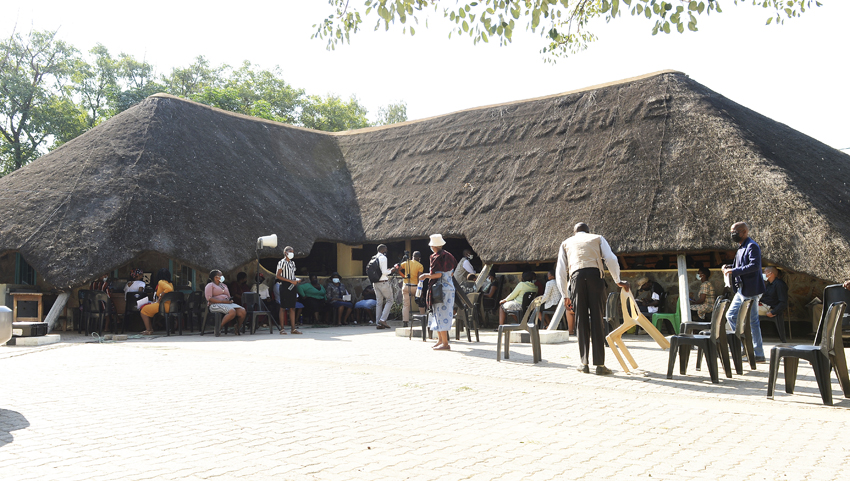
The commission continues its consultative meetings this morning in Mmopane. ENDS
Source : BOPA
Author : Lindi Morwaeng
Location : MOGODITSHANE
Event : Constitutional review Commission
Date : 10 Feb 2022
Related News

07 Aug 2026
Xiplomacy Hosting the world building the future
07 Aug 2026
Xiplomacy Pursuing the greater good for all

06 Aug 2026
Gaolathe inspires learners to aim high
06 Aug 2026