

Distance learning benefits many
22 Sep 2013
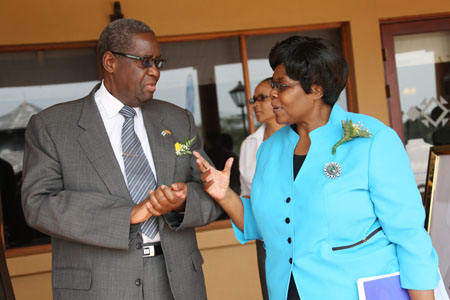
Government is happy about the contribution of Distance and Open Learning (ODL) towards the development of the country, Vice President, Dr Ponatshego Kedikilwe, has said.
Speaking at the Distance Education Association of Southern Africa (DEASA) conference and general meeting in Gaborone on September 20, Dr Kedikilwe said more Batswana benefitted from programmes offered through ODL, ranging from certificate to degree level.
This, he said, was portrayed by increased literacy levels and overall basic education, which were paramount in the development of personal life-skills needed to tackle challenges such as unemployment, domestic violence and abuse as well as HIV/AIDS.
Dr Kedikilwe said the 1993 national literacy survey showed an improvement of 40-69 per cent, which had significantly grown to 81 per cent in the 2001 survey, attributable to out-of-school education programmes through Botswana College of Distance and Open Learning (BOCODOL) and Out of School Education and Training (OSET).
“This is why government has now gone further to legislate the establishment of a university dedicated to the provision of ODL,” he said.
Dr Kedikilwe said having made a landmark on the provision of open and distance learning at secondary and tertiary levels, BOCODOL had become the logical choice of the college that should transform into the envisaged Open University for Botswana. He said the new institution would join established counterparts such as the Zambia Open University, and others in Zimbabwe, Tanzania, Mauritius and South Africa.
He said DEASA was making immense contributions to the envisaged new university through collaborative practices among institutions in a variety of ways. Dr Kedikilwe said Zimbabwe Open University, a member of DEASA, had over the years assisted BOCODOL to institutionalise tertiary education systems in readiness for the planned transformation.
Dr Kedikilwe further noted that the conference was timely concerning the current concerns of quality, relevance and responsiveness of education and training. The Vice President also said the theme for the conference was consistent with the ideals of SADC, all of which revolved around the need for member countries to work in unionism towards regional integration.
Meanwhile, chairperson of DEASA, Professor Primrose Kurasha said when ODL institutions collaborated, peer interaction within specialised academic disciplines would be enhanced by inter-institutional collaboration that will provide an opportunity to create communication network about emerging fields in distance education.
She said strengthening collaboration in ODL in the SADC region had many societal benefits. “You will see that combining the most up-to-date technologies with expert staff creativity across all SADC ODL institutions bridges the gap between distance education and population segments that have historically lacked access to the benefits of ODL,” she said.
The three-day conference brought together SADC country representatives of DEASA, academicians from the SADC region and SADC Secretariat under the banner of DEASA to talk to issues of strengthening collaboration in ODL in the SADC region. DEASA became a critical organ in the Regional Education Strategy after the SADC education ministers agreed that ODL was the best strategy for achieving Millenium Development Goal of Education for all by 2015. ENDS
Source : BOPA
Author : Mmoniemang Motsamai
Location : Gaborone
Event : International conference
Date : 22 Sep 2013
Related News

04 Jun 2026
Employment Act Comes Into Effect July 1
04 Jun 2026
SADC Fortifies Region Anti-Money Laundering
04 Jun 2026