

Moromberombe Magical detergent

29 Jun 2020
Use of soap dates back to pre-colonial era.
Oral history has it that indigenous African people used readily available materials to make soap for cleaning purposes.
For instance, Moromberombe fruit tree seeds were among the many water-soluble cleansing agents that were used to produce foam.
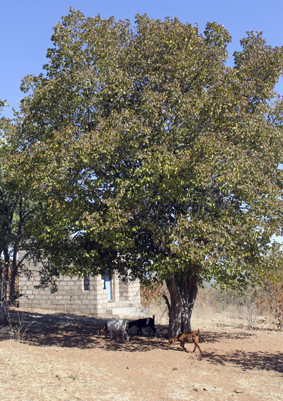
In Botswana, Moromberombe tree is found in Kavimba and Kachikau which make up the Chobe west enclave.
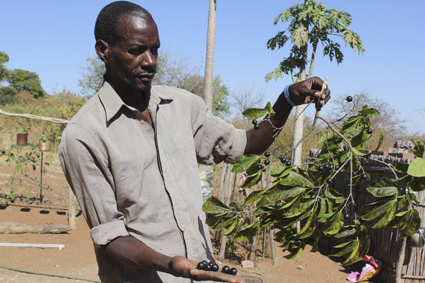
The tree derives its name from little rain like drops excreted from its leaves during summer.
Forty five year-old Mary Serufo, who hails from Kavimba, calls it Mulola.
Even across neighboring Zimbabwe, the tree bears the name Moromberombe.
This soap nutcgoes by a botanical name; Sapindus Mukorossi or the Indian Soap Berry.
The tree’s fruits are pitch black when ripe.
If not looked at carefully, one can mistake Moromberombe with another tree called Moroka because they have almost identical physical appearance.
Kgosi Josephat Mwezi of Kavimba calls the magical tree ‘My humble soap-berry’.
To him, the soap nut tree is a gift of nature.
“Mother nature has really showered us with a great gift,” he says.
He says the people of Chobe District are obsessed with Moromberombe tree due to its many uses. Besides being used as a detergent to wash clothes, Kgosi Mwezi adds the tree is also a delicacy for livestock especially goats.
“When the fruits are ripe they fall to the ground and you will see goats merrily feasting on them.”
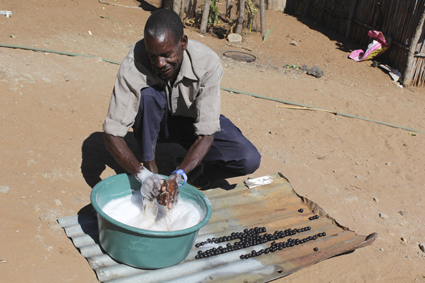
When the fruits of this splendid tree species are placed into water, they create gentle bubbles and swiftly foam with a high cleaning efficiency.
Kgosi Mwezi says the soap can be used to wash any colour of cloth including white colour clothes.
“You would think that you have added jik to a white cloth once you are done with your laundry,” he adds.
However, Kgosi Mwezi is a worried man that the tree is on the verge of extinction and calls for authorities to device ways to preserve it so that it could benefit future generations.
He has urged research institutions such as Botswana International University of Science and Technology (BUIST) and the University of Botswana (UB) to act with speed and conduct research on this tree.
Fifty-one-year-old Kenny Tumedi of Mowana ward in Kavimba, who has a penchant for trees has a lot to say about Moromberombe tree.
“My wife and I have used Moromberombe to wash our clothes for years. When my wife told me about it many years ago, I decided to give it a go, and I have never regretted using Moromberombe seeds,” he says.
According to Mr Tumedi, Moromberombe fruit is first dried following which it will be boiled to produce foam.
“After a short while, a nice, thick soap liquid is ready to do the magic,” he says.
Some people, he remarks, use the soap nut liquid as a shampoo for their hair or to bath their pets.
In their book; Forestry and Climate Change, Peter Feer-Smith, Mark Broadmeadow and Jim Lynch write that Moromberombe contains plant saponin, a totally natural gentle soap that has been used for centuries to clean both the skin and clothes.
The three authors further explain that saponin works as a surfactant, breaking the surface tension of the water thereby creating a lather that lifts dirt and grease from skin, leaving it suspended in the water that is rinsed away.
“For laundry, this surfactant action penetrates the fibers of clothing too, lifting stains from the fabric and washing them away with the water”, says an extract from the book. ENDS
Source : BOPA
Author : Thamani Shabani
Location : KAVIMBA
Event : Feature
Date : 29 Jun 2020
Related News
28 Jul 2026

28 Jul 2026
Value chain key to industrial growth - Ntsima

28 Jul 2026
Africa SME body honours Boko

28 Jul 2026
Domestic funding vital - SADC
28 Jul 2026
MoA opens doors for economic opportunities
23 Jul 2026