Plans afoot for Bank of Botswana Amendment
23 Jun 2020
In order to enhance its role of assisting Botswana to attain its ambition of high income status, the country’s central bank is working with the Ministry of Finance and Economic Development to come up with a new Bank of Botswana (BoB) Act.
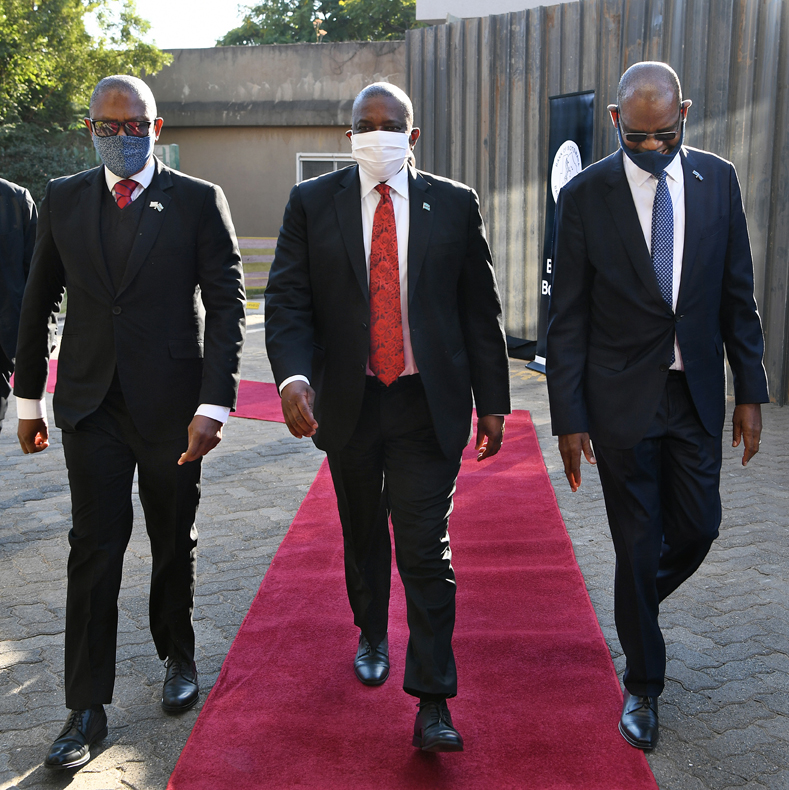
This was revealed by BoB governor, Mr Moses Pelaelo, during a presentation he made to President Dr Mokgweetsi Masisi and cabinet June 23 as part of the central bank’s annual economic briefing.
Mr Pelaelo said in consultation with the International Monetary Fund (IMF), the bank had drafted a regulatory framework guide that could strengthen financial institutions.
“With the support of the IMF, and as the bank’s contribution towards strengthening institutions needed to transit the country from the so-called “middle-income trap” to high income status, the bank has completed and submitted to Minister of Finance and Economic Development a draft amended Bank of Botswana Act, for legal drafting and possible consideration by Parliament later this year,” Mr Pelaelo said.
Giving an overview of the economy, he said three challenging themes had emerged including the fact that Botswana’s export potential had shrunk as a proportion of GDP, a narrow economic base persisted and thirdly a prospective transition towards structural fiscal deficits and depletion of official foreign exchange reserves.
The mentioned issues, Mr Pelaelo said, had the potential to undermine the economy’s resilience to withstand future economic shocks adding that effective policy responses and the transformation agenda were therefore necessary.
“There is an urgent need for rejuvenation by redesigning the country’s industrial policies to promote exports, anchored on outward looking policies, with an export bias and better integration into regional and global value chains,” he said.
Further acknowledging that economic diversification efforts as well as large infrastructure development and social spending by government had thus far not managed to broaden the economic base, Mr Pelaelo said there was need for innovation.
“It is important to reinforce the focus on the Vision 2036 aspirations to achieve high-income status and inclusive diversified growth.
The thrust required is to galvanise efforts towards structural and economic transformation as well as harnessing opportunities enabled by the fourth industrial revolution by upscaling investment on digital infrastructure and adoption of ICT,” Mr Pelaelo said.
He said inventive measures needed to be implemented to ensure the country’s fiscal revenue base did not become depleted.
“There is need to enhance domestic resource mobilisation, by broadening the tax base, rationalisation of distortionary subsidies and with the right governance architecture, a more optimal domestic borrowing programme to tap into resources accumulated by retirement funds, annuity providers and other institutional funds,” Mr Pelaelo said.
In addition to giving a presentation on the draft for the proposed BoB Act amendment, the bank’s deputy director of research and financial stability, Mr Innocent Molalapata, also highlighted the importance of central bank autonomy, transparency and accountability.
“These factors are important in facilitating effective discharge of the central bank mandate and in the maintenance of macroeconomic stability, attainment of inclusive and sustainable economic growth,” Mr Molalapata said.
The BoB briefing coincided with the publication of its 2019 statutory annual report which covers audited financial statements and overview of the 2019 economic developments.ends
Source : BOPA
Author : Pako Lebanna
Location : GABORONE
Event : Bank of
Date : 23 Jun 2020
Related News

11 Aug 2026
Boko calls for radical reforms in public service
11 Aug 2026
Botswana and US commit to global peace

11 Aug 2026
Chobe district receives malaria drugs
11 Aug 2026