

Kashweka finds a niche in fresh produce
29 Mar 2020
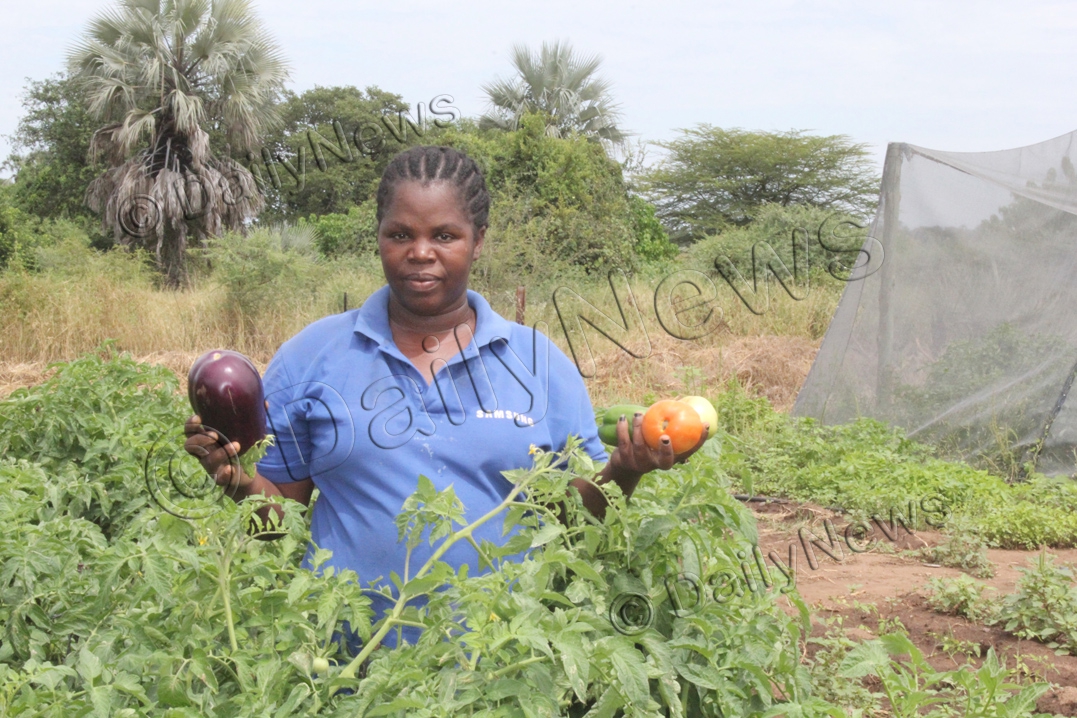
Ms Katlego Kashweka’s story, is a testimony of some of the successes of the Poverty Eradication Programme, which can motivate others.
Residing in Muchenche, an extension ward of Mabele in the Chobe District, Ms Kashweka is an example of a few women who, when opportunity calls, they take a chance to put food on the table for their families.
The mother of six, has the bravery to create a kind of life she wishes to lead, unconstrained by stereotypes set against women.
“It took a lot of boldness to stand up and apply for the programme, because my sister benefited from it and failed,” she said in interview.
She said she believed in a world where women were economically empowered for their businesses to flourish.
She calls her 40 by 40 metres field, from the one hectare lent to her by her mother, ‘My home’ because she spends most of her time there.
“I call it my home because I spend my time here, from six am to six pm,” she added. She said she was assisted under the programme in 2017 and she has never looked back since then. She was assisted with a 500 litre jojo tank, a shade net and a fence, to start her business.
She can make up to P2 000 on a good day.
Her clients include Chobe Marina Lodge and Ronns Fruits and Vegetables in Kasane, apart from ordinary customers on the main road, where the field is strategically located.
She sells a variety of crops ranging from fresh and organic vegetables that include spinach, rape, tomatoes, green paper, sweet potatoes, butter nuts, okra, egg plants (obejin) as well as maize.
Walking into Ms Kashweka’s business,one cannot miss the smell of herbs.
She sells herbs in the likes of lemon grass, peppermint, rocket, basil and Nasturtium of the Brassicaceae family (cabbage family) as a way to argument and diversify her business.
She explained that the herbs offer multiple health benefits, such as preventing infection, boosting oral health and many more.
Ms Kashweka said she either sells these herbs fresh from the field or dries them as a preservation strategy because fresh and dried herbs are in high demand in the hospitality industry in Chobe.
She now wants to introduce poultry farming and she has already constructed a poultry house to rear broilers.
She explained that there was high demand for chicken meat in the Chobe District and having such a business is an added advantage.
Quizzed on where she wants to be in the next five years, Ms Kashweka responded, ‘Five years is too far, I need only two years,’ she said.
She said in two years’ time she would be having her dream house and car.
“Ke tla bo ke le Lekgoa,” literally meaning that she will be counted amongst the haves or rich.
She said the flowing of the Chobe River brings a lot of opportunities because she would have a break of not paying water bills, which had been high.
Ms Kashweka said she had a pump station by the river bank and given the amount of flowing water on the river, it might go for a year and a half watering her crops from the river.
She said Water Utilities Corporation (WUC) had been charging her high water bills that sometimes amounted to P10 000 a month.
She appealed to government to exempt beneficiaries of Nyeletso Lehuma from paying water bills, as they were very high for the ‘small man.’
The poverty eradication programme was rolled out by the government in 2010, targeting more vulnerable groups such as women and the youth, in addition to initiatives such as the Youth Development Fund and the Women Economic Empowerment, amongst others. ENDS
Source : BOPA
Author : Thamani Shabani
Location : MABELE
Event : INTERVIEW
Date : 29 Mar 2020
Related News
28 Jul 2026

28 Jul 2026
Value chain key to industrial growth - Ntsima

28 Jul 2026
Africa SME body honours Boko
28 Jul 2026
Domestic funding vital - SADC
28 Jul 2026
MoA opens doors for economic opportunities
23 Jul 2026