

Department sprays locusts in Chobe
23 Mar 2020
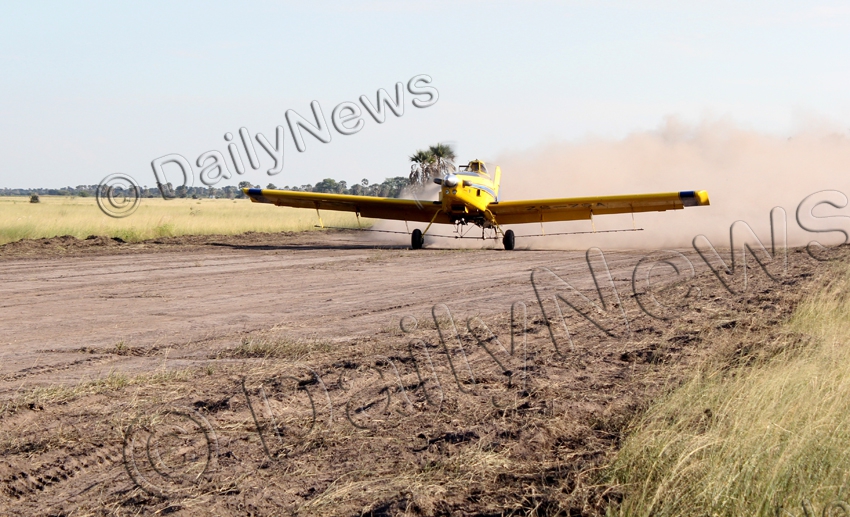
Department of plant protection in Kasane this weekend started a project to spray locusts from the air in Parakarungu and Satau.
The locusts, which were suspected to have migrated from one of the neighbouring countries, attacked these villages since February, leaving a trail of destruction in several fields.
The use of arial support from Fortwest Holding, a spraying company, was last resort for the department to eradicate the locusts, which threatened food security.
Plant protection officer, Mr Boikelo Dimpanyana, said in an interview that the locusts were first reported on February 19.
After the locusts descended on Satau, the department took samples, which were later confirmed by the ministry’s research unit to be the African Migratory Locust.
Mr Dimpanyana said this type of locust could ravage five hectares in a day.
“We immediately mobilsed resources and we started spraying using knapsack tank sprayers, which are carried by a person but it could not help because we were thin on the ground whilst the pest increased in migratory level, hence engagement of an arial spray to eradicate the locusts,” he added.
He explained that the most important thing was to protect the crops, which were a source of livelihood for communities and the strategy was to control it when at its first stage of nymph.
Mr Dimpanyana said the arial spray covered a total of 500 hectares in Satau and 177 in Parakarungu.
He said after the spray, the department would monitor the situation before wrapping up its campaign.
He advised farmers to be on the outlook to alert the department of a possible new attack.
Mr Dimpanyana said this was the third outbreak since 1987, followed by another outbreak in 2004.
“This form of migratory pest has a form of a pattern in terms of outbreak and it raises fears over food security as farmlands are decimated,” he added.
Meanwhile, another catastrophe hit farmers when armyworm caterpillar hit several areas with Satau being the hardest-hit.
Parakarungu-based agricultural demonstrator, Mr Mokwadi Kgosietsile, said the worm mostly destroyed maize.
He said it had now covered over 400 hectares.
He said if left untreated, fall armyworm caterpillar could destroy pasture or field of crops in a very short time.ends
Source : BOPA
Author : Thamani Shabani
Location : PARAKARUNGU
Event : Interview
Date : 23 Mar 2020
Related News

28 Jul 2026

28 Jul 2026
Value chain key to industrial growth - Ntsima

28 Jul 2026
Africa SME body honours Boko

28 Jul 2026
Domestic funding vital - SADC

28 Jul 2026
MoA opens doors for economic opportunities
23 Jul 2026