

DAR drills farmers on fodder making
16 Mar 2020
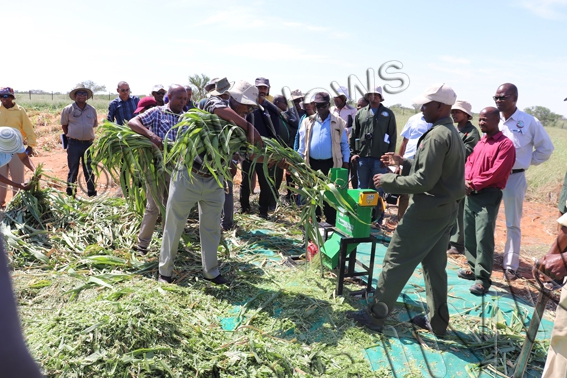
Following the introduction of napier grass, cencrus cilliaries and salt boast shrub at Lobu Small Stock Farm last year, the Department of Agricultural Research (DAR) recently drilled farmers on silage and hay making to counter drought seasons.
Speaking during the demonstrations, farm manager, Mr Geoffrey Balogi said President Dr Mokgweetsi Masisi had called for the government-owned production and training farm to become a small stock production hub.
He said the vision was thus to rally citizens to venture into small stock production with a view to feed the nation and ultimately export quality breed.
Mr Balogi said in the era of continuous drought seasons it was critical for farmers to factor in feeding in the planning of the production process to counter the drought seasons.
He advised farmers to make hay while the sun shines and to prepare for the drought and ensure that their livestock and small stock was well fed.
He said 2019/2020 had been declared a drought year and advised farmers to plan for small stock production by incorporating the drought and making feeds as it was clear that each year Botswana faced drought conditions.
“We must come up with strategies on how we can effectively and continuously feed small stock in the phase of drought,” he said.
During the inaugural planting of the grasses last year, DAR director, Dr Pharaoh Mosupi said it was critical for farmers to adopt and apply climate smart agriculture.
The event was organised by the DAR Kang office at Lobu under the theme: Taking DAR technologies to the community to improve the adoption rate.
Speaking during demonstrations, senior agricultural officer, Mr Bornwell Mabechu said after different fodder was planted, it was pertinent to drill farmers on hay and silage making using the napier grass beginning with how to harvest and showing farm implements to be used in the process.
Principal technical officer from Kang, Mr Seboko Molatlhegi explained that hay making was the process of turning green, perishable fodder into a product that could be stored and easily transported without danger of spoilage while at the same time keeping its nutrients loss to a minimum.
The process involves reducing grass moisture content by drying it in the sun, he said, adding that it was important to have an open wooden container with handles to stash and contract the semi-dried grass by first laying a string at the bottom.
He said compressed forage was then tied together and stored under the shade in a bale.
He cautioned that hay should not be baled while wet to avoid decaying and that it must be placed in a storage with free air circulation to preserve nutrients.
He said the process turned green forage into a product that could be safely stored as its moisture content was reduced to around 25 per cent or less.
On silage making, he said it was made using fresh grass cut using either a sickle or a parker knife if one did not have a machine.
He said the grass must be finely chopped and compressed to remove any air pockets using either a silage bag, plastic bucket or that one could dig a hole and compress the forage using a tractor.
He added that if there was no tractor, one could use available tools such as a water filled drum to compress the forage.
He noted that silage was produced by controlled fermentation under anaerobic conditions.
Mr Molatlhegi said any grass in the pasture could be used if farmers did not have the napier grass. He also advised them to add liquid molasses to produce natural bio activities where bacteria converted plant sugars into organic acids that preserved grass nutritional qualities. He added that forage conserved this way could be kept for up to three years without deteriorating.
Furthermore, farmers also learnt how to mix diet 1 formulation, commonly referred to as beef finisher. He said the diet was created to prepare small stock or livestock for sale where it was capable of gaining quality meat mass.
He noted that the diet formulation consisted of 40kg of stover, 42kg of maize or sorghum, 14kg bran, urea of 1.4 kg, liquid molasses of 2kg, salt at 0.3kg and DCP at 0.3kg finely mixed together.
Lobu was established in 1978 to support farmers and encourage them to practice good animal husbandry.
The farm covers 10 310 hectares and is capable of holding 1 500-2 000 small stock.
Mr Balogi said currently the farm had 1 589 small stocks of eight different breeds such as Dorper, Damara, Karakul, Meat Master, White Karakul, Sannen, Boer Goat and Savannah Goats.
The aim is to produce quality breeds to be sold to farmers nationwide to improve their stock. Ends
Source : BOPA
Author : Calviniah Kgautlhe
Location : MIDDLEPITS
Event : Fodder making demonstrations
Date : 16 Mar 2020
Related News

29 Jul 2026
29 Jul 2026
Poultry industry attains self-sufficiency
28 Jul 2026
Ross Breeders pioneers Botswana poultry exports

28 Jul 2026
Value chain key to industrial growth - Ntsima

28 Jul 2026
Africa SME body honours Boko

28 Jul 2026