

Hayes findings put Makgadikgadi on map
02 Mar 2020
Research findings by Australia’s Professor Vanessa Hayes published in the a 2019 “Nature” journal, which sent waves around the world, is a positive contribution to the popularity of Makgadikgadi.
This was said by Minister of Environment, Natural Resources Conservation and Tourism Ms Philda Kereng during an event which was held in Maun to promote research.
The event, organised by the ministry, follows recent research findings by Prof Hayes suggesting that Makgadikgadi is the birthplace for human origins.
Makgadikgadi, she said, was home to thousands of archeological relics found in about 200 sites.
“This palaeolake of the Makgadikgadi is also a home to tens of thousands of people who value it as a home through sustainable use of its resources,” she said.
Ms Kereng told the gathering that government embraced research as critical to transformational agenda.
She said research done by different institutions and individuals was relevant for heritage tourism development.
In addition, the minster said research provided solutions to challenges facing wildlife and natural resources.
For her part, the Australian geneticist, Prof Hayes, said her DNA-based research pointed to Makgadikgadi as the ancestral home of humans.
"The research used DNA because all people carry traits of our ancestors that can be traced back to where we originate," she said.
Prof Hayes said her team traced the female genome called L-Zero, which pointed to the residual Makgadikgadi-Okavango wetland as the home of modern human origins some 200 000 years ago.
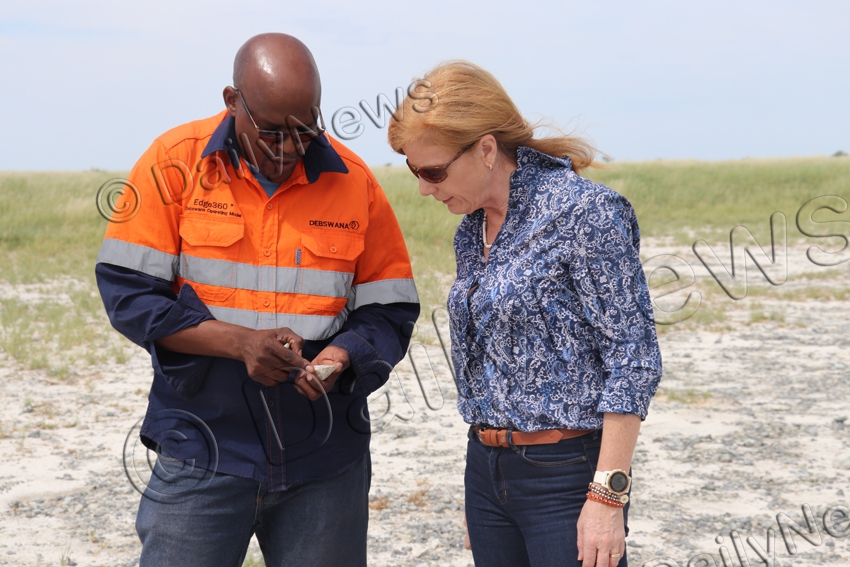
Prof Hayes, who visited Makgadikgadi for the first time in her life on Saturday, said she was open to work with local institutions.
An University of Botswana archeologist, Dr Sarah Mothulatshipi said her research team had been exploring Makgadikgadi for over five years focusing on Ntwetwe Pan.
Dr Mothulatshipi said Makgadikgadi was initially neglected by archeologists.
Nonetheless, she said, Makgadikgadi findings were pleasing with relics from middle to later stone age such as pots and farm materials found in their original places while some were degraded.
Further, Dr Mothulatshipi said research was critical for human development.
Makgadikgadi is a unique vast landscape covering about 37 000 square kilometers with three main features of Ntwetwe Pan, Nxai Pan and Sua Pan.
It has magnificent trees such as Baines Baobab, Chapman Baobab and Greens Baobab, which were named after 19th century European travellers.
Prof Hayes and her team uses variation in the human genome (the entire compliment of the human DNA code) to define human origins, evolution and disease.
Prof Hayes’ paper suggests that “modern humans originated in Southern Africa around 200 000 years ago although some of the oldest skeletal remains had suggested origins to be in Eastern Africa.”
Despite using a different discipline of genetics, Prof Hayes’ research coincides with UB’s archeological findings which indicate Middle Stone Age activities in the Makgadikgadi over 200 000 years ago.
Other collaborative researches at Makgadikgadi are carried out by the Department of National Museum, Monuments and Art Gallery as well as universities of Oxford, Brighton and Olso. ENDS
Source : BOPA
Author : Kedirebofe Pelontle
Location : MAUN
Event : Launch ceremony
Date : 02 Mar 2020
Related News


04 Jun 2026
Employment Act Comes Into Effect July 1


04 Jun 2026