


Media critical in armyworm control
01 Mar 2020
The outbreak of Fall armyworm in the country is worrisome as it can threaten food security if not properly controlled.
Briefing the media, Chief Plant Protection officer in the Ministry of Agricultural Development and Food Security Ms Velleminah Pelokgale said the pest could destroy the agricultural sector which could lead to job losses, especially in seed manufacturing companies.
She said the pest attacked maize, sorghum, groundnuts and cowpeas.
The pest, she asserted, was found in most parts of the country except in Kgalagadi. and Ghanzi districts.
As a management strategy, she indicated that weeding, the use of fertilizers and bio-pesticides was recommended, saying unlike the African armyworm, the pest appeared annually.
She also added that since its outbreak government had come up with interventions to inform the public and agricultural demonstrators were taken for capacity building in places where the pest appeared to learn more about its management.
For his part the Acting District Agricultural Coordinator in Central, Mr Tabuzani Maposa said media engagement was part of government efforts to manage the Fall armyworm.
This, he added, formed part of the awareness campaigns that the ministry had embarked on, including building the capacity of the media to report factually on the pest.
Mr Maposa noted that Botswana was not spared from the effects of climate change which had seen the prevalence of a variety of pests.
One of the facilitators Mr Willis Ochilo explained that surveillance and monitoring helped the ministry to detect the presence of the pest or its build up in order to determine its management.
Furthermore, he said they also scouted its presence at the fields using pheromone traps.
Mr Ochilo explained that they also used traps and highlighted that high catches of ten and above over consecutive nights indicated chances of an outbreak.
“Farmers can also scout and if some plants have damaged leaves and there is presence of the caterpillars, control measures should be initiated,” he explained.
On other issues, he said trapping the pests helped them as they exchanged information with other countries on the likelihood of an outbreak.
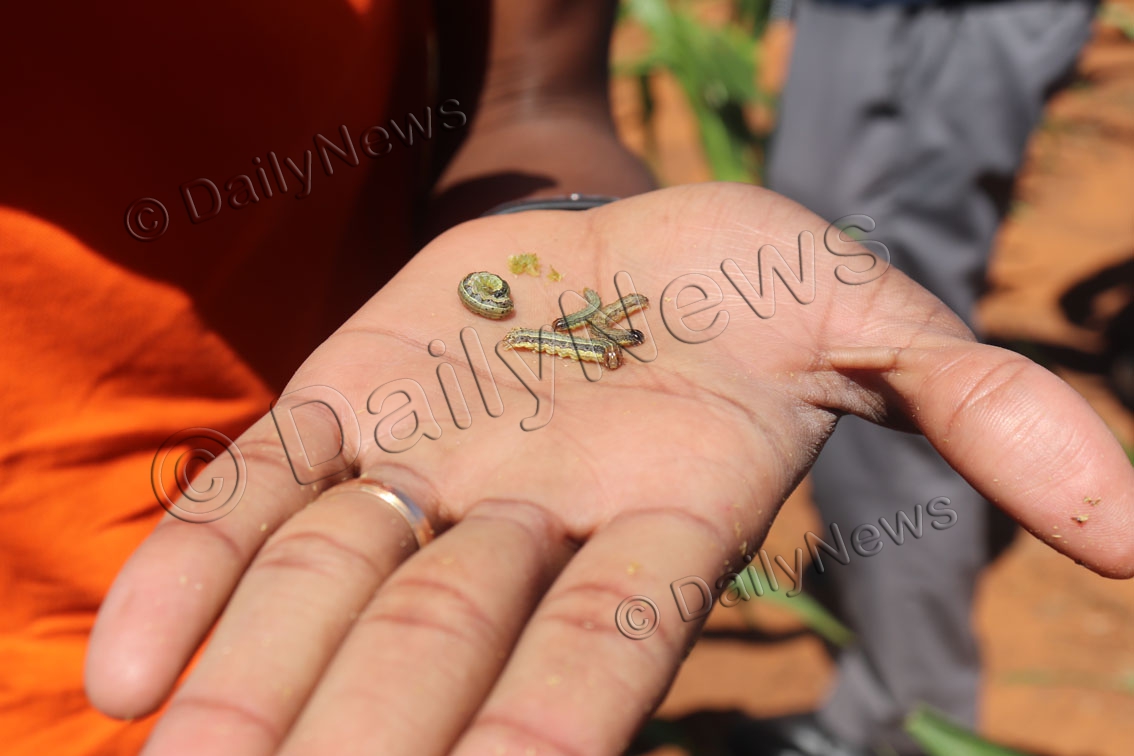
He said the difference between the Fall armyworm and the African armyworm and Stalk borer was that the head of the Fall Armyworm had an inverted ‘’Y’’ and its upper body end had got four distinct bumps.
Media practitioners and farmers who attended the workshop visited to Dithojane fields near Serowe to get firsthand information about the damages caused by the Fall armyworm and how the worm looked like.
The moths (butterfly) which lay eggs are similar in shape and size to other moths in Lepidoptera family.
They are greyish in colour and about 4cm long.
The front wings of the male are greyish in colour with white markings near the wing tips. The front wings of the female are similar but the markings are less distinct.
The larvae closely resemble that of the African armyworm. Newly hatched larvae are pale green with black heads. As they grow, the heads turn orange brown.
Fully grown larvae are about 4cm long and are pale green with reddish brown head and they are very active early in the morning and late in the afternoon.
The pest originates from the Americas and first appeared in Botswana in 2017 after causing massive damage to crops in Zambia .
Ms Pelokgale explained that the media was a critical stakeholder in agricultural development, adding that the success of agricultural programmes depended on the mass media to mobilise people.
“The media is important in transferring agricultural information to the people. In cases where there is no collaboration this has an impact on farmers as they miss out on key information,” she said.
Agriculture, she added, was still critical in a developing country like Botswana.
The dissemination of agricultural knowledge, Ms Pelokgale explained, was very important as beneficiaries such as farmers relied on the media to get information.
She also mentioned that science reporting was key to exposing and educating farmers, noting that there were deep rooted factors which kept the reporting of agricultural information in the margins.
Most of the journals which contain useful information for farmers, she highlighted, are not accessible to them.
“It is up to journalists to dig this information and deliver it to the relevant audience,” she said.
In this regard, she noted that as one of their objectives, they wanted farmers to understand what the Fall armyworm was and the threat it posed to food security.
Farmers, she added, needed information on how to control and manage the pest and to also know where to seek help in case of an outbreak. Ends
Source : BOPA
Author : Tshiamiso Mosetlha
Location : Serowe
Event : Media brief
Date : 01 Mar 2020
Related News
12 Aug 2026
12 Aug 2026
Adopt modern and flexible public service

12 Aug 2026
Ministry and De Beers partnership yields fruit

12 Aug 2026
Tsabong adopts China model to fight poverty

12 Aug 2026