


Conditions were suitable for assessment
06 Feb 2020
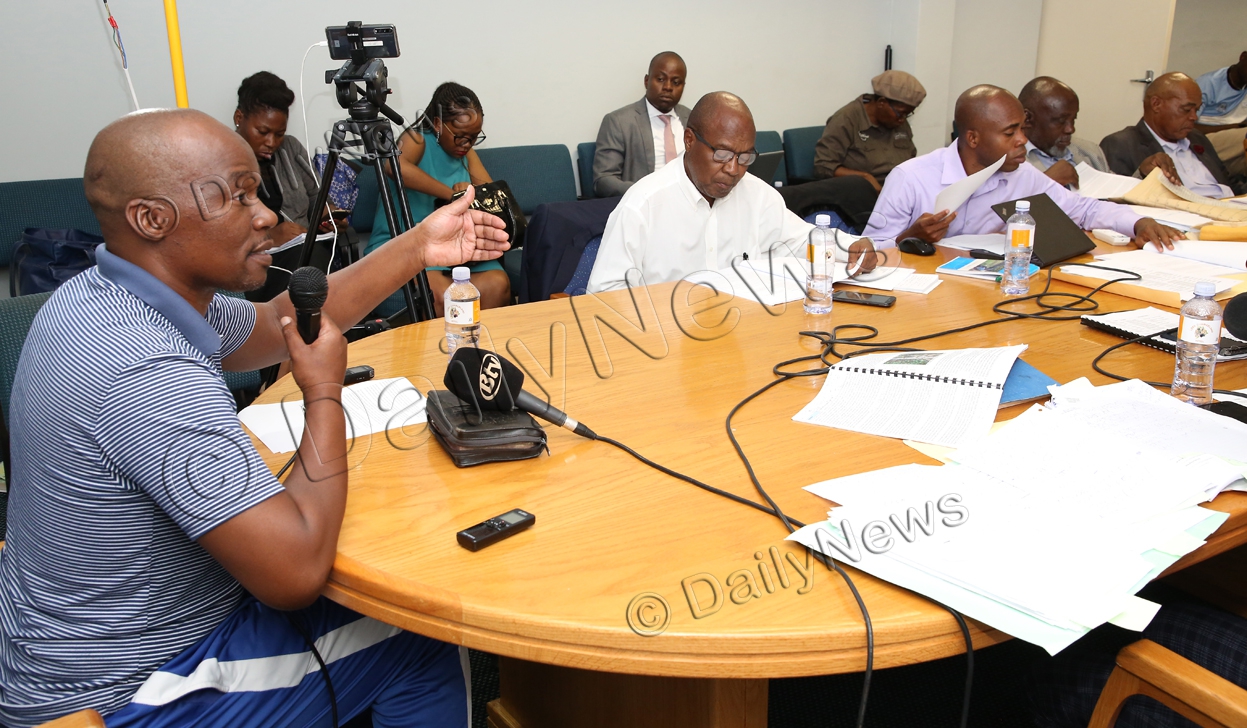
Botswana Railways (BR) engineman, trainer and assessor, Mr David Seima says weather conditions allowed for assessment of a trainee during the night of a fatal train accident last December.
Two crew members lost their lives when a north-bound train derailed and crashed near Palla Road in the early hours of December 10.
Mr Seima, who gave evidence to the board of enquiry on the accident, said on Wednesday that conditions were good when the train started its journey at Lobatse station with himself, a lady trainee and another person in the cabin.
Mr Seima said he started assessing the trainee on December 6 with a train trip to Mafikeng and back to Lobatse.
He said they then took a break and arranged with the station foreman for another journey for the trainee on December 9.
“On December 9, I was with an engineman and the candidate.
The trip was the third for the trainee and was going to get her qualification if she was successful.
We normally have the engineman attached to the train to avoid putting the candidate under pressure,” Mr Seima said.
He said they were advised to drive with caution when they departed Lobatse station at around 8pm because there had been rains.
He said conditions in Lobatse were good at that time.
“We proceeded up to Gaborone observing caution on areas that are regarded as hotspots.
When we entered the platform in Gaborone the locomotive touched the stairs a little bit and the candidate applied the brakes.
Our speed was below 10km per hour. Afterwards we shunted and I talked to the station foreman about the incident of the train touching the platform because I was concerned.
I called the acting operations manager and told him about that incident. He told me he would follow it up,” said Mr Seima.
Mr Seima said it was while in Gaborone that they were told by Mr Kgomotso Seaitsoketsa that there had been rainfall between Mahalapye and Palla Road.
“He was concerned and told me he would join us at Palla Road.
It is normal practice for PWI to join trains to make a foot plate inspection.
I agreed to that and proceeded with the journey.”
He said they left Gaborone station around 11pm and were told by the controller to continue being cautious.
He said they stopped to observe the points at Palla Road and that was when Mr Seaitsoketsa joined them in the cabin.
He said they then saw water at the level crossing that leads into Palla Road village and the candidate reduced speed.
“We managed to go past the area and the track was clear afterwards.
Our thought was we could continue at a lower speed with focus because we knew that Bonwapitse is the common hotspot that always pose threat during rainy seasons,” he said.
However, he said two minutes after passing the culvert they saw a portion of the line was washed away and the candidate tried to apply breaks.
Mr Seima said he stopped the candidate applying breaks because the locomotive break was going to make the situation worse.
He said the locomotive then dipped after it derailed.
“I lost my conscience.
When I recovered I found myself trapped in mud. I pleaded for help because I could not move. We waited with hope that someone would come.
We waited until help came about five and a half hours afterwards.
I was taken to hospital and up to today I am still seeing a doctor. I had injuries to my legs, head and I had a six inches cut.
I still experience chest pains,” he said.
Mr Seima told the board of inquiry that they were not told that there was water at the place where the train derailed.
He said the only instruction he had was to be cautious on the way to Gaborone and also to Palla Road.
He also told the inquiry that it was normal practice at BR for a trainee to drive a train full of passengers.
“Our assessment is a standard based type of assessment.
The trainee has to be assessed on a passenger train.
It is international standard.
I was trained on the passenger train at Transnet,” Mr Seima said.
He pointed that he would not have commenced the exercise of qualifying the learner if the weather conditions were not permitting.
Mr Seima said he was in control of the train throughout the journey and they had not expected nor had been warned about the water after the culvert at the level crossing near Palla Road.
He said they did not even see the water from the locomotive.
He said the train was travelling at a speed of 65km/h when they approached the point where the train derailed.
“The area that was washed away was a very short distance.
It is quite difficult to observe the spot that had been washed from the train,” he said. ENDS
Source : BOPA
Author : Jeremiah Sejabosigo
Location : Lobatse
Event : BR Public Hearing
Date : 06 Feb 2020
Related News


13 Aug 2026