


Image under threat
04 Feb 2020
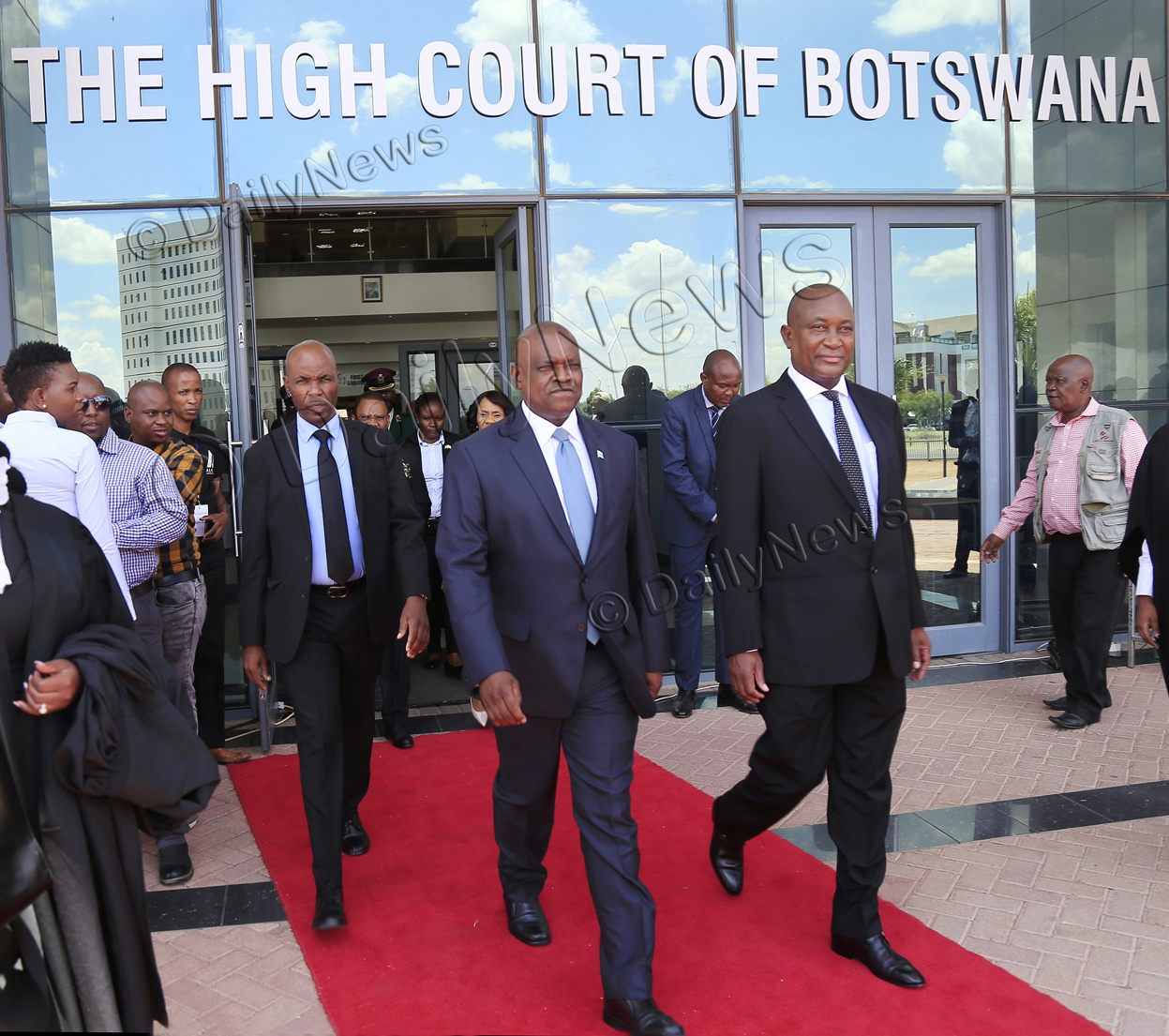
Registering cases and taking ages to complete investigations is hurting the image of the justice system and that of the country as a whole, Chief Justice Terrence Rannowane has said.
Speaking at the opening of the legal year in Gaborone yesterday, Justice Rannowane called for the sharpening of investigating officers’ skills to improve their abilities for completing investigations speedily.
“This will obviate the bringing of weak prosecution cases to court which more often than not frustrates public expectation that justice would be served when suspects or offenders are released on account of inclusive evidence or the cases are withdrawn,” he said.
The chief justice warned that the loss of public confidence in the integrity and impartiality of the judiciary would be a recipe for anarchy and lawlessness.
Mr Rannowane said judges needed not only to be fair but must be perceived to be so by ordinary members of the public.
“Though they may be different and diverse in terms of outlook, orientation, beliefs and persuasion, judicial officers must have a common denominator,” he said.
As servants of the law and employees of the people, they accounted to the public through simple, well-reasoned and researched, lucid, easy to read and understand rulings, orders and judgements delivered timeously, he said.
Mr Rannowane said judicial officers’ decisions ought not only to be correct in law but must also reflect the norms and values that society held dear in order to achieve outcomes consistent with social justice.
The chief justice said justice should play an active role in protecting fundamental human rights.
On forthcoming developments, he said relevant stakeholders would be engaged on the urgent need of establishing a satellite station at either Letlhakeng or Takatokwane to service Kweneng west communities.
“The same intervention applies to Mogoditshane,” he said, adding that despite being one of the biggest modern villages in Botswana, it was serviced from either Molepolole or Gaborone.
This inevitably results in these courts being overcrowded and overwhelmed in the registration ad adjudication of cases,” he said.
Mr Rannowane said an additional High Court facility had commenced operations in Maun.
“I am pleased to report about the establishment of that division with its requisite personnel,” he said.
The chief justice said the division, which commenced registration and operations on December 4, was temporarily housed at the Maun Magistrate Court premises and was currently being serviced by visiting judges.
About special courts, Justice Rannowane said they were dedicated to cases of stock theft, traffic, maintenance and corruption.
He said special courts were viewed as cheaper and more efficient, leading to quicker decisions and by so doing ultimately improving the turn-around time for the conclusion of cases.
In an endeavour to aid government efforts in fighting corruption and expedite disposal of corruption cases, the chief justice said petty or minor corruption cases were handled at magistrate courts.
“Only cases involving grand or industrial-scale corruption or those that are of national or public interest are to be handled by the High Court special corruption courts,” he said.
He advocated for the increase of accountability and transparency as well as intensification of public education on the subject of corruption.
Mr Rannowane emphasised the need to reinvigorate the judiciary by leveraging the use of technology to enhance efficiency and effectiveness.
“We also intend to fully take advantage of the impending constitutional review to advance our restructuring programme,” said Justice Rannowane. ENDS
Source : BOPA
Author : Moshe Galeragwe
Location : GABORONE
Event : Opening of legal year
Date : 04 Feb 2020
Related News

13 Aug 2026