San art inspires students research
02 Sep 2013
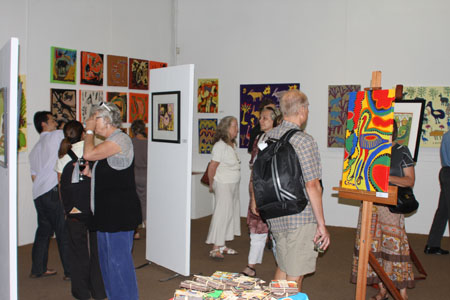
The amazingly unique San art remains amongst the world’s best regarded human inventions. Now, a student who has been captivated by the art, has embarked on a journey to study it further.
Leila Baracchini, a PhD student from Switzerland is doing her research on how San art has impacted on the social development of the San and also how it has influenced art in Botswana as well as internationally. She first came across the art pieces in France at a Kuru art exhibition in 2008.
She was struck by the uniqueness of the craft. She would later learn of its internationally acclaimed status. She knew then she would have to fly to Botswana to experience first-hand how the artists worked. Once in Botswana, she found herself face to face with amazing and unpretentious potential in the Kuru art.
She knew this was what the universe had purposed for her to follow for her PhD Anthropology of Art research requirements. “I had many topics to choose from, but I chose this one,” she said excitedly. So in January, Leila got to work, studying Kuru Art. Her research is affiliated with the San Research Centre and University of Botswana.
She is based most of the time in D’Kar, Ghanzi but she also travels to all the places where Kuru art thrives and attends both local and international art exhibitions specific to Kuru art. The smart young woman that she is, Leila knew she could not possibly do her research effectively while there existed a language rift between her and the people whose art she wanted to study.
So she started learning the Naro language. But even after learning a few of the basics of the language, she found it hard to win the trust of a wary community. “There was no trust and they could not open up to me, but my research depended on them,” she says.
But her humility, good nature and determination to be one of the people won their heart. One person here and another there, they started opening up to her and to trust that her intentions were genuine. Soon her research was in full swing as the people gave her interview after interview.
She got herself a translator to rescue her – for now and then she gets stuck in the maze of clicks that appears to make at least half of the Naro language. Leila will forever remain amazed by Kuru art and its makers. For here is a people who without even basic education, have through art, been able to speak to peoples of different races and languages and far beyond their desert habitation.
Through the art, the San, or more officially Basarwa, tell the story of their hunter-gatherer lifestyle. It is a lifestyle and art that has been passed down from generation to generation over many centuries. The gatherers that they are, the San are great conservationists with much respect for the plants that give them food, water and medicine. Not surprisingly, most of their art works displays various plants.
Part of the magic for the love of Kuru art by Europeans comes from the fact that the makers of these masterpieces are not educated, says Leila. That magic may very well be in the attitude of the artists who tell Leila that working on their art pieces is therapeutic – even spiritual, as they become deadened to their problems when they are immersed in their work.
Leila has equally been struck by the economic capability that the art holds for the San communities. Many of the artists rely completely on their artwork for a living. There is nearly half a year left for Leila to finish her research work. She is determined however that she will go back home having not only satisfied her study requirements and speaking good Naro.
She will be able to play her host’s music instruments. Already she can play the popular dengo or thumb piano. Hopefully, she will also be able make the San’s amazing dance moves that harmonise beautifully with their art and music. .ENDS
Source : BOPA
Author : Ketshepile More
Location : Gaborone
Event : Interview
Date : 02 Sep 2013
Related News

06 Aug 2026

06 Aug 2026
Mayor implores creatives to be innovative

05 Aug 2026
Batho Ba Metsi honours Okavango Delta custodians

05 Aug 2026