Botswana on right path
18 Dec 2019
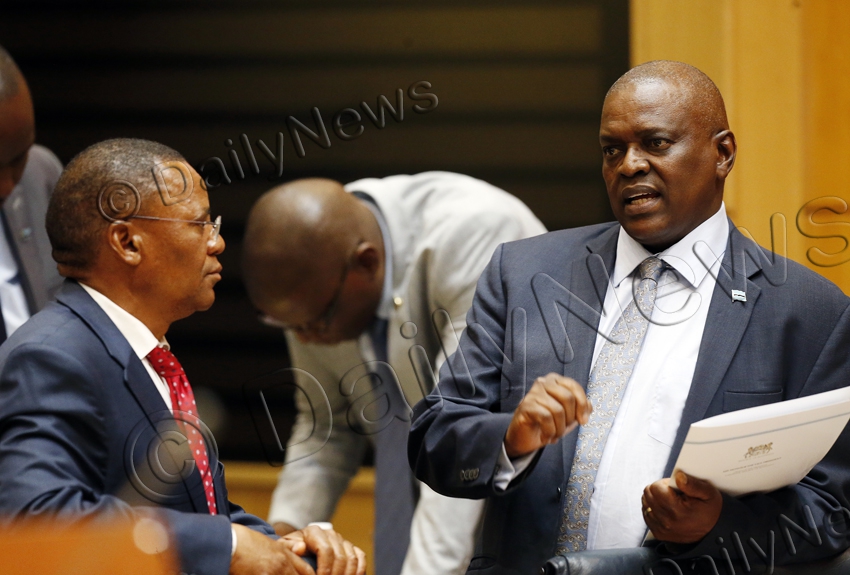
Vice President, Mr Slumber Tsogwane has reiterated Botswana’s progress in transforming from middle-income class to a high-income country.
Responding to the State-of-the-Nation address, the Vice President and MP for Boteti West said the country had made several policy pronouncements that were part of the development roadmap, which sought to propel Botswana to greater heights.
He said such included the National Transformation Strategy that was a blueprint for the Government’s Development Agenda.
Mr Tsogwane said the country had embarked on a vision of transforming from an upper middle-income country to a high-income country by 2036, the vision that he said was a clear ambition to charter on a course driven by transformation and characterised by a knowledge-based and inclusive economy.
To achieve the ambition, the Vice President said it was ideal that a team was set up to design the National Transformation Strategy (NTS) which would provide a strategic roadmap and be a steering vehicle towards achieving Vision 2036.
“This Strategy, which is to be delivered by end of the first quarter of the next financial year, is expected to lay the foundation for years of sustained economic growth, which will put Motswana, indigenous solutions and values at the forefront of strategic solutions to achieve Vision 2036,” he said.
He said the National Transformation Strategy would clearly articulate the milestone projects and programmes that would transform Botswana’s economy across all four pillars of Vision 2036 with ‘inclusiveness’ and ‘sustainability’ at the core of measuring success and impact.
He stated that government had undertaken measures to ensure inclusion of most or all members of the society in the distribution and enjoyment of the benefits of economic growth.
Mr Tsogwane expressed pleasure that the survey results published by Statistics Botswana pointed that the proportion of people living below the poverty datum line had decreased from 19.3 per cent in 2009/2010 to 16.3 per cent in 2015/2016.
He said the household poverty incidence rate decreased from 21.7 per cent in 2002/2003 to nine per cent in 2015/2016.
Similarly, he said the unemployment rate also declined from 26.2 per cent in 2008 to 17.7 per cent over the same period.
He said government had also adopted the multi-dimensional approach to address poverty with in-built strategies focusing on issues of employment, inequality, health, education, sanitation and others to appropriately and comprehensively address the challenges.
Though he admitted some concern over the high youth unemployment rates, the Vice President said incognisance of such, Government had put several initiatives in place to engage the youth in various economic activities, among them, Youth Development Fund and Young Farmers Fund.
He said government had also put in place measures in procurement, which favoured the youth with some projects being reserved for them, as well as reduced tendering fees by the youth.
The Vice President said government had established a link to the African market through the African Continental Free Trade Area to address problems faced by the youth in selling their products. Mr Tsogwane stated that macroeconomic stability was important for ensuring and promoting growth, hence the establishment of the National Development Plan programmes.
“It is a fact that Botswana is well known for its macroeconomic stability in terms of fiscal, monetary and exchange rate policies with prudently managed resources for development. However, the country has some development challenges due to its reliance on diamonds, which are determined by factors outside government’s control,” he said.
In that regard, he said government had put various initiatives in place to improve the livelihoods of Batswana from medium scale enterprises to household level ranging from financial support through CEDA, farmers’ programmes as well as women and youth financial grants. All these, he said, supported the micro level, which included individual firms, households, workers, needy people and the youth.
While mineral revenue constituted a substantial share of total revenue, Mr Tsogwane indicated that the government had not, in any way, neglected the need to broaden and deepen the non-mining tax base.
Admittedly, he said there was a need to shift from heavy reliance on mining revenues, hence efforts aimed at diversifying the economy from the traditional sources being put in place.
He said the Economic Diversification Drive (EDD) was currently under review to put in place interventions that would enhance implementation of the EDD strategy as well as coming up with legislation that would ensure compliance by all stakeholders. ENDS
Source : BOPA
Author : Thato Mosinyi
Location : GABORONE
Event : Parliament
Date : 18 Dec 2019
Related News
13 Aug 2026
13 Aug 2026