


Interview to TASS News Agency
21 Oct 2019
Drug and alcohol abuse is a menace in society, which has far reaching effects on the functioning of the body and brain of the user.
The addiction inhibits the body from functioning optimally as it lowers reaction and good judgment, leading to risky behaviour.
The health consequences of drug abuse can be long lasting and permanent, as some continue even after a person has stopped using.
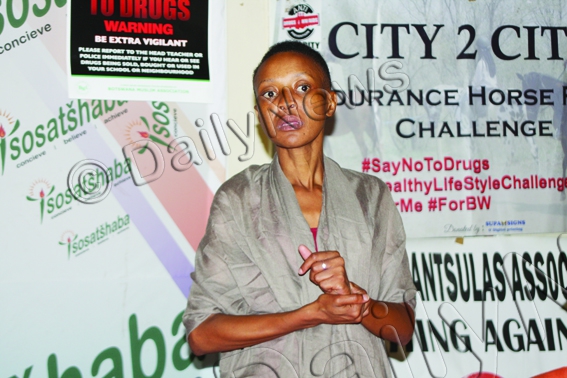
Drug and alcohol addict and a peer educator, Ms Tapedza Sekelemani has vowed to help spread the message about drug and alcohol abuse as well as the associated risky behaviours to the members of the public.
A member of Captive Eye Organisation and one of those affected by drugs and alcohol abuse, Ms Sekelemani shared her experiences of living with substance usage disorders during a City 2 City Anti-Drug and HIV prevention campaign briefing in Francistown last week.
“I am unemployable, despite my good academic background and good grades, I am at a point where I do not have anywhere to turn.
I still have the problem with addiction, I struggle with it every single day of my life and will do until the day I die,” she said.
Narrating her ordeal, she said she had been struggling with drug and alcohol addiction for over 20 years, having started at age 14. Despite having a good upbringing and good education, she conceded that she made bad choices and got herself trapped into addiction.
Ms Sekelemani dismissed perceptions that it was just people from poor families or a certain area that were affected as evidenced by her background, stressing that being an addict, was a serious challenge.
Living with substance usage disorder, the 37-year-old mentioned that she was also a member of a key population because it led her into sex work.
“Your walking through the streets at night gets you exposed to thieves, having unprotected sex, either by force or because you are desperate to get drugs, that you end up getting any sum of money from any random man you meet on the streets as that would only be what would matter at that moment,” she said.
Explaining how dangerous all that was, Ms Sekelemani said that she had two friends murdered on the streets due to the desperation to get another fix to quench the cravings.
She further explained that one of her deceased friends was murdered over a P100 change, which she had used to buy drugs as she was desperate for a fix, despite having been ordered to return the change by a certain man.
She revealed that her friend’s body was found almost decapitated, with her private parts stuffed with used condoms and the body was displayed on the streets of Block 7 in Gaborone.
Ms Sekelemani said this was not just a problem that affected those with the risky behaviours, but also their families and loved ones, as they would not know what to do with the family members who are addicted.
“They love us but start to love us in the wrong way and it becomes a sickly cycle, which makes everything worse,” she said, urging members of the public to look at ways their addict family members could be helped to deal with it.
She also noted that drug addicts make their families’ lives miserable as they steal from them and do all sorts of things.
She said the addiction grips one’s mind, body and soul and often there was very little one could do once they are in it, without some kind of help or somewhere to turn.
Ms Sekelemani said some of the risky behaviours that drug addicts turn to include belonging to trap houses, where they often feel free and welcome.
A trap house, she said, was when a drug dealer would take over a house and accommodate drug addicts inside to freely smoke, drink and do all sorts of activities.
Inside the closed doors of a trap house, she revealed, were men having sex with other men in exchange for money or drugs, men selling their girlfriends or siblings to get money for drugs, and sharing of needles, which leads to the spread of sexually transmitted infections (STIs), including HIV.
“People in there do not even know their statuses, you go into the house and find out that there are some who have been inside for almost two weeks and have not set foot outside. They do not bath, do not eat nor sleep and they constantly live in fear of what they necessarily do not know,” she said.
She said most probably go home to their families, but lived with fear of what they should say or do, especially when one finds out that they have contracted an STI, adding that they often choose to hide in shame.
Ms Sekelemani said trap houses were everywhere and that even minor children were often part of the traps.
She said drug dealers sell to minors and would even go to the extent of waiting for children outside school premises to sell them drugs.
Although they often know their drug dealers, she said it was very unfortunate that they could not share information with security officials or anyone as it would endanger their lives.
“Someone has said that snitches get stitches, so who would want to risk it, I have been stabbed with a knife on my hands a few times because I had reported someone,” she revealed.
She added that another reason drug dealers continued their work unabated was because certain law enforcement officers worked alongside them, therefore it would be difficult to stop the distribution of drugs.
Ms Sekelemani also shared that she had at one point been human trafficked by a drug dealer and she found herself in South Africa, with other girls lined up for sale to men, adding that fortunately, she was able to escape from the house she was kept in and made her way back home.
The peer educator noted that drug addicts needed help from the public and relevant people because the next victim could be from anyone’s family.
She added that people should not shun those affected, but help them live past the addiction, hence why she was working alongside Captive Eye Organisation and Botswana Pantsula Association (BPA) to fight drug abuse.
Captive Eye Organisation and BPA are in place to address social ills, she added.
In their endeavour to educate the public about HIV prevention, condom use, substance abuse and dependence, alcohol abuse and mental health, the two will host a City 2 City Anti-Drug and HIV prevention campaigns next month, starting in Francistown on November 02, later proceed to other places until it reaches Gaborone.
Botswana Pantsula Association Chairperson, Mr Peter Modise said the campaign would start with a health screening, then a parade march to Donga Kgotla and later culminate in an evening musical festival, at the Francistown Old Stadium.
He added that there would also be a donation of sanitary pads to secondary schools’ female students in villages along the A1 road.
Giving the overall objective of the campaign, a member of Captive Eye Organisation, Mr Percy Mothibi said the issue of drug and alcohol abuse was worrisome as it brought about numerous social ills, hence the need to intensify the campaign.
He mentioned that there were drugs such as crack cocaine, which he said were highly addictive.
He said drug usage happened even in schools, where teachers were experiencing silent drop outs by students, adding that in some instances, students just attended school not to learn, but to sell drugs to their peers.
Mr Mothibi said a lot of crimes in the country were a result of the influence of drugs and alcohol.
“The abuse also leads to Satanism as some of our beneficiaries have explained to us. Our children sell their souls to the devil and he takes control of their lives,” he said.
On other issues, he explained that too much drug usage affected communities and scared away investors, urging leaders and government officials involved in such issues to partner with them to address drug and alcohol abuse in Francistown.
Mr Mothibi said the partnership would be important as the two organisations hoped to hold campaigns annually, which he highlighted, would enable them to access financial assistance to open up a friendly centre in Gaborone to help those living with substance use disorders.
Francistown District Health Management Team (DHMT), Sexual reproductive health coordinator, Ms Caroline Setshego said it was high time the country opened up to the idea of building rehabilitation centres because on its own, public education was not enough. ENDs
Source : BOPA
Author : Keneilwe Ramphotho
Location : FRANCISTOWN
Event : Interview
Date : 21 Oct 2019
Related News

13 Aug 2026
Six decades of judicial growth

13 Aug 2026
Botswana and South Africa reaffirm cooperation

13 Aug 2026