


Masisi visit beacon of hope to Lempu
26 Sep 2019
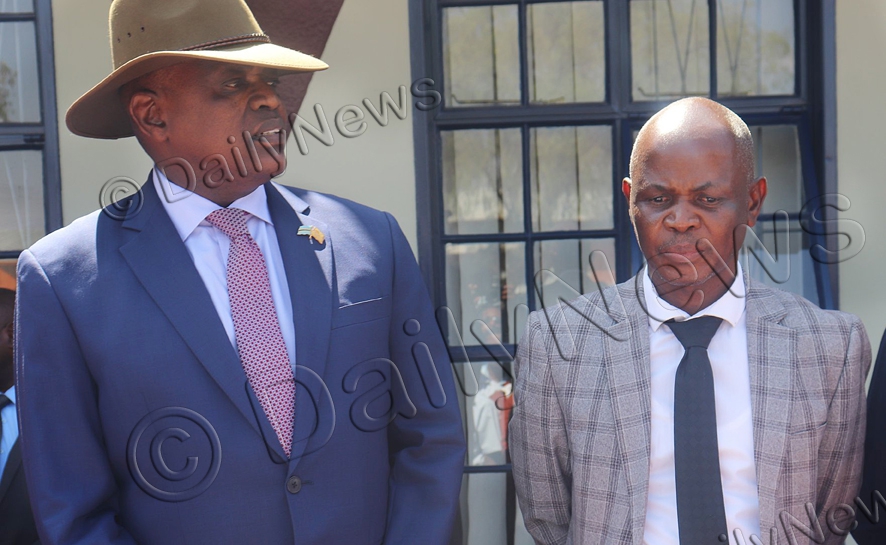
President Dr Mokgweetsi Masisi’s visit to a teacher and student community seemingly consumed by hopelessness at Lempu Junior Secondary School in Salajwe on September 24 has spurred them to rise to the occasion to overcome the numerous challenges they grapple with daily.
Among the challenges is an unexplained mass hysteria that had both government and the community racing against time to try and arrest the situation that had a number of students missing classes while others may not sit for their final examinations at the end of the year.
President Masisi’s visit followed a kgotla meeting in the village, whereupon after having a brief luncheon with the community felt the urge to drop in at the school to ‘just meet and greet’ the school staff and students.
Excitement of seeing the first citizen standing right before them and wearing a broad smile, got the better of everyone as hope replaced gloom in an almost downcast school populace.
Rightly so because President Masisi as head of government will see to it that action is taken to address the debilitating conditions in the school.
Top on the list is congestion at the student hostels. While the school’s boarding facility has a capacity to house about 288 pupils, the major challenge currently is congestion in that the number of pupils accommodated almost double.
There is an overflow of 231 pupils, given that there are 519 boarding pupils comprising 281 boys and 238 girls.
Such calls for prompt action by government or private sector, let alone a good Samaritan, to rescue the situation before any eventuality that cause untold misery.
That is because in March this year, the school experienced an unprecedented outbreak of mass hysteria causing enormous disruption to the normal day to day teaching and learning. The sad outcome of such is that about 92 students are reported to be not attending classes, out of which 28 are Form Three students, 40 Form Ones and 24 Form Twos. This means that the Form Threes will not be sitting for their final Junior Certificate Examination (JCE) this year.
Congestion at the school is also caused by the increase in the number of streams from 15 to 19, further compounding shortage of classrooms.
Following investigations on the cause of the mass hysteria, there is also a good chance that overcrowding or cramming of boarders may be also to blame.
The situation had caused anxiety among the students, who in an attempt to come to terms with the situation, some felt it was some kind of spiritual possession while others concluded it was due to mold exposure given the symptoms presented.
However, modern research suggests signs of mass psychogenic illness, a form of mass hysteria. According to Wikipedia, Mass psychogenic illness (MPI), also called mass sociogenic illness, mass psychogenic disorder, epidemic hysteria, or mass hysteria, is ‘the rapid spread of illness signs and symptoms affecting members of a cohesive group, originating from a nervous system disturbance involving excitation, loss, or alteration of function, whereby physical complaints that are exhibited unconsciously have no corresponding organic aetiology’.
The condition is said to involve the spread of illness symptoms through a population where there is no viral or bacterial agent responsible for contagion.
Further, research shows that MPI is distinct from other types of collective delusions in that it involves physical symptoms. Some scholars say mass hysteria is to date a poorly understood condition.
Little certainty exists regarding its etiology. Qualities of MPI outbreaks often include symptoms that have no plausible organic basis, symptoms transient and benign, those with rapid onset and recovery, occurrence in a segregated group as well as the presence of extraordinary anxiety.
Some symptoms are said to spread via sight, sound or oral communication, a spread that moves down the age scale and affecting females in the main.
With little or no knowledge of the major cause as well as uncertainty, some parents have become skeptical and hesitant to have their children admitted for junior secondary at the only school in the village.
It is also reported that some parents whose children are doing Standard Seven in feeder schools that include Sorilatholo, Kaudwane, Monwane, Khudumelapye, Salajwe and Malwelwe, have as a result, written letters to the education ministry, through the regional office, requesting that their children should not be admitted at the school for their junior secondary education next year (2020).
Teachers are also reported to be unwilling to take positions at the school hence a number of vacant posts.
The situation deteriorated to such an extent that the Vice President, basic education minister and permanent secretary, district commissioner, council secretary, regional office, civic leaders, dikgosi and ministers’ fraternal, visited the school to offer psycho-social support to affected learners.
Besides, efforts are on course to upgrade the school and make it more habitable and conducive for a learner environment.
Thus, four conservancy tanks have been erected to curb water logging while hostel toilets were dislodged in May and June this year.
The basic education ministry has also refurbished about 70 bunk beds, provided 200 mattresses and 50 chairs, in addition to installing a cold room and a freezer.
As a way of support, guidance and counselling officers have also been dispatched to the school to provide counselling to the entire Lempu JSS community.
However, the sad part is that the mass hysteria, that had affected about 145 students, continues unabated in that some students continue to miss classes because of relapses.
As a mitigation factor, the District Health Management Team has embarked on a study through which all the 145 affected as well as 314 unaffected students have so far been interviewed. The team is said to be still analyzing data with preliminary results indicating that boarding girls in Form One and Two are the most affected.
Interviewees are said to have complained about lack of security and inadequate lighting at the dormitories apart from filth in the ablutions.
A number of students are also reported to have suffered some history of bullying, depression and anxiety besides physical abuse.
In concluding the study, the health team met with the school authorities to discuss preliminary results and recommendations as a way forward and such includes expediting renovation of some buildings at the school and further continuing with psycho-social support for students.
As word of encouragement, President Masisi took time to comfort Lempu JSS students to work hard in their studies especially in Science, Technology, English and Mathematics (STEM) because economies which grew fast or instantly worldwide depended on such subjects.
He observed that where students knew and understood such subjects at their level, they were able to reach high levels of schooling and managed to choose their careers paths so easily.
“These studies will open opportunities for you to go and work in other countries around the world. Secondly, I encourage you to do what is in your hearts and minds, that which you have passion for so that you can be able to bring solutions to every problem in the country with your studies.
Right now we are facing a problem with the current disease and high temperatures.
You must have competitions, do some research or investigations to find out what you can do with these high temperatures. We, as the nation, are expecting good results with your researches and investigations,” he said.
He also encouraged them to set targets to do better and create things they can patent, copyright to create jobs for others or make own income.
“Not all of you can have cattle posts and lands.
There is shortage of land countrywide, so you must get some small space, do something that will create employment for others while it gives you income in both local and foreign currencies so that you get rich.
And with your wealth you will be able to develop this country.
So I wish you luck. I am very happy to see you,” President Masisi said.
Meanwhile, not only were the students and staff thrilled by President Masisi’s visit. It appears many in the village also left hopeful after the kgotla meeting, particularly after an announcement that construction of Letlhakeng-Kaudwane road would be made a priority given it was in a bad state and resulting in frequent breakdowns of government vehicles.
Salajwe is one of the 23 villages under Letlhakeng Sub-district administration, which is considered among the poorest in the country. With just a population of about 2 440, according to the 2011 population and housing census, the village falls under Takatokwane Constituency which has six council wards.
It is reported that while government has tried to address such status through poverty eradication programme in the sub-district, there still arises challenges such as lack of markets for the products and poor performance by the programme resulting in high numbers of people requiring social safety nets.
Statistics show that currently, the village’s enrolment into social safety nets, which includes destitute, needy students as well as orphans stands at 329, with females topping the charts.
In addition to such statistics, it is indicated that nine students are attending different brigades while three were this year placed for tertiary education in different institutions through Special Dispensation Programme.
Also in effort to address challenges engulfing the village and its populace, all needy students and orphans receive toiletry when schools re-open every term.
Private transportation is also provided for needy students and orphans during school holidays given that the council fleet is unable to handle the pressure that comes with such service.
Like any other village in the country, Salajwe has not been spared defilement cases. Reports indicate that the social and community development programme is currently handling a case in which a teacher has reportedly violated a student and the case is before the courts while, after such incident, parents requested that the child be transferred to Gaborone.
Government, as a measure to discourage such acts, through the recent Parliament sitting, amended the act so that perpetrators receive harsh penalties and face a sentence of 10 years for sexual relationship with those below the age of 18 instead of 16.
On the other hand, while President Masisi continues to preach cleanliness as he goes around addressing kgotla meetings, Salajwe is currently looking into debushing of government facilities and engage in village clean-up exercise which will include litter picking around the village.
Also in the plan to keep the village clean is debushing of internal road reserves, construction of bus shelter and maintaining the pit latrine at the kgotla as well as dam desilting.
Expectation is to see Salajwe at par with other villages, especially those in its proximity, as a centre for tourism. BOPA
Category Numbers Per Area
Male Female
Destitution 36 112
Needy Students 64 64
Orphans 22 31
TOTAL 122 207
Source : BOPA
Author : Thelma Khunwane
Location : Molepolole
Event : Masisi promises solution to Lempu woes
Date : 26 Sep 2019
Related News


13 Aug 2026
Six decades of judicial growth

13 Aug 2026