Experts explain how bail works
21 Aug 2019
Granting bail to an accused person has been in existence since time immemorial.
According to historians, in medieval England, the sheriffs originally possessed the sovereign authority to release or hold suspected criminals. But this was changed as some sheriffs would exploit the bail for their own gains.
Fast forward to our time, it seems some people are not comfortable when courts of law grant accused persons bail. The assumption is that the accused are granted bail at the expense of the complainants.
Bail, according to law experts, is the conditional release of a defendant with the promise to appear in court when required.
Recently a large and furious crowd filled Extension II courtroom showing disapproval of murder suspect being released on bail.
The trial was that of Simon Badisa Kgowe, who is accused of murdering his girlfriend, Elizabeth Kerekang, by cutting off her head at Block 3 location and dumped her headless body at Maratanang ward in Tlokweng in 2018.
The prosecution team stated that investigations into the matter were almost complete as they had in possession the evidence they were looking for hence they would not oppose the accused being granted bail.
The court went on to grant the accused bail on condition that he should not interfere with witnesses.
The accused was ordered to pay P5 000 in order to be granted bail as well as to bring two sureties that would bind themselves with P5 000 each.
Members of the public could not understand how the court came to the conclusion to release the accused back into the society, after allegedly committing such a heinous crime.
In his book titled; The Bail Book: A Comprehensive look at Bail in America’s Criminal Justice System (2017), Shima Baughman defines bail as a temporary release of a person awaiting trial for a crime.
The decision to remand or release an accused is made in court rooms every day all over Botswana.
It is a decision that often takes a few minutes and does not require much evidence. But what happens within those few minutes tells a significant story about criminal justice system in Botswana.
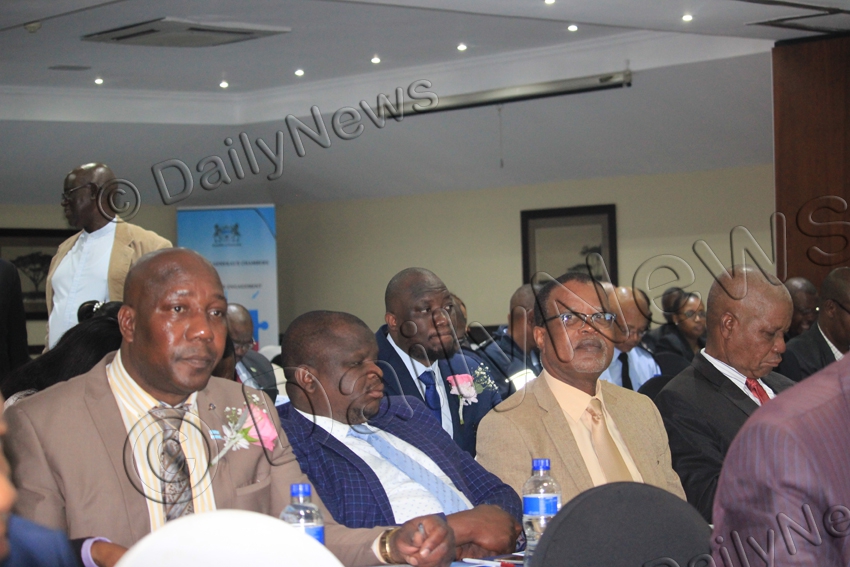
Deputy Director of the Directorate of Public Prosecution (DPP) Mr Wasson Manchwe recently told a Bail Pitso in Francistown recently that the freedom and security of a person is a fundamental right which is protected and guaranteed by the laws of Botswana.
“The starting point of this discussion is Section 3 (a) of the Constitution of Botswana which guarantees every person in Botswana the right to life, liberty, security of the persons and the protection of the law” subject to rights and freedoms of others and for the public interest.
He said the enjoyment of this right like that of other fundamental rights was subject to such limitations as were contained in the respective provisions which limitations were designed to ‘…not to prejudice the rights and freedoms of others or the public interest.’
Mr Manchwe further explained that Section 5 (1) of the constitution sets out circumstances under which a person may be deprived of his/her personal liberty.
Particular interest is on sub-section thereof which permits deprivation of personal liberty ‘upon reasonable suspicion of his or her having committed or being about to commit, a criminal offence under the laws of Botswana.’
He further added that Section 5 (3) (b) of the constitution gives direction on how a person arrested or detained as aforesaid and who is not released on bail is to be dealt with. If such person is not tried within a reasonable time, then without prejudice to any further proceedings that may be brought against him/her, he or she shall be released either unconditionally or upon reasonable conditions to ensure that she/he appears at a later date for trial or for proceedings preliminary to trial.
While section 10 (2) (a) entrenches the presumption of innocence in favour of any person accused of any criminal offence.
He explained that the foregoing indicates that the right to liberty is not to be abridged or taken away lightly adding that Section 104 of the Criminal Procedure and Evidence Act grants magistrate’s discretion to grant bail to persons committed to trial for any offence save murder and treason.
Still under the same Act, Section 133 provides that any person who considers himself aggrieved by the refusal of any magistrate court to grant him/her bail can appeal to the High Court who shall make such order while section 144 of the same Act gives the High Court the power to grant bail “Except where otherwise expressly provided the High Court shall have power, at any stage of the proceedings taken in any court in respect of an offence, to admit the accused to bail, whether the offence is or is not of the offences specifically excepted in Section 104 (Murder and treason).
Mr Manchwe further stated that it should be noted that the courts do not take a passive approach when determining whether an accused be released on bail. The courts rather exercise their discretion by balancing the interests of society, the accused and justice enshrined in the Constitution.
Also, he said, the court is also interested in whether or not the accused is guilty of the alleged offense. That determination is left to the trial court. What the interests of justice entail is a value judgment of what is fair and just in an open and democratic society for all concerned.
The leading case in the subject of bail is the matter of Binikwa v The State 2005 (1) BLR 285 (HC). At paragraph 38 the court held the following:
‘The courts do not like ever to deprive a man of his freedom while awaiting trial. He may be innocent and then it would be very wrong. Also, even if he is guilty, we try not to deprive him of his freedom until he has been convicted.’
Nevertheless, the ugly fact remains, however, that public peace and security are at times endangered by the release of persons charged with offences that incite public outrage.
Deputy Secretary (Justice) in the Ministry of Defence, Justice and Security, Mr Nchunga Nchunga said that much still needs to be done to instill in the community a proper understanding of the presumption of innocence and the right to freedom pending trial.
He explained that bail was not the real problem with the general public but a symptom of the slowness of the whole process right from the investigation up to the trial.
The Receiver in the Ministry of Defence, Justice and Security Mr Bafi Nlanda said there must be a balance between the two extremes of upholding personal freedoms and guarding the interest of justice, which will suffer if the accused should abscond before trial or appeal.
He said on the contrary of denying the accused bail would come at a cost to government if it results in the following; the rise in the costs of maintaining prison facilities, the high cost of building more prisons, suspects who ultimately get acquitted suing the government, as well as material cost of keeping people in remand bearing in mind that the courts are clogged with cases.
Bail serves mainly three purposes: First, the liberty interest of the accused, second the public interest (to avoid overcrowding in prions) and lastly by reducing the number of families deprived of a breadwinner.
Mr Nlanda said there are reasons why bail is refused. The purpose of refusing bail is to protect the community and to reduce the likelihood of further offending, and should not be used to punish or coerce the accused into a course of action. He said bail can also be refused for safety of the suspect (s) from the public.
It should be understood that a person who is on bail before trial has not been convicted of an offence, and this accords with the principle of the presumption of innocence.
There are five different types of bail, although some of them are used less frequently than others. The most common used ones in Botswana are the cash bail, surety bail, and release on own personal Recognizance.
Cash bail means that the accused pays the full amount of bail in cash while surety bail or bond is used for any amount of bail, but it is especially useful when the accused cannot afford to pay his or her bail.
This type of bail often requires the involvement of a close relative or friend of the accused contacting a bail agent. The bail agent will make sure that the accused is compelled to appear in court as and when required and if the accused does not appear, the bail agent will have to pay the full amount of money attached to the bail.
Release on own personal recognizance is a type of bail with no condition other than the arrestee (s) promises to appear in court.
Different speakers at the conference lectured on the conditions that are attached to the bail and one such common condition is the promise by the accused that (s)he will not commit another crime during the adjudication of the crime. If the accused breaks such a condition, the bail is automatically forfeited.
Interests of society, the accused and that of justice are protected by providing legally permissible conditions for the release of the accused on bail. These include the accused reporting to a local police station, the accused staying away from possible witnesses and victims and even handing his or her passport over to the police until the determination of his guilt is made by a competent court.
They said these conditions, which are subject to the courts judicial discretion, are there to secure the accused’s release from the holding cells to ensure that the accused does not in any way hinder the investigation, that the accused does not commit any another offence, that members of the public are protected and lastly to ensure that the accused attends his next court appearance.
But at the end of the conference, it became clear that bail is not a favour from the presiding officers nor is it denial form of punishment either. Bail is a constitutionally guaranteed right in the Bill of Rights.
Reading from the mood of the conference one can deduce that issuance of bail in Botswana is here to stay because bail is usually given to people who are not considered to be a risk if they stay in the community but may need to follow rules or conditions.
Perhaps what is more needed is rigorous public education on issues surrounding bail because our society is predominantly conservative. ENDS
Source : BOPA
Author : Thamani Shabani
Location : FRANCISTOWN
Event : Two-day Bail Pitso event
Date : 21 Aug 2019
Related News

15 Aug 2026
15 Aug 2026