Researchers introduce new grass at Lobu
15 Aug 2019
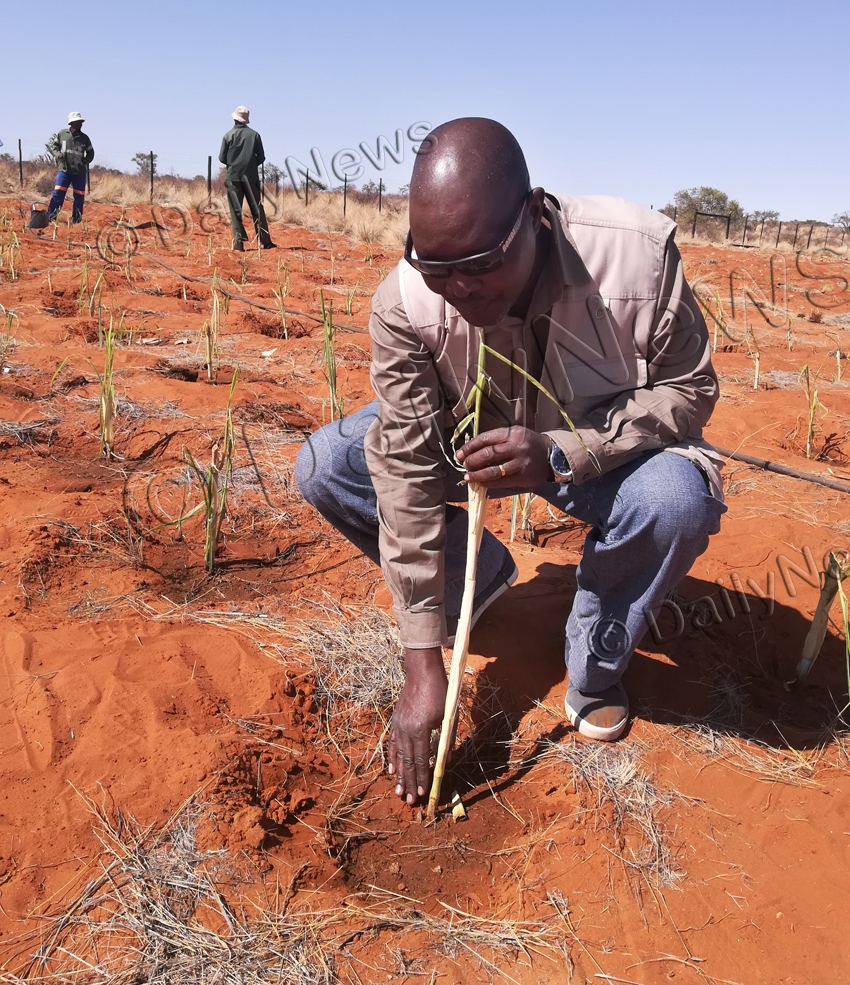
The Department of Agricultural Research (DAR) has introduced Napier grass at Lobu small stock farm.
It is part of efforts to train farmers to adopt climate smart agricultural practices to deal with the effects of climate change.
Speaking in an interview during demonstrations of how the grasses; Napier and cencrus cilliaries as well as the salt boast shrub were planted, director of DAR Dr Pharaoh Mosupi said it was critical for farmers to adopt and apply technologies for climate smart agriculture.
He said DAR introduced the technologies to improve the adoption rate as climate change was real and farmers needed to adapt.
As a training farm for small stock, he said Lobu would be used to train more farmers about natural feeds and to feed the livestock at the farm.
He said research that was done on Napier, cencrus cilliaries and salt boast shrub proved that they carried traits that enabled them to survive in sub-Saharan climatic conditions.
Dr Mosupi said the Napier grass contained more protein, roughage and carbohydrates.
He said after planting the grass, especially in the first two weeks, farmers should ensure that the ground had good moisture content and that afterwards watering could be done intermittently.
“When the rain comes you rely on the rain,” he said, adding that planting it was easy and that the grass would grow and spread fast afterwards.
He cautioned that it was important to plant and harvest Napier grass to feed livestock and not to allow animals to feed directly from the grass bed as they could destroy it.
Another grass planted was cencrus ciliaries, commonly referred to as molekangwetsi, which he said was a tough grass that carried the same nutrient content as Napier and provided natural feed for livestock.
Dr Mosupi explained that it was easy to plant and manage the grass, which could also be used to replenish the range where the farm was eroded.
Furthermore, cencrus easily grows in rainy seasons and also spreads easily.
However, he said caution must be exercised as the grass required well drained soils such as sandy soil to thrive.
“It is difficult to rely on natural grass in the range because it dies during drought seasons. Planting and managing the grass would provide the necessary food for animals, and the animals will not feel the pinch of the drought season,” he said.
Dr Mosupi said it was critical to get it right from the beginning as the grass might not grow and yield properly.
Kgosi Giel Jacobs of Gakhibane, who is a small stock farmer, appreciated the demonstrations, saying they would help him to plant Napier grass the right way. He said in the past, he planted the grass but it did not grow well because he did not do it right. ENDS
Source : BOPA
Author : Calviniah Kgautlhe
Location : MIDDLEPITS
Event : INTERVIEW
Date : 15 Aug 2019
Related News

15 Aug 2026
15 Aug 2026