High literacy rate key to economy transformation
29 Jul 2019
As the country is moving towards a knowledge based economy, literacy is underscored as a critical skill for everyone as it enables them to achieve their goals.
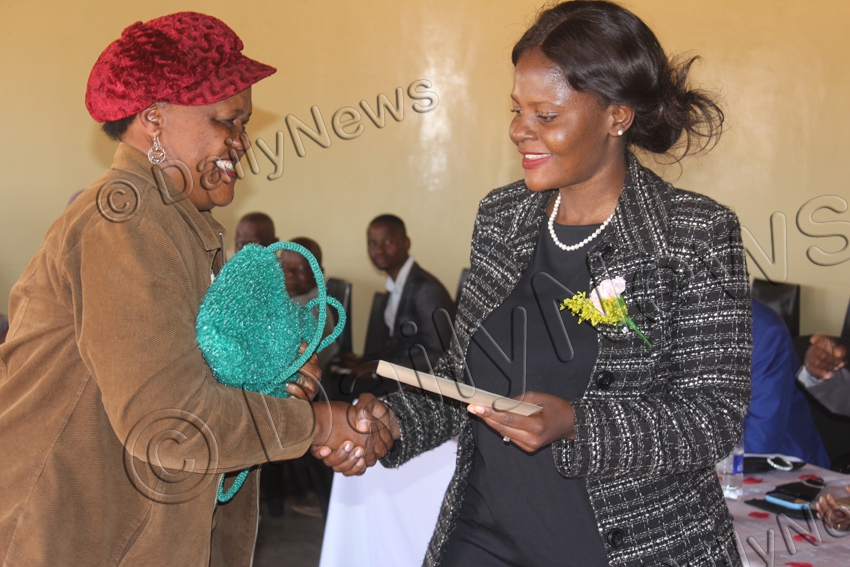
Speaking during the award ceremony of Out of School Education and Training (OSET) at Ditshegwane, recently, Dr Keneilwe France from the Department of Lifelong Learning and Community Development at the University of Botswana, said no one should be left behind without literacy skills or excluded because of the language being used to teach literacy.
Dr France said according to UNESCO (2004), literacy is the ability to identify, understand, interpret, create, communicate and compute using printed and written materials associated with varying contexts. She further said ‘literacy involves a continuum of learning in enabling individuals to achieve their goals, to develop their knowledge and potential, and to participate fully in their community and wider society’.
Dr France buttressed the importance of teaching literacy in one’s own language so that no one is denied the right to learn, adding that this makes language an important factor in teaching and learning of literacy contexts.
“Research has however shown that learning to read and write in one’s home or first language or mother tongue facilitates access to literacy as well as the ability to read and write in other languages (Brook-Utne, 2000)”.
She therefore said this accentuated the importance of adult literacy in mother tongue or home language and as such no one should be excluded from adult education classes because of their language.
Dr France said the theme; Literacy and Multilingualism, fitted the recommendation of UNESCO (2003) that adult literacy learners should make their first steps to literacy through mother tongue.
She said UNESCO also recommended a bilingual/multilingual approach to literacy, which should be a key element of linguistically and culturally diverse societies, which means ‘we should not only have Setswana and English as media of instruction in our literacy classes, mother tongue should be considered as well’.
She added that in a knowledge based society, considering globalisation and technologically advanced societies, it is not only enough to read and write but one should be literate enough to read and understand instructions given in English but also learn other languages other than their own.
Dr France said ‘we should learn to read and write other languages because we want to be global citizens who can be able to explain their products to somebody who does not speak our language.
She encouraged men in the region to come forth and learn literacy as statistics show that more women than men were enrolling in the OSET programme. The statistics show that there are 1435 women enrolled against 718 men.
When giving an overview of Out of School Education and Training, Kweneng Director of Regional Operations, Mr Benson Rauwe said literacy in the country started many years back, facilitated by the then missionaries who were teaching Batswana the word of God.
He said the Botswana Government introduced Botswana Extension College where people were taught through radio sets distributed to different communities. Mr Rauwe said in 1980, the National Literacy Programme (NLP) was piloted and launched in 1981 under the Department of Non Formal Education, which is now known as Out of School Education and Training.
The director further said the main objectives of NLP was to eradicate illiteracy and enable 250 000 people to become literate in reading and writing Setswana as well as compute simple arithmetic, enable participants to apply knowledge in their cultural, social and economic life and also perform and exercise rights and obligations of citizenship.
“It should be noted that when the programme was piloted in 1980, the literacy rate was at 40 per cent and we are currently at 90 per cent.
Kweneng district also experienced this growth as indicated by Statistics Botswana report after the 2011 census, which showed that the highest literacy level in the district is 98 per cent with the lowest village at 52.1 per cent,” he said.
Mr Rauwe said this called for more focus on expansion of the programme to areas that are lagging behind and matching the recruitment strategies with the 21st century.
He said the 1994 Revised National Policy on Education recommended that the department develop a programme that would be equivalent to Standard VII and also recommend the teaching of Out of School children in both urban and rural areas by providing those who want to join formal school with equivalent curriculum.
The director said some other achievements included the implementation of Adult Basic Education programme, out of school education for children, and the skills development and training programme with adult education programme having their blue print and OSEC policy developed.
He said despite their achievements, they still had challenges among them lack of resources, inadequate teaching materials, access problems, qualified skills trainers and start-up project funds.
In his welcome remarks, Kgosi Selelo Kelebang said learning to read and write was critical to one’s development and social dignity as they acquired the necessary skills to live a better life.
Kgosi Kelebang therefore urged those still lagging behind to come on board. Ends
Source : BOPA
Author : Booster Mogapi
Location : Ditshegwane
Event : Award ceremony
Date : 29 Jul 2019
Related News

15 Aug 2026
15 Aug 2026