Botswana commits to conservation sustainable practices
16 Jul 2019
Assistant minister of Agricultural Development, Food and Security, Mr Kostantinos Markus has said Botswana is committed to conservation and sustainable agricultural practices in order to address the issue of climate change and food security.
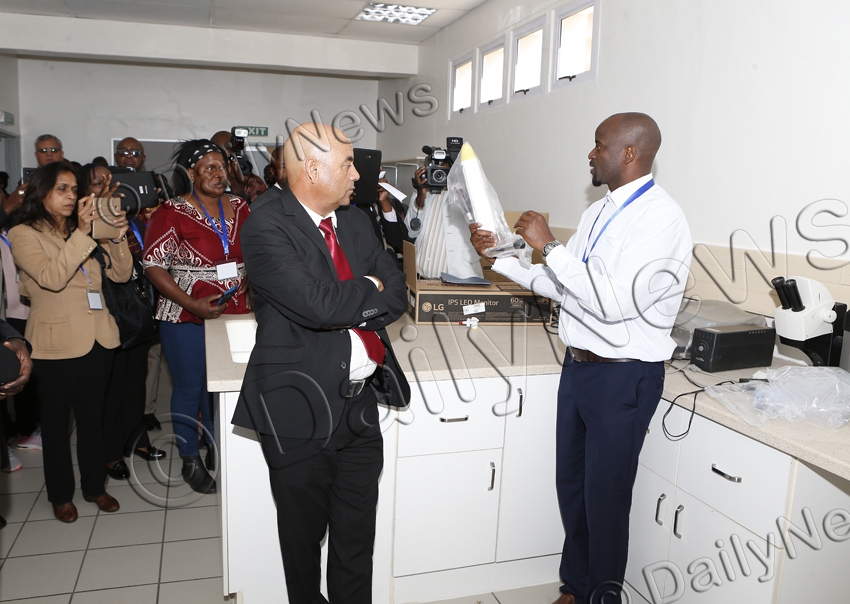
Speaking during the hand over of equipment for the animal genetic resources bank donated by AU-ABAR and the European Union (EU) recently, Mr Markus stated that Botswana was grateful to have benefited from the genetics project.
He noted that the AU-IBAR assisted with the funding from EU, purchased the equipment worth over P3 million.
Mr Markus said the importance of farm animals’ genetic resources in Botswana and the region as a whole could not be over emphasized, stating that domestic animals produce food such as milk, meat and by products such as hides and fibre as well as provision of transport.
He mentioned that livestock therefore contributed significantly to food supply and nutrition since animals were a major source of high quality proteins, minerals, vitamins and micro-nutrients. “It is estimated that meat, milk, eggs provide about one fifth of the proteins of the African diets,” he said.
He mentioned that despite benefits that farm animal genetic resources provide to society, they were threatened by disappearance which has necessitated global efforts to address the loss of genetic diversity within the livestock production systems.
He said the genetic erosion was attributed to among others, the uncontrolled cross breeding, neglect, wars, livestock diseases and others.
He mentioned that in Botswana, the outbreak of diseases such as foot and mouth disease (FMD) negatively affected the livestock populations, especially those of cattle.
“As a result of these diseases some useful ecotypes, strains and breeds are gradually being lost” stated Mr Markus.
He pointed out that the lost breeds or strains represent important genes which may be needed in the future to address global challenges such as diseases and climate change.
“A classic example in our case is the indigenous Tswana pigs whose numbers have drastically dropped to below 1000 nationwide,” he stated, adding that such numbers compelled Botswana as a country to take necessary measures.
He therefore said during such times of global warming and climate change, the importance of the existence of the gene bank facility could not be over emphasised.
He said Botswana was compelled to ensure food security for her people, adding that farm animal genetic resources was a means of ensuring such.
Mr Markus also said Botswana had put in place the livestock improvement act of 2009 that established the Animal Advisory Board, which among others advises the Minister of Agricultural Development and Food Security on issues related to conservation of farm animal genetic resources.
He further said the act also provided for the establishment of breeder societies for the different livestock species, and stated that the development of breeder societies in the country was still at a fledgling stage with more still needing to be done.
He urged African Union member states to ensure they were not left behind on issues of conservation and stainable utilisation of animal genetic resources. Ends
Source : BOPA
Author : Naomi Leepile
Location : Gaborone
Event : Handover ceremony
Date : 16 Jul 2019
Related News

15 Aug 2026
15 Aug 2026