

Building kraals not economic - minister
19 Jun 2019
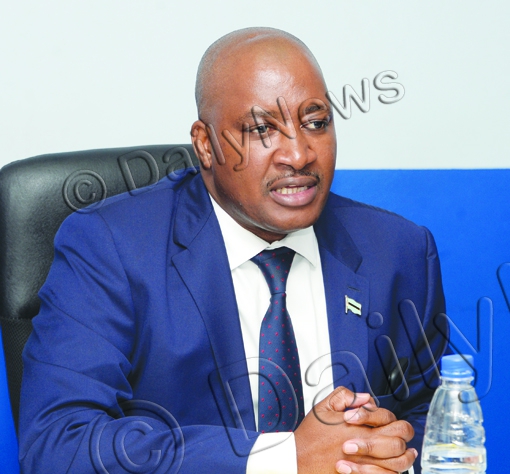
Minister of Agricultural Development and Food Security, Mr Fidelis Molao says it is not economical to construct cattle holding kraals in Botswana as in Namibia.
He said their counterparts in Namibia informed them that the holding kraals were contructed to confine cattle from Botswana while waiting for officials to collect them.
The minister was responding to recommendations by the North West Council following a tour by a team from the council to assess the state of the boundary fence along Caprivi Strip, Namibia.
The team was assigned to conduct the exercise after the recent outbreak of Contagious Bovine Pleuropneumonia (CBPP) in Caprivi Strip, Namibia. It recommended that basic border facilities where customers could be assisted be provided since there were no holding kraals for cattle like in Namibia.
Mr Molao noted that holding kraals could be a disadvantage to the district, saying once they discovered that cattle from Namibia had CBPP, it would mean that the whole district would be infected.
He also said it would be duplication of resources as they believed that it was not economical to construct holding kraals.
He appreciated efforts by the council, saying it was an indication that they wanted a permanent solution to livestock diseases that had crippled their district.
He also applauded some of the recommendations and said efforts would be made to act on those which could be implemented such as de-bushing roads, but said some would take time to address because of financial constraints.
Some of the recommendations requested government to source funding for the de-bushing, rehabilitation and maintenance of the boundary fence between Botswana and Namibia.
The team said the Botswana and Namibia boundary fence from Mokaukau to Selinda Veterinary Camp was in a state of disrepair and needed urgent attention. They said any livestock disease outbreak in Namibia would easily cross into Botswana.
The team also called for the revival of fence maintenance units, saying other disease control fences in the district should be regularly maintained.
Mr Molao informed councillors that efforts were underway to implement Commodity Based Trade (CBT) as the Makalamabedi quarantine was operational. He said although they were about to complete the refurbishment of the quarantine, the number of cattle coming into the quarantine were low.
He said from April the quarantine expected 1 000 cattle but received 480 while in May it expected 2 400 but received 1 500. He appealed to the district leadership to encourage farmers to bring cattle to the quarantine so that they could achieve their goal of securing better markets.
“We are still in need of cattle which will be slaughtered at Maun Botswana Meat Commission. I urge you to bring more cattle to the quarantine,” he added.
Mr Molao also expressed concern about stray cattle at the quarantine, noting that most were from zone 4A and D, adding that some farmers did frustrate government efforts by cutting the quarantine fence to graze their animals.
Cattle which entered the quarantine illegally, he said, forced the ministry to kill them because they did not know their disease status.
He said 67 cattle were removed, 11 killed and that owners were compensated. ENDs
Source : BOPA
Author : Esther Mmolai
Location : MAUN
Event : North West Council meeting
Date : 19 Jun 2019
Related News
29 Jul 2026
29 Jul 2026
Poultry industry attains self-sufficiency
28 Jul 2026
Ross Breeders pioneers Botswana poultry exports

28 Jul 2026
Value chain key to industrial growth - Ntsima

28 Jul 2026
Africa SME body honours Boko

28 Jul 2026