Summit solution
07 May 2019
Prevailing circumstances call for the urgent review of the 2005 SADC Elephant Management Strategy with effective international engagement hence the Kasane summit, President Dr Mokgweetsi Masisi has explained.
Officiating at the summit on May 7, Dr Masisi said the strategy was meant to facilitate coordinated management of trans-boundary populations, but to date, had not been implemented.
The outcomes of the summit, themed “Towards a Common Vision for the management of our elephants”, would therefore set a tone for conserving and managing Kavango-Zambezi Transfrontier Conservation Area (KAZA) elephants, while ensuring that sustainable benefits to rural livelihoods and tourism were derived.
President Masisi said he was confident the summit would come up with decisions that were in the best interest of elephants and communities living side by side in the region.
“We cannot continue to be spectators while others debate and take decisions about our elephants. It is not by accident that our region is home to the largest population of elephants and our conservation and management practices and successes are world-class, and we should not be shy to publicly proclaim this,” he said.
Dr Masisi said it was indisputable that the abundance of elephants came with numerous management challenges for the region; as conflicts between them and people were on the rise.
He said the conflicts were aggravated by the increasing demand for agricultural and residential land.
The President said taking into consideration the set-up of African settlements and large spaces needed for the survival of elephants, there should be no debate that local communities needed protection to secure their livelihoods and most importantly participate in the conservation of the species.
Furthermore, he said the increasing prolonged drought spells in the region were placing even more pressure on the fragile ecosystems.
“This in turn requires us to adopt more active measures to manage our wildlife in order to secure the resources that they are dependent on for their continued survival,” he said.
President Masisi said the impact of the conflict on communities could not be underestimated and that in an effort to reduce it, government of Botswana had over the years implemented numerous mitigation measures including the erection of electric fencing, use of early maturing crop varieties and deterrents such as bees and chili pepper.
The many measures, he said, required significant resources which were not always readily available.
On illegal elephant trade, President Masisi said there was serious concern about the recent upsurge of the crime in the region.
“The two systems which are intended to monitor trends in elephant poaching and illegal trade in elephant ivory and other specimen, as approved by the Convention on International Trade in Endangered Species of Fauna and Flora (CITES) member states, that is, the Monitoring of Illegal Killing of Elephants (MIKE) and the Elephant Trade Information System (ETIS), have revealed a steady increase in the illegal killings and seizures of ivory which originate in the region,” said Dr Masisi.
He said the suspension of the right to bring trade proposals to the CITES Conference of Parties (CoP) for consideration had come with costs to the region as ivory stocks had continued to grow at an exponential rate.
“There is no doubt that there is a need for deeper stakeholder conversations on this matter in an objective and realistic manner,” he said.
President Masisi said countries whose elephant populations were on CITES Appendix II had been actively lobbying to utilise elephant by-products, including ivory, to generate revenue which could be used to manage their elephants.
“This has been successful including the last one-off sales for Botswana, Namibia and Zimbabwe. The revenues accrued from these sales were used for elephant conservation and community development and Botswana welcomes the proposal by Zambia to down-list her population to Appendix II and will support the proposal at the upcoming CITES CoP in Sri Lanka,” he said.
Earlier in his welcome address, Minister of Environment, Natural Resources Conservation and Tourism Mr Kitso Mokaila said KAZA countries believed in community based resource management as the best form of conservation.
He said Botswana, Namibia, Zambia and Zimbabwe, which had large elephant populations, would help Angola catch up by opening elephant corridors amongst other measures.
He lamented that the closing of wildlife products had frustrated efforts by southern Africa to attach value to the products.
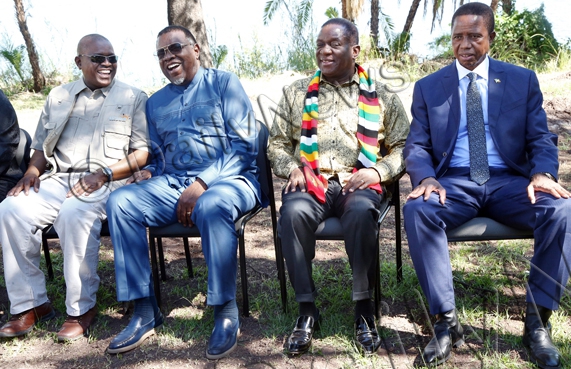
Meanwhile, the summit, which was also attended by the Presidents of Zambia, Zimbabwe and Namibia, Messrs Edgar Lungu, Emmerson Mnangagwa and Hage Geingob respectively was preceded by a technical meeting and ministers meeting on May 3 and 6. ENDS
Source : BOPA
Author : Keamogetse Letsholo
Location : KASANE
Event : Elephant Summit
Date : 07 May 2019
Related News

15 Aug 2026
15 Aug 2026