

Ostrich farming promising venture
27 Jan 2019
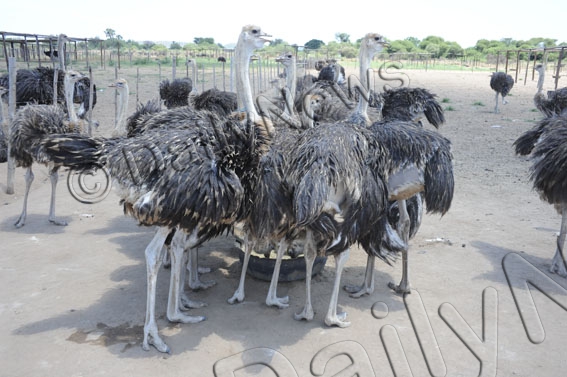
Ostrich farming is said to be one of the activities that can diversify the economy.
This was said by the livestock supervisor at BUAN, Mr Nicodemus Mosweu, who encouraged farmers to opt for ostrich farming as it did not need constant monitoring and feeding compared to other domestic animals.
He said ostriches were also cheaper as three of them could consume two bags of 50 kg feed in a month. In addition, he said ostrich farming did not need a large area of land as one hectare was enough.
“You can farm in your own field, but the specifications are that your fence has to be 1.5 metres above the ground,” he said.
He explained that everything in the ostrich was useful, citing that the ostrich skin made bags and shoes while feathers were used as decorations and feather dusters.
He also noted that eggs and meat were edible while egg shells could be used to make decorations and necklaces.
Mr Mosweu also noted that it took two years for ostriches to start laying eggs and breed from August to September. “Ostriches lay 15 eggs per year and their life expectancy is about seven to 10 years,” he said.
He advised interested farmers that the bird was susceptible to ticks and worms hence dipping and deworming should be done regularly.
Furthermore, ostrich farmers were advised to always check the birds and get in contact with them so that they get used to people.
“Failure to do so will result in the birds being injured by the fence, as they will not change their wild behaviour hence will try to flee,” he said.
Mr Mosweu said although ostrich abbaitors had collapsed, they were hopeful that more Batswana would venture into ostrich farming and reopen more especially that the university was starting a new diploma in ostrich production.
He, however, said it did not mean that the one-week short course they usually ran on ostrich farming through Inservice and Continuing Education would come to an end.
Mr Mosweu also said they have three ostriches at BUAN, and that the intention was to breed them as they would be useful in their practicals for ostrich farming.
An official at the Ministry of Agricultural Development and Food Security, Mr Tapologo Ditshupo said 12 ostriches could be kept in a one-hectare land.
He said they gave licences to individuals who wanted to do ostrich farming through the Department of Animal Production.
He said their duty was to assess the land to see whether it was not sandy nor muddy as ostriches could not be kept in such conditions.
He said if someone wanted to pursue agro-tourism, they could go to the Ministry of Wildlife and National Parks and be assisted in regard to game ranching. ENDS
Source : BOPA
Author : Sylviah Disele
Location : GABORONE
Event : interview
Date : 27 Jan 2019
Related News


30 Jul 2026
BMC eyes new export deals

29 Jul 2026
Modisaotsile on rise to the top
29 Jul 2026
Poultry industry attains self-sufficiency

28 Jul 2026
Ross Breeders pioneers Botswana poultry exports

28 Jul 2026