

Duo aims to transform vegetable sector
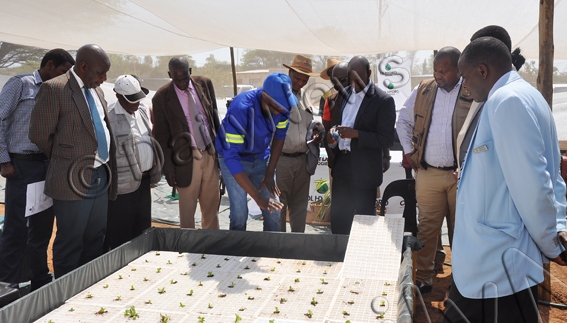
16 Oct 2018
It is pleasing to see some Batswana determined to make their country a better place to leave in, Batswana who assist government to create a conducive environment for the country to feed itself.
Two such Batswana who would like to see Botswana being self sufficient in vegetable production are the founding directors of OL Hydro Veggie, Messrs Olemogile Botsile and Lesego Obuseng.
They said their vision was to ensure that they turn Botswana into a vegetable hub.
In an interview, the two, who have launched their hydroponic company on October 12, said there was need for Botswana to not only sustain herself in vegetable production, but also produce for the international market.
The company was launched by Assistant Minister of Local Government and Rural Development, Mr Kgotla Autlwetse.
“Our government is already a step ahead in the effort to set the pace through backyard gardening, an initiative which was to boost the country’s food security as well as another way of income generating for households,” he said.
He explained that hydroponic was a method of growing plants without soil. He said they used coconut fibre instead of soil.
“It is the fastest growing agricultural method which has the potential to dominate food production,” he said.
Mr Obuseng said the method used 90 per cent less water when compared to the traditional planting method.
“We have had many beneficiaries of the backyard gardening initiative, which is an indication that people are interested in farming,” he said.
Mr Obuseng also said hydroponic was the solution to gardening as it had the potential to maximise production needed to transform agriculture.
“We intend, in our own way, to contribute to the transformation of the economy where everyone will have his/her own garden,” he said.
For his part, Mr Botsile said the hydroponic method of planting was ideal and an answer to the success of vegetable production.
He said their company trained those interested in hydroponics, noting that the traditional way of planting had low harvest unlike in the hydroponic method where the farmer was sure of high yields.
Mr Botsile said after years of setbacks they embarked on research to find out the easiest way of planting.
He said they observed that hydroponic was the key to success as it had the potential for high returns with less costs.
“Besides ourselves doing the actual farming, we also supply the hydroponic farming equipment. We basically engage our prospective clients in a realistic, goal-oriented, simple practical course on hydroponics,” he said.
During the launch, the company had five planting techniques on display, and he was optimistic that the techniques were of excellent value.
“Our equipment does not need extensive theoretical and practical teachings. All that is needed is for farmers to know how to mix nutrients, as hydroponic nutrients differ from others which are used to feed plants in the soil,” he said.
Mr Botsile also said they displayed the vertical growing system, adding that it was a unique growing system which was designed to maximise the use of space, and that it could accommodate up to six times as many plants in a square meter area than in a traditional garden. ENDS
Source : BOPA
Author : Thuso Kgakatsi
Location : SEROWE
Event : Interview
Date : 16 Oct 2018
Related News

30 Jul 2026
BMC eyes new export deals
29 Jul 2026
Modisaotsile on rise to the top
29 Jul 2026
Poultry industry attains self-sufficiency
28 Jul 2026
Ross Breeders pioneers Botswana poultry exports

28 Jul 2026